

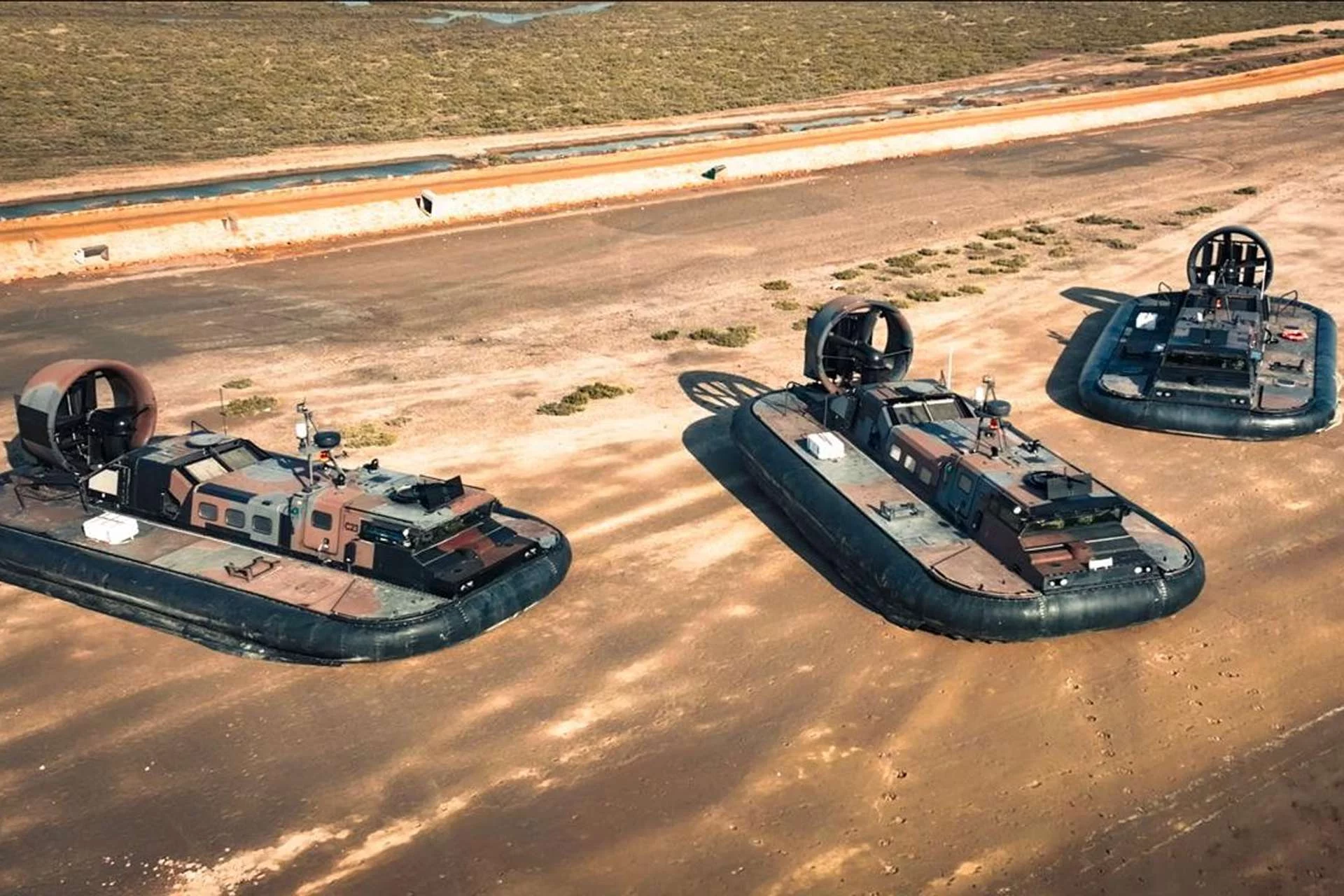
Pakistan has officially introduced three Griffon 2400 TD hovercraft into service with its Marine units, marking a major step in enhancing coastal mobility and rapid-response capabilities in the country’s difficult creek and delta environments. The induction was presided over by Chief of the Naval Staff Admiral Naveed Ashraf during an operational review in the southern Sindh Creeks Area, one of Pakistan’s most strategically sensitive coastal zones.
The new hovercraft—high-speed, air-cushioned platforms capable of moving seamlessly across water, mud, and sand—are expected to significantly improve the Marines’ ability to conduct patrol, interdiction, logistics, and casualty evacuation missions in shallow-water regions. The Griffon 2400 TD, designed and built by the UK-based firm Griffon Hoverwork, provides a unique operational advantage in areas where conventional hull-based boats cannot operate effectively due to shifting sediments, tidal flats, and narrow mangrove channels.
Each 2400 TD hovercraft measures approximately 12 to 13 meters in length and can achieve speeds exceeding 30 knots while carrying a section-sized troop element or up to 2.5 tons of cargo. The craft’s ability to transition effortlessly from sea to land without grounding enables swift amphibious deployment in littoral combat scenarios. Its low wake and reduced acoustic signature also make it ideal for stealthy movements in environmentally sensitive or contested coastal areas.
The three hovercraft inducted by Pakistan were previously operated by the UK Royal Marines before being retired in 2021. Following decommissioning, they were refurbished in 2022 under a program overseen by the UK’s Defence Equipment & Support (DE&S) organization and subsequently transferred to Pakistan in 2025. This approach allowed Pakistan to rapidly field a proven and reliable capability with minimal development risk and a well-established logistics and training framework.
Strategically, the introduction of the 2400 TD class represents a significant enhancement in Pakistan’s coastal defense and amphibious mobility. The hovercraft strengthen the Navy’s capacity to secure vital sea lanes, counter smuggling and infiltration, and conduct surveillance operations across the complex waterways of the Indus delta. Their mobility across both land and water gives the Marines tactical flexibility to insert forces or equipment in locations previously inaccessible, enhancing deterrence and situational control in the region.
While financial details of the acquisition have not been disclosed, British authorities confirmed the sale and refurbishment under the UK’s defense export framework. The induction aligns with Pakistan’s broader modernization agenda, which focuses on integrating adaptable, terrain-optimized systems into its naval and marine structure.
Admiral Naveed Ashraf emphasized that the new platforms would play a central role in “turning geography into an advantage” by improving operational access and reaction speed across the nation’s most challenging coastal sectors. The introduction of the Griffon 2400 TD marks not only a technological upgrade but also a doctrinal evolution—one that leverages mobility and adaptability as key enablers in Pakistan’s coastal security strategy.
