

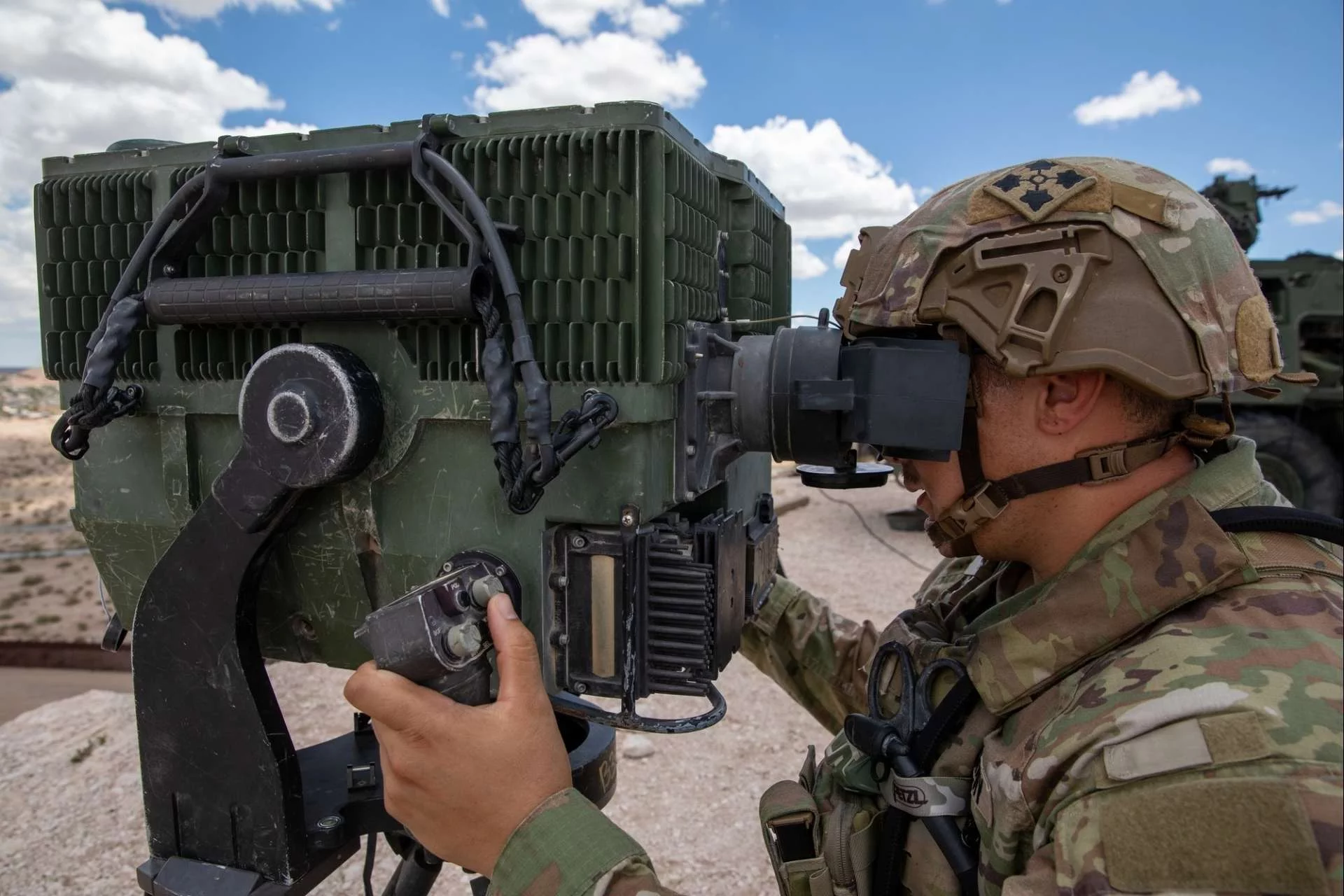
By mid-August 2025, the Pentagon deployed advanced surveillance and augmented-reality systems along the U.S.–Mexico border, the U.S. Army confirmed. The initiative highlights how border security operations are increasingly doubling as testbeds for next-generation defense technologies, with lessons learned feeding directly into broader military modernization efforts.
At the center of the deployment are three platforms: the Ground-Based Operational Surveillance System–Expeditionary (GBOSS-E), the Long Range Advanced Scout Surveillance System (LRAS3), and the Common Remotely Operated Weapon Station (CROWS). Together, they form a layered monitoring network across desert, mountain, and riverine terrain. GBOSS-E, mounted on telescoping masts or towers, integrates day/night optics, infrared sensors, radar, and laser rangefinding for wide-area surveillance. LRAS3, mounted on Stryker vehicles, extends long-range reconnaissance capability, relaying target data to Customs and Border Protection (CBP) for rapid interdiction. CROWS, normally used to remotely control heavy weapons, has been adapted for surveillance-only roles, providing stabilized optics and 360-degree awareness without exposing personnel.
Beyond these established systems, troops are field-testing the Integrated Visual Augmentation System (IVAS) 1.2 goggles, co-developed with Anduril and Meta. Incorporating augmented reality overlays, thermal vision, and real-time mapping, IVAS enables patrol teams to share data instantly with CBP counterparts. Earlier criticized for poor ergonomics, the 1.2 version reportedly addresses weight and interface issues.
Complementing the wearable tech are microdrones such as the 70-gram Black Hornet 4, designed for covert reconnaissance in complex terrain. Border troops are also equipped with the handheld Dronebuster jammer and vehicle-mounted TITAN system, forming a counter-UAS layer against hostile drones. Together, these assets transform patrols into networked surveillance nodes capable of multi-domain detection and response.
Strategically, the move reflects more than border defense—it signals the Pentagon’s intent to use domestic missions as proving grounds for future combat systems. The austere, varied conditions of the southern border mirror operational environments overseas, allowing systems to be refined under real-world stress. The integration of combat-tested platforms with emerging digital tools underscores Washington’s emphasis on adaptability and technological edge in an era of contested domains.
For the Pentagon, the U.S.–Mexico border is no longer just a security perimeter—it has become a live laboratory shaping the surveillance and reconnaissance tools of tomorrow.
