

The Philippines’ Exclusive Economic Zone (EEZ), extending 200 nautical miles from its baselines under UNCLOS, grants the country sovereign rights over natural resources, scientific research, environmental protection, and economic activities. Much of this EEZ overlaps contested areas in the South China Sea, frequently approached by Chinese coast guard and maritime militia vessels, making it a strategic flashpoint.
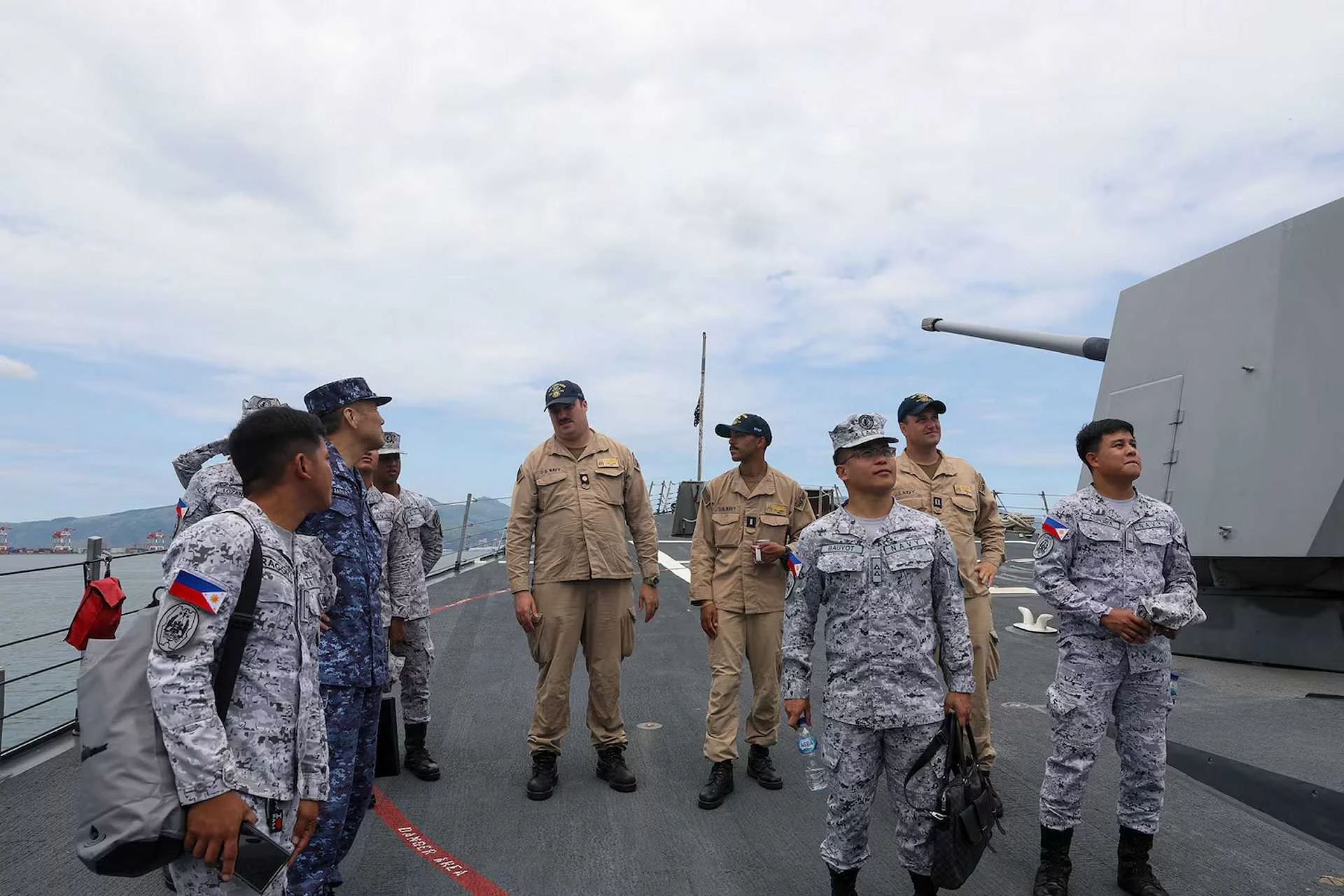
During the latest Multilateral Maritime Cooperative Activity (MCA), all three nations deployed significant surface and air assets. Japan fielded the Ōsumi-class tank landing ship JS Ōsumi (LST-4001), capable of amphibious and humanitarian missions. The Philippine Navy contributed its flagship BRP Jose Rizal (FF-150) with an AW-109 ASW helicopter, a C-208B maritime patrol aircraft, and four FA-50 light fighters. The U.S. Navy deployed the Arleigh Burke-class destroyer USS John Finn (DDG-113), accompanied by a P-8A Poseidon and two MH-60R Seahawk helicopters.
Exercises included coordinated division tactics, contact reporting, helicopter landings, surveillance, and communications drills. Notably, BRP Jose Rizal challenged a Chinese PLAN Type 054A frigate (551) operating roughly 35 nautical miles southwest of Capones Island, within the Philippine EEZ and 7 nautical miles from the Filipino vessel. China cited sovereign immunity but did not interfere.
This MCA builds on over a decade of trilateral cooperation, enhancing doctrine, tactics, and procedures under realistic conditions. It also visibly reinforces principles of freedom of navigation and lawful maritime operations.
Philippine officials emphasized that, while this was the 11th multilateral exercise, it was the first of this scale involving real-time interaction with a foreign warship. Rear Admiral Alfonso Torres noted the exercise reflects “deterrence postures aligned with our constitutional duty to protect our exclusive economic rights.”
Conducted shortly after the Philippines’ Maritime Zone Act (Republic Act 12064) formalized maritime claims, the exercise highlights growing allied coordination despite Chinese protests. The absence of interference suggests recalibrated tactical thresholds and mutual confidence among participating forces.
Led by the U.S. 7th Fleet, this MCA demonstrates allied unity, operational readiness, and strategic signaling in a highly contested Indo-Pacific maritime domain. The exercise underscores that preserving sovereign rights and maritime law remains a priority while preparing for potential future contingencies.
