

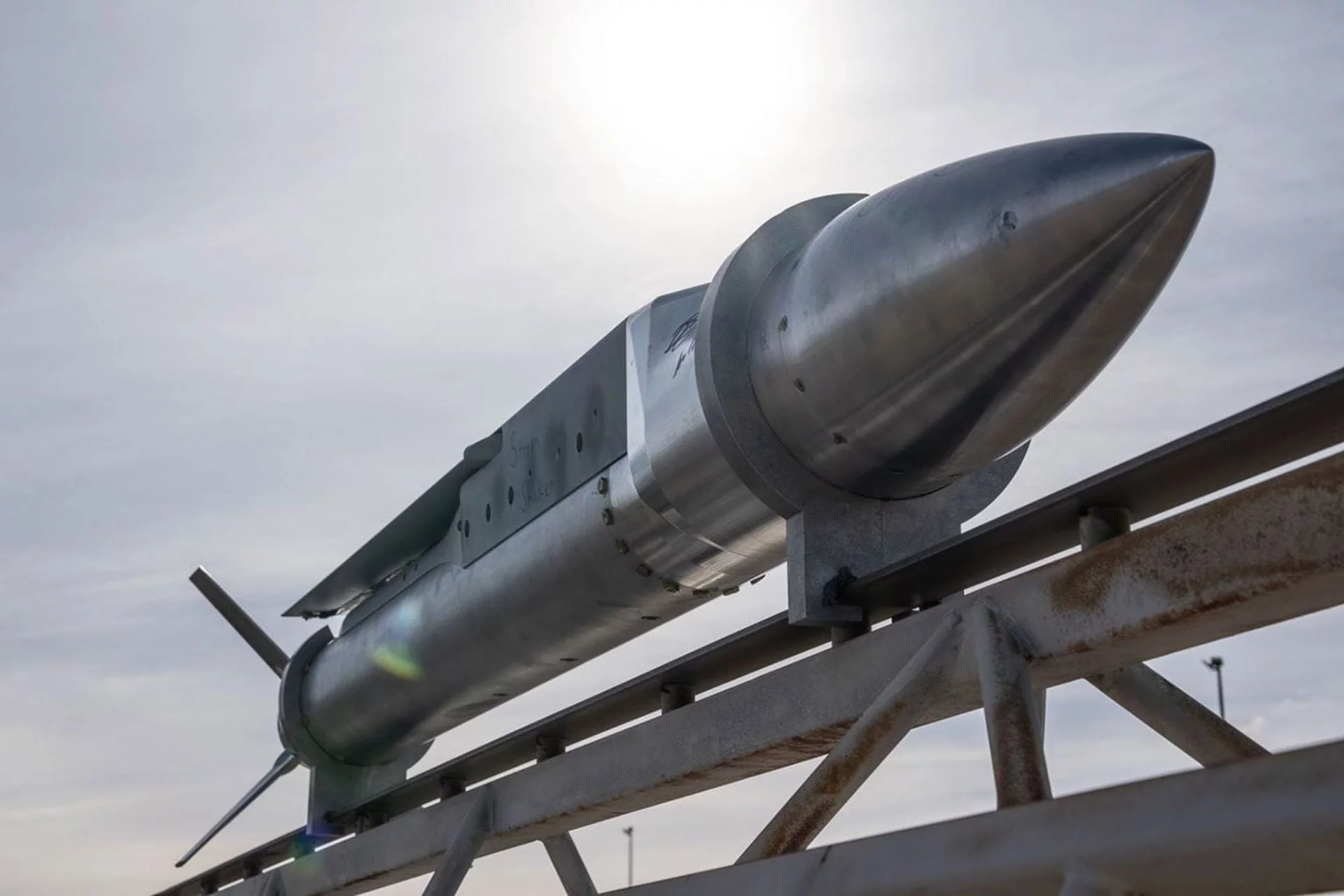
Raytheon announced it conducted a firing of a ground-launched GBU-53/B StormBreaker prototype at a private Mojave Desert range, following a roughly 50-day design-to-test effort. Company footage and statements identify March 22, 2025, as the test date, which reportedly took place in spring 2025.
Using a commercially available rocket motor, the prototype climbed to about 6,000 meters (roughly 20,000 feet) before transitioning to a glide profile similar to the air-released variant. The move to a ground-launched configuration is intended to give land forces a precision option against moving targets in poor weather and GPS-contested or electromagnetic-contested environments.
StormBreaker is already fielded as a multi-sensor, networked glide munition for aircraft. Adapting it for ground launch requires adding an initial booster to provide the speed and altitude an air release normally supplies; once the booster burns out and separates, wings deploy and the weapon glides and homes using its seeker and networked updates. Raytheon has not published a specific ground-launch range; air-release profiles are often cited near 45–46 miles, but actual ground-launched reach will depend on launch angle, winds, boost energy and seeker tactics.
The 250-lb class weapon combines GPS/INS guidance with a tri-mode seeker—imaging, infrared and millimeter-wave radar—plus a semi-active laser option. That sensor mix is designed to track moving targets through rain, smoke or fog while retaining a terminal laser mode when available. The warhead is a multi-effect design offering shaped-charge penetration, fragmentation and blast, with a programmable fuze.
Integration on aircraft includes the F-15E Strike Eagle and planned F-35 fits, with potential for dense salvos (internal and external carriage options). Networking allows fire-control handover between platforms and sensors consistent with JADC2-style concepts, enabling third-party cueing, retargeting in flight and coordinated engagements of moving columns or maritime targets at standoff ranges.
From a tactical perspective, a containerized launcher or vehicle-mounted pod could fire salvos that let onboard seekers and network nodes discriminate and allocate targets beyond visual range, complementing artillery and rocket fires. The millimeter-wave channel in particular helps when optical seekers struggle in adverse weather, and datalinks support handover from drones, forward observers or command posts.
Key unknowns remain for the ground variant: published performance parameters such as operational range, time-of-flight, seeker handover logic and defined target sets are not public. Raytheon says further testing in 2025 will clarify launcher form factors, integration and reload concepts. If the ground system retains high commonality with the air-launched StormBreaker, logistics and sustainment for operators already using the weapon could be simplified.
