

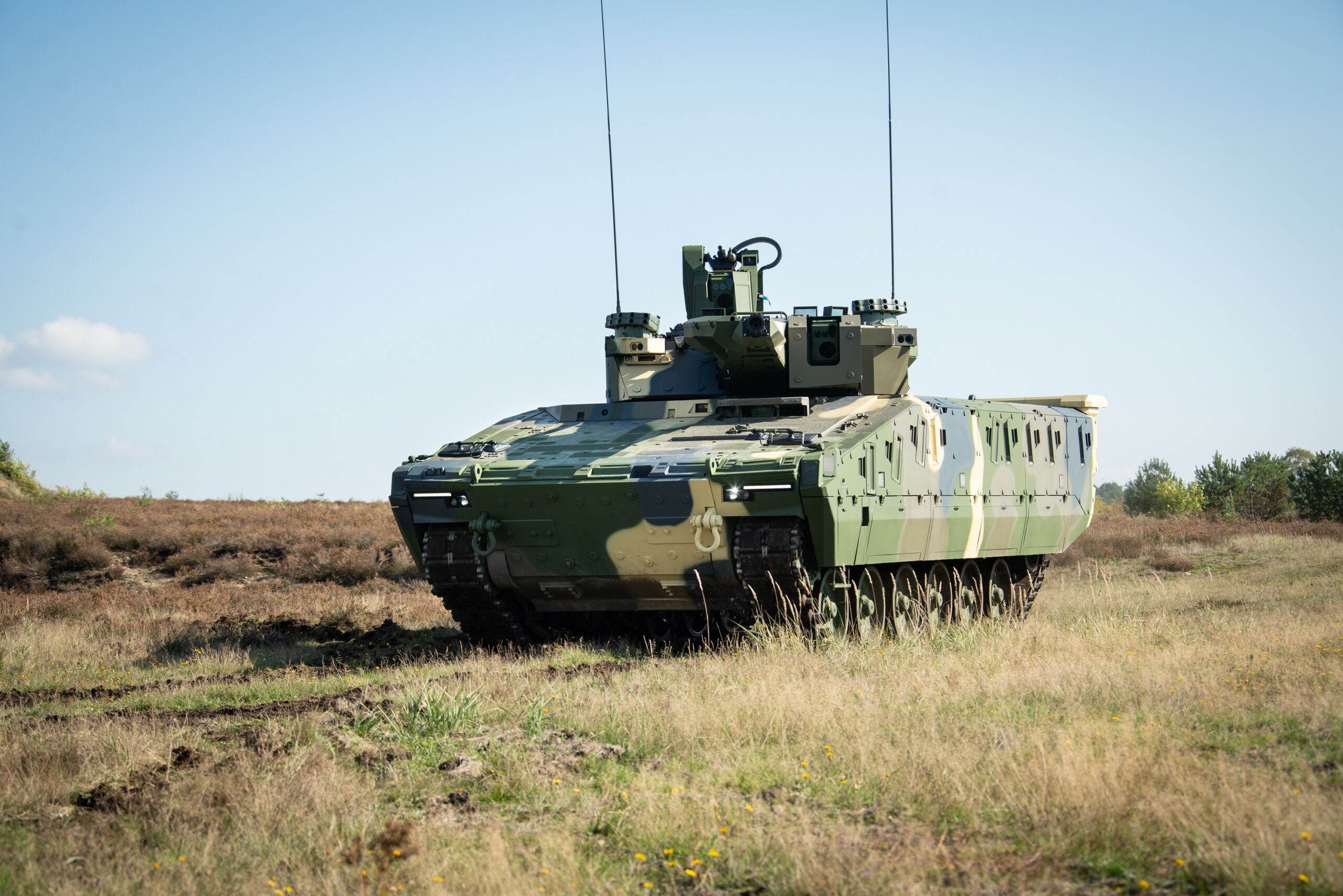
Romania has formally selected Rheinmetall’s Lynx KF41 as its next-generation infantry fighting vehicle, confirming a 298-unit acquisition plan that will rely heavily on domestic production. The procurement marks one of Bucharest’s most ambitious modernization efforts and strengthens NATO’s defensive posture along the alliance’s eastern frontier.
According to Euronews Romania, the decision became public on 13 November 2025 after Rheinmetall CEO Armin Papperger held high-level discussions in Bucharest with Prime Minister Ilie Bolojan, Economy Minister Radu Miruță and Defence Minister Ionuț Moșteanu. The deal includes 46 mission-specific variants based on the Lynx chassis, with assembly and integration activities to be carried out largely inside Romania. The programme builds on earlier parliamentary approval for local IFV construction as well as previous cooperation with Rheinmetall on ammunition production and a future propellant plant.
The announcement brings an end to Romania’s long search for a replacement for its ageing MLI-84 and MLI-84M Jderul vehicles—Soviet-derived platforms that have reached the limits of feasible upgrades. The tracked IFV programme, launched in mid-2025 with an initial target of around 246 vehicles and an approximate €2.55 billion budget, eventually expanded to the nearly 300-vehicle structure now agreed. The competition featured several high-profile contenders displayed at BSDA 2024, including the CV90 Mk IV, AS21 Redback, ASCOD 2, Borsuk and Turkey’s Tulpar.
Romania currently fields about 140 MLI-84 series IFVs—platforms with limited protection, confined interior volume and little potential for new sensors or active protection. As Bucharest raises defence spending toward 2.5 percent of GDP in 2025—and potentially 3 percent in the future—the armed forces view a modern IFV as essential to supporting NATO’s operational plans.
The Lynx KF41 represents a generational leap for Romania’s mechanized units. Weighing between 40 and 50 tonnes, the vehicle is powered by a 1,140 hp Liebherr diesel engine paired with a Renk HSWL 256 automatic transmission. It can match the mobility of modern main battle tanks, climbing steep gradients, handling challenging cross-slopes and crossing wide trenches. The KF41 configuration carries three crew members and eight dismounts in a spacious rear compartment accessed by a powered ramp.
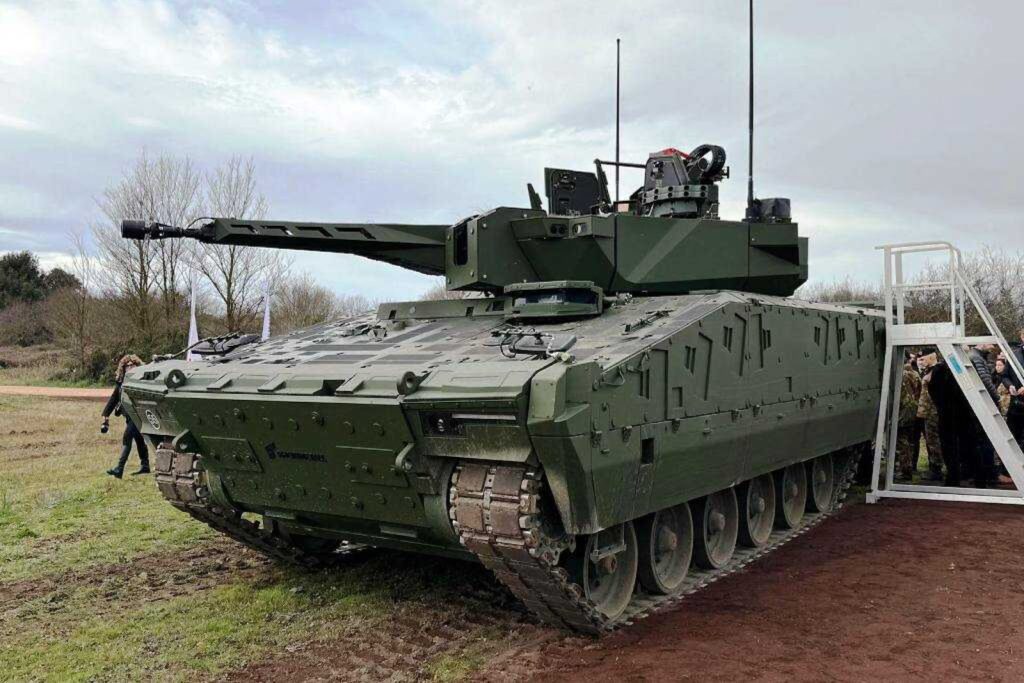
Its primary weapon system is the digital Lance 2.0 turret, armed with a 30 or 35 mm gun firing airburst and armor-piercing rounds. The turret also supports Spike LR2 anti-tank missiles with engagement ranges up to roughly 5.5 km and top-attack profiles optimized for defeating ERA-equipped armor. Independent sights for both commander and gunner support rapid hunter-killer engagements across multiple target types.
The Lynx’s design places strong emphasis on protection. A modular armor system allows customized protection packages, while a reinforced hull, decoupled seating and blast-mitigating design improve survivability against mines and IEDs. The vehicle is also compatible with Rheinmetall’s StrikeShield hybrid active protection system, laser warning sensors, rapid smoke deployment options and an NBC protection suite.
A key advantage of the Lynx is its modular architecture. The drive module can be paired with mission kits to create variants including command posts, reconnaissance vehicles, mortar carriers, recovery vehicles, ambulances or short-range air defense units. This flexibility promises simplified logistics, quicker adaptation for different missions and reduced long-term operating costs for the Romanian Army.
Rheinmetall has already established an industrial foothold in Romania. The company’s majority stake in Automecanica Mediaș—now Rheinmetall Automecanica—positions it as the main local assembly center for the programme. Additional initiatives include a training campus and broader cooperation with domestic partners. Furthermore, a joint venture for a propellant plant in Victoria, Brașov County—valued at more than €500 million—is expected to create roughly 700 jobs and link Romania more closely to Europe’s expanding ammunition-production network.
Other competitors in the IFV contest offered strong capabilities as well—the Swedish CV90 Mk IV with its proven combat record, Hanwha’s Redback with advanced protection systems, and modern platforms like the ASCOD 2 and Borsuk all offered compelling packages. Yet Rheinmetall’s pre-existing industrial presence in Romania and its willingness to localize production appear to have tipped the balance.
If the contract is signed within the Ministry of Defence’s projected timeline, the first Romanian-built Lynx vehicles could enter service before 2030. For Romanian soldiers accustomed to the constraints of the MLI-84 series, the transition will deliver significantly improved protection, more firepower, modern digital systems and full integration into NATO’s connected battlespace. For Europe’s defense industry, the project signals a continued shift toward local production as a decisive factor in major procurement deals.
