

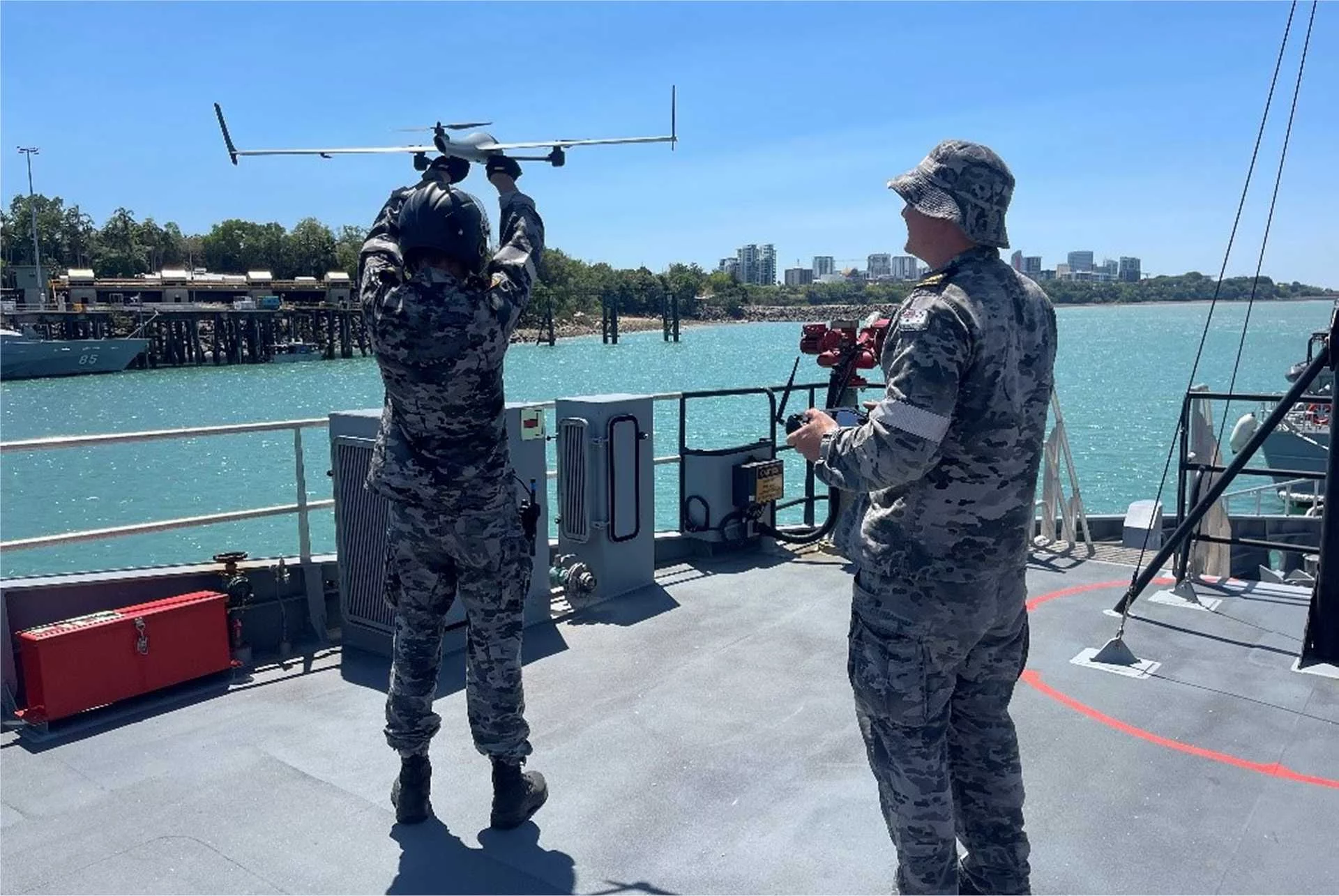
On December 1, 2025, the Australian Ministry of Defence announced that the Royal Australian Navy has successfully completed its first-of-class trials of the Edge 130 tri-copter drone aboard the patrol boat HMAS Cape Pillar. Conducted in September across Darwin Harbour and surrounding littoral areas, the tests confirmed that small uncrewed systems can significantly expand surveillance reach for Australia’s minor warships.
The test campaign focused on proving safe deck operations, validating launch-and-recovery procedures, and determining how effectively a lightweight UAV can extend a ship’s sensor coverage. Defence officials reported that the drone performed reliably under all tested conditions, giving crews clearer insight into how uncrewed systems may be integrated into routine coastal patrol missions.
Weighing just 1.2 kilograms, the Edge 130 is designed for rapid deployment with modular components, swappable batteries, and a range of compatible sensors. Its beyond-visual-line-of-sight (BVLOS) capability allows long-endurance missions over coastal waters, filling intelligence and reconnaissance gaps that manned aviation cannot easily address on patrol boats.
Trials aboard HMAS Cape Pillar included technical integration, remote pilot training, development of onboard procedures and joint test flights alongside HMAS Coonawarra. The operational phase tested the drone in diverse littoral environments—mangroves, shallow bays, and offshore surveillance lanes—demonstrating its value in reducing crew exposure and enhancing real-time situational awareness.
For small naval vessels, compact aerial drones like the Edge 130 represent a significant force multiplier. They enable persistent over-the-horizon reconnaissance without relying on larger aviation assets and support a wide range of missions—from detecting illegal fishing or smuggling, to search-and-rescue overwatch, to tactical surveillance during interdiction operations.
Throughout the evaluation, the Edge 130 delivered stable offshore flight performance and successfully captured high-resolution imagery during a multi-ship coordination test near Charles Point, involving HMAS Cape Pillar, Albany and Cape Woolamai. This demonstrated the system’s readiness for integration into broader fleet-level operations.
The success of the Edge 130 trials forms part of the Royal Australian Navy’s broader expansion of uncrewed systems across the fleet. With growing maritime challenges in Australia’s northern approaches, drone-equipped patrol vessels offer a cost-effective and scalable solution for monitoring vast maritime zones. The system is already supporting Joint Task Force 639, providing surveillance over mangrove-dense regions to detect illegal activities.
With its first operational milestone achieved, the Edge 130 is poised to become a key element in the future of Australian—and allied—maritime patrol operations, enabling greater reach, reduced risk, and improved maritime domain awareness.
