

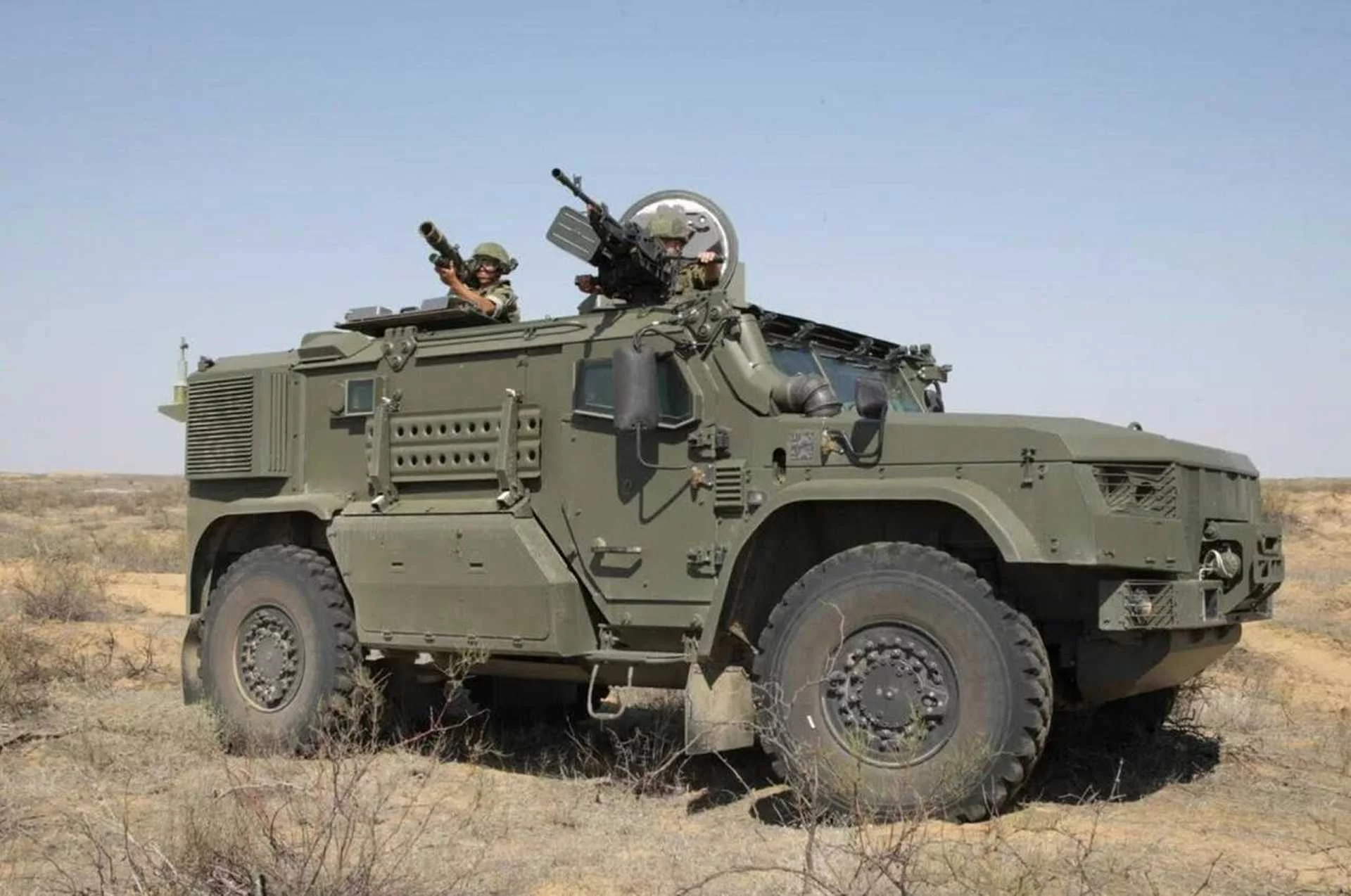
On July 15, 2025, TASS reported that the Russian air defense vehicle Typhoon-PVO has officially entered serial production after successful state qualification trials. Fanil Ziyatdinov, General Director of the Izhevsk Electromechanical Plant “Kupol,” part of the Almaz-Antey Air and Space Defense Concern, confirmed that serial production aims to boost both enterprise workload and battlefield protection and mobility for MANPADS teams.
Previously tested, exhibited internationally, and featured in military parades, the Typhoon-PVO meets the technical requirements set by the Russian Ground Forces. Kupol funded the research and development independently, and the vehicle is currently being integrated into the Russian military.
Specifically designed for MANPADS operators, the Typhoon-PVO is built on the KamAZ-4386 4×4 armored chassis from the Typhoon-VDV family developed by Remdiesel. This chassis was chosen to reduce costs and simplify logistics. It replaces older air defense platforms based on KamAZ and Ural trucks or infantry fighting vehicles that were not optimized for air defense roles. The vehicle accommodates a crew of five: commander, driver, machine gunner, and two MANPADS operators. Internally, it carries nine man-portable missiles, three radar interrogator sets, nine power units, and ammunition for the onboard machine gun.
The vehicle demonstrated its capabilities at events such as the 2019 Clear Sky competition in China, completing a 9.5 km obstacle course in 43 minutes 30 seconds, and at the Ashuluk range during Army-2020.
Equipped with the Verba missile system, which has been replacing Igla and Igla-S since 2014, the Typhoon-PVO features 9M336 missiles with three-spectral seekers operating in ultraviolet, short, and medium infrared bands. This enhances target lock-on and discrimination against low-signature targets like helicopters and cruise missiles. Compatible with the Barnaul-T command system, Verba includes friend-or-foe identification and external target guidance. Its sensors cross-check to differentiate between heat decoys and real targets. Its seeker sensitivity is eight times higher than predecessors, with a lock-on and kill zone 2.5 times larger than Igla-S. Russia plans to standardize Verba across MANPADS units, with Typhoon-PVO vehicles configured accordingly.
The vehicle features a rotating turret with a 12.7 mm Kord heavy machine gun, capable of engaging aerial targets while moving at speeds up to 20 km/h. The gun mount has sights optimized for air targets, addressing the rising threat of small drones that are too costly to counter with missiles. Two roof hatches allow the machine gunner and MANPADS operator to operate without exiting the armored compartment.
Armor protection meets STANAG 4569 Level 4 standards, withstanding 14.5 mm armor-piercing rounds, and mine protection equivalent to 8 kg TNT at Level 3b. The hull is equipped with 360-degree video cameras, NBC protection via an overpressurized sealed interior, and FVU-100 filtration. Emergency evacuation hatches are installed on the roof.
Powered by a 350 hp KamAZ-650 diesel engine, the vehicle can reach speeds up to 100 km/h and has an operational range exceeding 1,200 km. Independent hydropneumatic suspension allows fording depths up to 1.75 meters and gradients up to 30 degrees. Dimensions are approximately 6.9 m long, 2.5 m wide, and 2.7 m high, with a combat weight around 14 tons. Unlike the airborne-capable Typhoon-VDV variant, the Typhoon-PVO sacrifices airdrop ability for enhanced protection and mission-specific features. A spring-suspension KamAZ-4386 variant exists for lower-cost users without airdrop requirements.
Integrated into Russia’s layered air defense network, the Typhoon-PVO can work alongside Tor-M2 systems, receiving targeting data from higher-echelon radars and engaging targets with MANPADS using external guidance. It may also serve as a command vehicle coordinating Tor-M2 batteries. Inclusion in Victory Day parades since 2021 confirms its acceptance into service. Trials from 2021 validated its technical specs, with minor issues addressed promptly. The vehicle is slated for frontline use as well as infrastructure protection, including oil refineries, gas plants, railway stations, and bridges.
Positioned between standard air defense systems and the Pantsir platform, Typhoon-PVO offers localized protection in dispersed operational environments. Almaz-Antey Deputy General Director Vyacheslav Dzirkaln noted interest from African countries facing increasing drone threats, many of which still rely on outdated Soviet-era systems lacking modern networking and sensor integration. The vehicle’s modular design, affordability, and adaptability make it attractive for asymmetric and urban combat zones. Discussions are ongoing with potential clients in the Commonwealth of Independent States and Asia-Pacific regions.
