

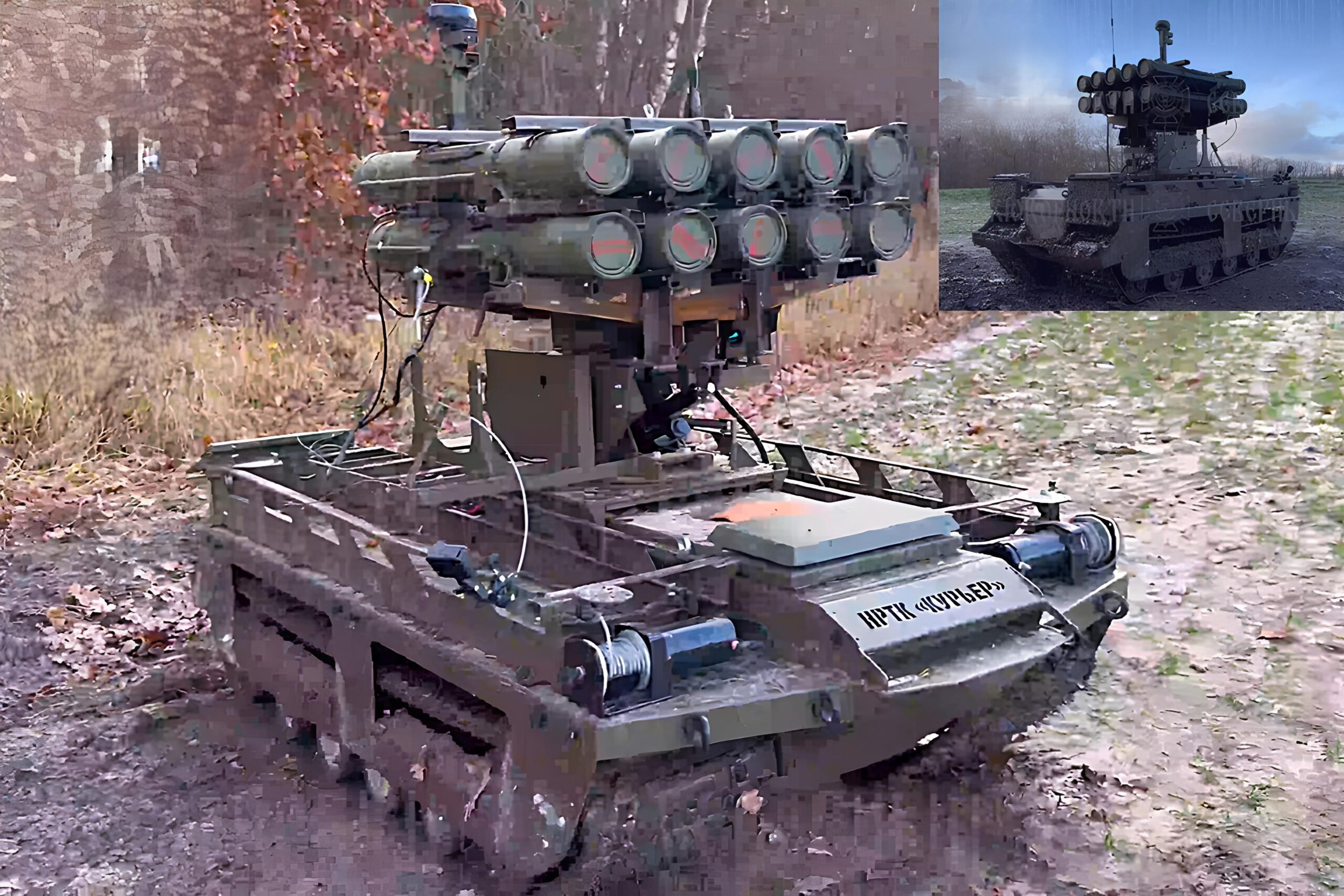
Russian media have released the first confirmed combat footage of a Courier unmanned ground vehicle (UGV) equipped with a Shmel thermobaric rocket module operating on the Sumy axis in Ukraine. The deployment highlights Moscow’s increasing use of small robotic systems in frontline combat roles.
Courier UGV and Weapon System
The modified Courier features an 8–10 tube Shmel rocket launcher mounted on a tracked chassis, operated remotely via sensor-guided control. Originally designed for logistics, casualty evacuation, and engineering support, the platform has now evolved into a compact remote fire-support system, capable of delivering short-range thermobaric strikes.
Tactical and Operational Advantages
- Low-profile tracked chassis for mobility in forests, mud, and damaged terrain
- Remote operation keeps personnel out of direct fire
- High-impact short missions ideal for trenches, bunkers, or specific targets
Limitations
- Limited armor makes it vulnerable to small arms, artillery fragments, and drones
- Dependent on radio control and susceptible to electronic warfare
- Limited ammunition: 8–10 rockets per salvo, requiring withdrawal to reload
Development and Strategy
Courier variants previously tested machine guns and automatic grenade launchers. The Shmel-equipped version demonstrates that UGVs are increasingly being used as active combat participants rather than just logistics or reconnaissance assets. Russian sources indicate future Courier modules may include anti-tank missiles, loitering munitions, or electronic warfare payloads.
With its first official combat use in Sumy, the Courier-Shmel UGV brings thermobaric strike capability to the battlefield without putting human operators at risk. This milestone underscores that robotic ground warfare is no longer a future concept but an ongoing reality, requiring updated doctrines and countermeasures.
