

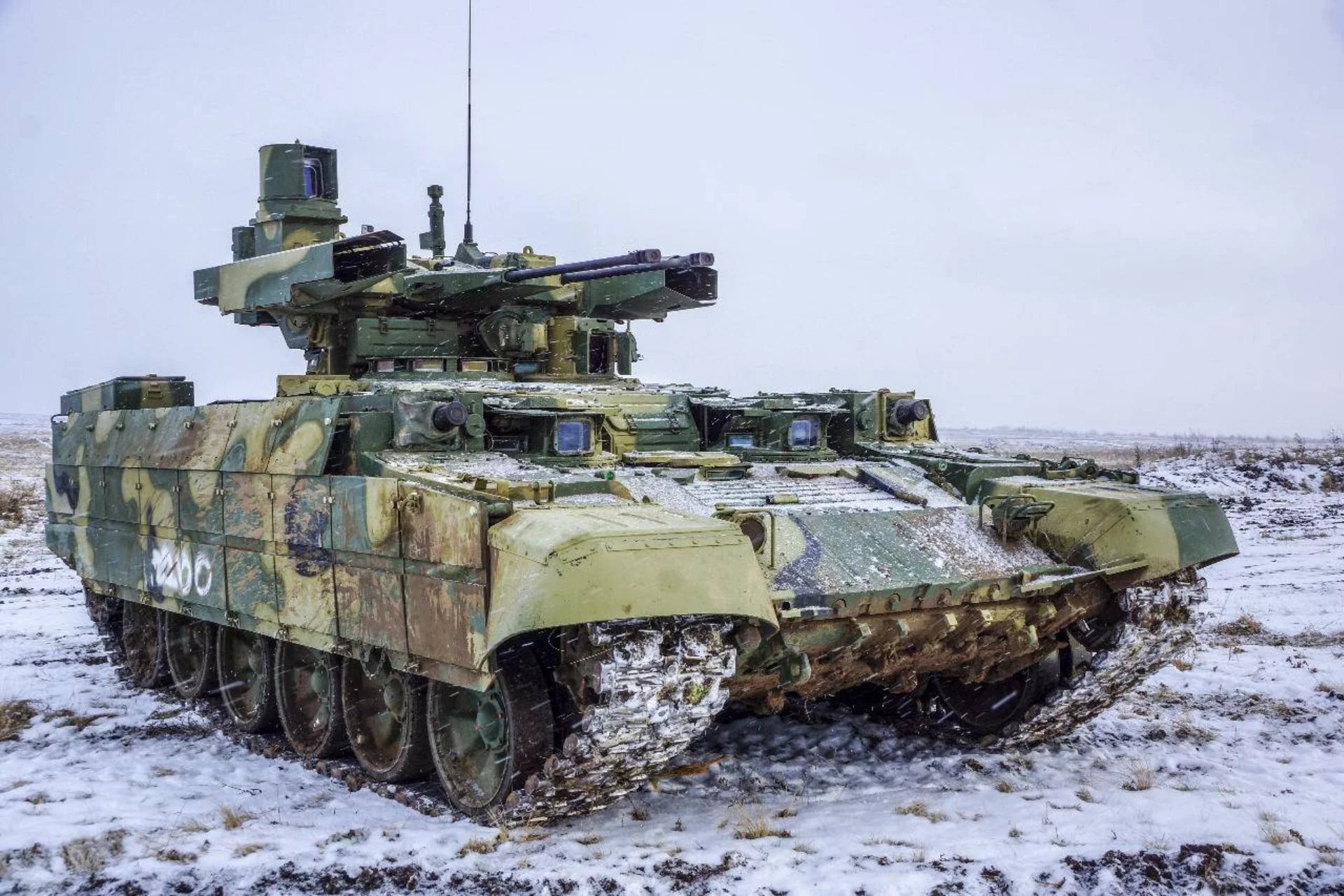
Alexander Potapov, CEO of Uralvagonzavod (part of Rostec), confirmed that the Russian Ministry of Defense will expand its order of BMPT Terminator combat vehicles. The announcement came during an interview on Voennaya Priemka aired on September 14, 2025. Potapov said the increase covers 2026 deliveries and future procurement plans but did not disclose the exact number of vehicles involved.
Role and Purpose of the Terminator
Built on the T-72 chassis, the BMPT is designed to enhance the survivability of main battle tanks during urban warfare. First unveiled in 2008, it can engage up to three targets simultaneously with its five-man crew, targeting anti-tank teams, concealed infantry, and light armored vehicles while tanks focus on enemy armor and fortifications.
Armament and Protection Suite
The BMPT mounts two 30 mm 2A42 cannons, a 7.62 mm coaxial machine gun, two 30 mm grenade launchers, and four Ataka anti-tank missiles with a 6 km range. Its remote-controlled turret provides full 360° coverage and day/night engagement capability. Protection is based on the T-72 hull reinforced with ERA modules and slat armor, while its 1,000 hp engine enables a top speed of 65 km/h.
Terminator 2 Modernization
The 2013 BMPT-72 “Terminator 2” introduced a modernized turret, improved fire control system, and reduced crew of three. The updated version removed the grenade launchers for better reliability and incorporated digitized systems. It remains unclear whether the 2026 order covers the original variant, the Terminator 2, or a combination of both.
Mixed Combat Record in Ukraine
Despite its promising design, the BMPT has seen limited use in Ukraine and has not demonstrated a decisive battlefield impact, raising doubts about its operational integration and overall effectiveness.
Possible Reasons for Increased Orders
Analysts suggest the expanded order may allow Russia to trial the vehicle in more diverse scenarios and adapt tactics for modern threats, including drones and loitering munitions. It could also represent an effort to build production capacity for potential export customers.
Industrial Pressure and Sanctions
Russia’s defense industry continues to face difficulties sourcing electronics, optics, and specialty materials due to Western sanctions. Production has been reorganized around domestic suppliers, increasing costs and extending delivery timelines.
Export Market Challenges
A large share of production is now reserved for the war effort in Ukraine, leaving limited capacity for foreign customers. Secondary sanctions, financing issues, and diplomatic pressure have further constrained Russian defense exports, resulting in fewer large contracts and reflecting Moscow’s growing dependency on its domestic market.
