

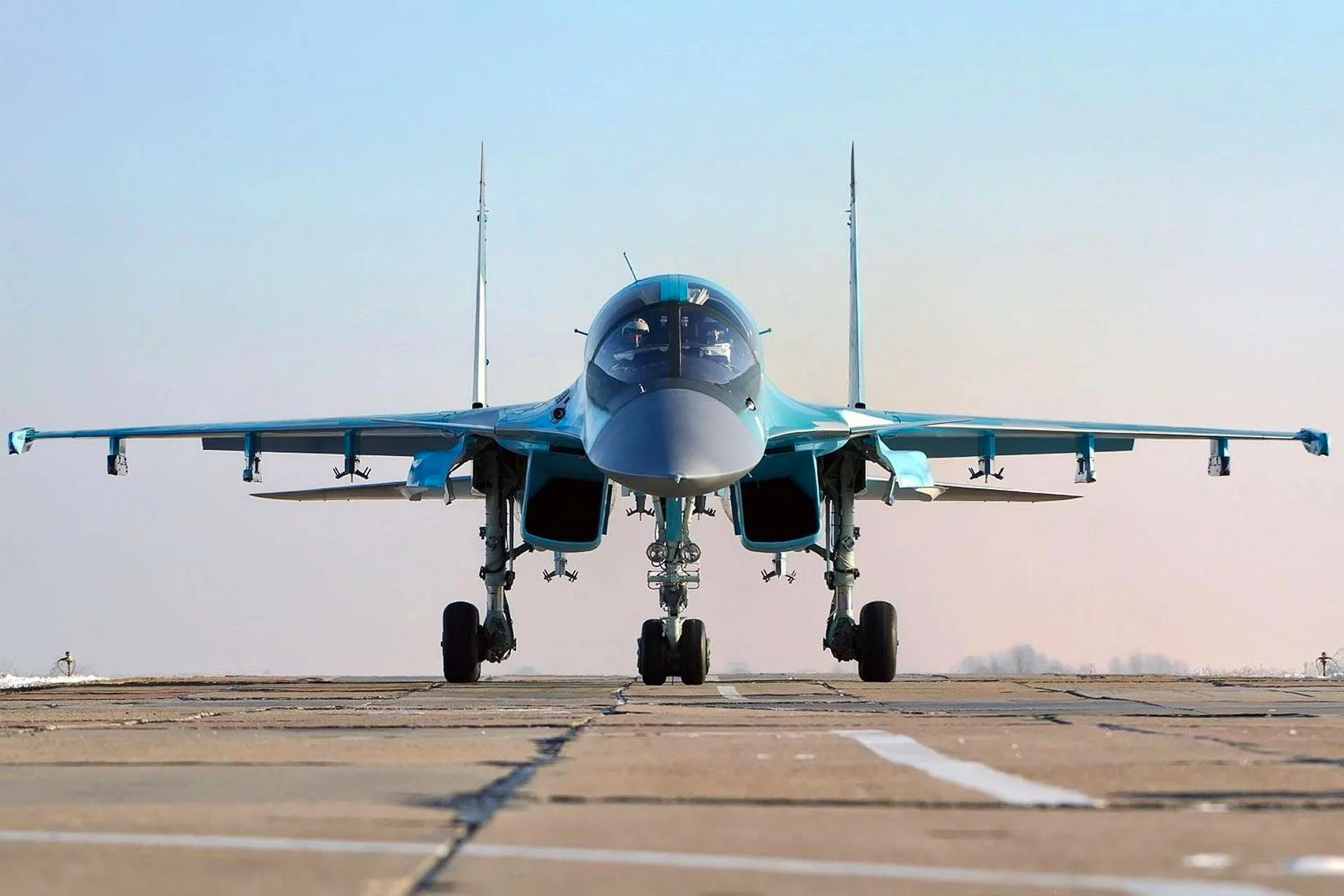
Russia’s Aerospace Forces have received another batch of Su-34 fighter-bombers, bolstering the nation’s operational-tactical aviation capabilities. The aircraft, produced by the United Aircraft Corporation—a subsidiary of the state defense conglomerate Rostec—were delivered under the Russian Ministry of Defence’s ongoing state armament program. According to Rostec, each Su-34 completed comprehensive factory testing before being officially accepted by Russian crews and deployed to their designated airbase. This delivery highlights Moscow’s sustained investment in enhancing long-range precision strike capacity amid ongoing military operations and regional security tensions.
The Su-34 “Fullback,” designed by the Sukhoi Design Bureau, is a twin-engine, twin-seat multirole strike aircraft derived from the Su-27 platform. Its distinctive side-by-side cockpit layout improves crew comfort on long missions, while a reinforced airframe boosts survivability in contested airspace. Capable of carrying up to 8,000 kg of weapons across 12 hardpoints, the aircraft can conduct precision strikes on land, sea, and aerial targets. Equipped with a Sh141 phased-array radar, fly-by-wire controls, and the Khibiny electronic warfare suite, the Su-34 can operate in adverse weather, day or night, even under heavy enemy electronic interference. Its combat radius exceeds 1,000 km without refueling.
Since its operational debut in 2014, the Su-34 has been deployed in Syria for deep strike missions and in Ukraine for long-range attacks, reconnaissance, and close air support. Compared to older Soviet-era platforms like the Su-24, it offers significant advances in avionics, survivability, and mission versatility, positioning it alongside Western counterparts such as the U.S. F-15E Strike Eagle.
The continuous integration of Su-34s into the Russian Air Force underscores Moscow’s commitment to sustaining and modernizing its conventional strike fleet, even as it develops next-generation aircraft like the Su-57. Versatile in roles ranging from suppression of enemy air defenses to intelligence gathering, the Su-34 remains a cost-effective and battle-tested workhorse. Annual deliveries—estimated at 12–14 units—maintain steady production, support the defense industry, and replace aircraft lost in operations.
Amid ongoing conflicts and shifting global power balances, the Su-34 stands as a key component of Russia’s airpower doctrine—bridging the gap between legacy systems and future combat platforms while ensuring the Kremlin retains the capacity to project power across multiple strategic theaters.
