

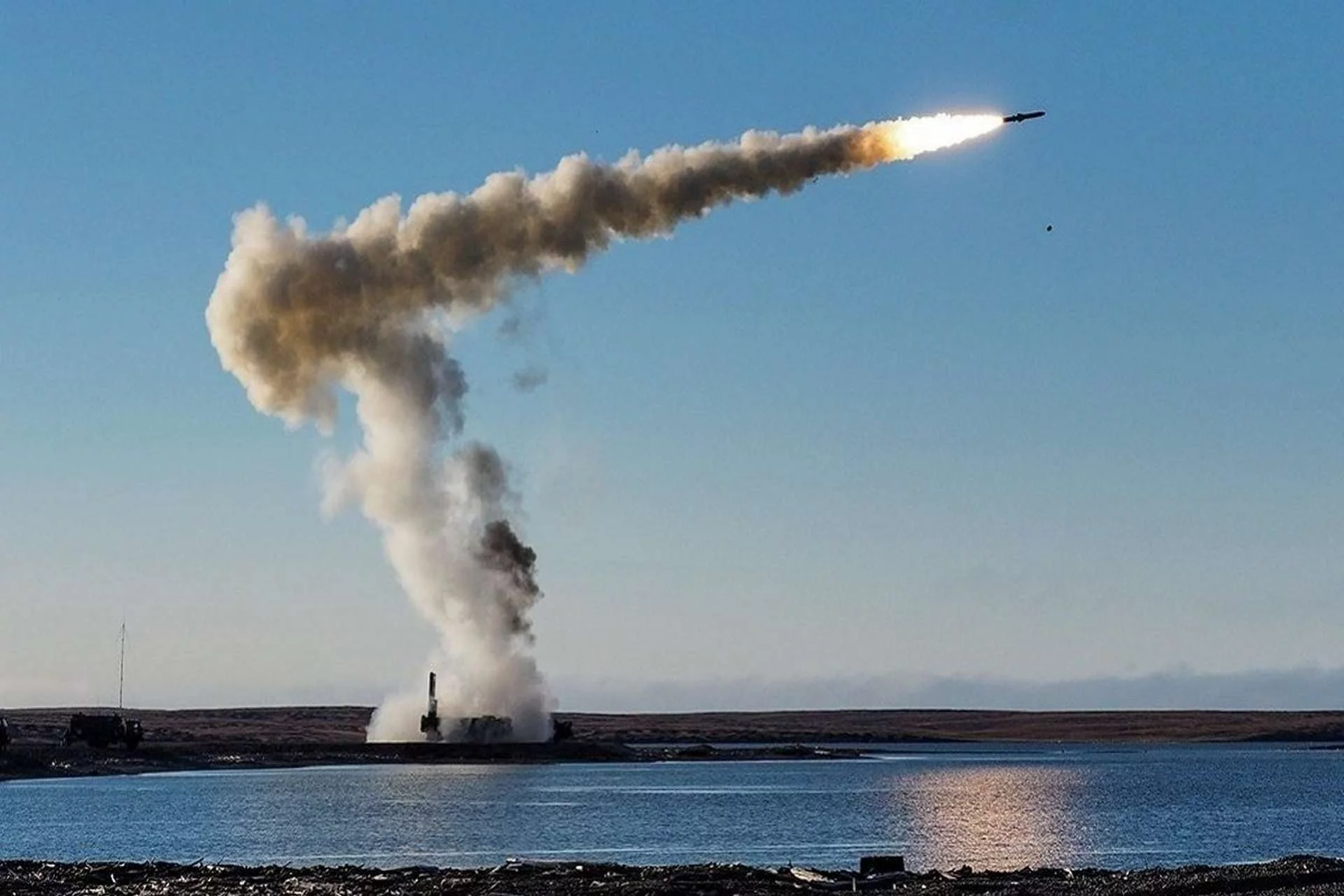
On September 13, 2025, the Russian Northern Fleet’s Bastion coastal defense systems launched P-800 Onyx supersonic anti-ship missiles from Franz Josef Land, striking naval targets over 200 km away. The live-fire drill was part of the Zapad-2025 joint exercises with Belarus, highlighting Moscow’s continued focus on strengthening Arctic defenses.
The Bastion (K-300P) is a mobile coastal defense platform mounted on an 8×8 MZKT-7930 chassis, enabling operations across rugged Arctic terrain. Each launcher carries two P-800 Oniks cruise missiles, which use a solid-fuel booster and a ramjet engine to reach speeds of up to Mach 2.5. With ranges between 300 and 600 km, the missiles combine inertial navigation, satellite guidance, and active radar homing to strike large surface vessels even under electronic jamming. Armed with 200–250 kg warheads, they pose a serious threat to major naval combatants.
Bastion units integrate with over-the-horizon radars and coastal surveillance networks, forming a layered reconnaissance-strike complex that can secure extended maritime approaches. Russia has previously deployed these systems in Crimea, Kaliningrad, and the Kuril Islands, as well as using Oniks missiles in Syria for land-attack roles — underscoring their versatility.
Military analysts note that the Arctic launch demonstrates Russia’s ability to enforce anti-access/area-denial (A2/AD) zones in one of the world’s most strategically contested regions. With melting ice opening new shipping lanes, Moscow is signaling that it is ready to defend its northern sea routes and limit NATO freedom of action in the High North.
