

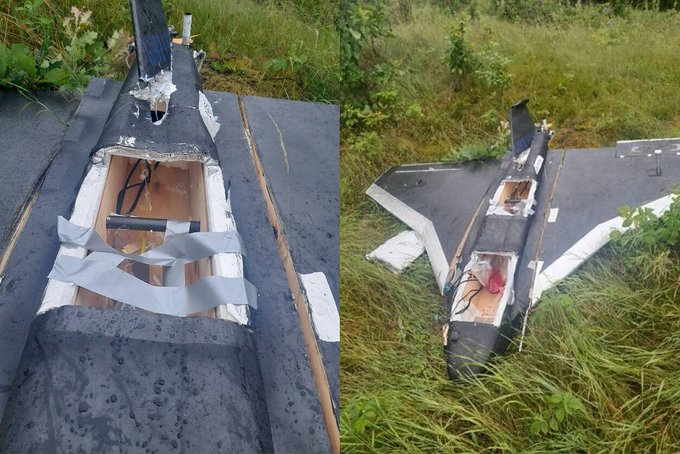
A Russian-made unmanned aerial vehicle (UAV), carrying explosives, flew over Lithuania’s capital Vilnius and crashed into the Gaižiūnai military training area in the eastern part of the country. Lithuanian officials have raised concerns that the incident may have been a deliberate act targeting NATO airspace and have called for urgent defensive measures.
The incident occurred on the morning of July 28, when a “Gerbera”-type drone, believed to have originated from Belarus, entered Lithuanian airspace and flew approximately 100 kilometers before crashing in the Jonava region. The drone, resembling Iranian-made Shahed loitering munitions, was found to be carrying around two kilograms of explosive material, which was later rendered safe by military experts.
Detection Took Days
At around 5:00 AM, a noise likened to a “lawn mower” was heard over Vilnius, causing panic among residents. However, the drone’s crash site was not discovered until August 1. The Lithuanian military later confirmed that the UAV had entered the country from Belarus.
In a statement, Chief Prosecutor Nida Grunskienė said the drone was made of plywood and plastic, making it difficult to detect via radar, especially during low-altitude flights. She added that the UAV is believed to have been produced in the Alabuga Special Economic Zone in Russia’s Tatarstan region.
Provocation or Navigation Error?
Authorities have not yet concluded whether the UAV intentionally targeted Lithuania. One hypothesis suggests the drone may have originally been headed for a target in Ukraine but veered off course due to electronic warfare or GPS jamming. However, military sources point out that, given the drone’s range, its presence over 800 kilometers from the front lines more likely indicates a test flight or a deliberate provocation.
Colonel Dainius Paškevičius, Chief of Staff of the Lithuanian Air Force, noted that while the country has modern radar systems, certain low-altitude threats can evade detection due to electronic interference. “Two kilograms of explosives can mean a lot depending on the type and configuration,” he said. “There’s no magic solution — we need a multi-layered, multi-sensor approach to defense.”
Call for NATO Reinforcements
The incident has also sparked a policy response from Lithuanian officials. Foreign Minister Kęstutis Budrys stated, “This is not just a violation of Lithuanian airspace; it’s a breach of NATO airspace — a threat to EU security.” Budrys and Defense Minister Dovilė Šakalienė have formally requested the deployment of additional air defense systems in a letter to NATO Secretary-General Mark Rutte.
Among the proposed reinforcements are high-speed intercept drones that have been tested in Ukraine. German General Christian Freuding’s warning that Russia may one day use 1,000 to 2,000 drones in a coordinated attack further reinforced Lithuania’s concerns.
Officials emphasize that this recent event should not be seen merely as a security lapse, but as a serious warning about vulnerabilities in NATO’s eastern flank.
