

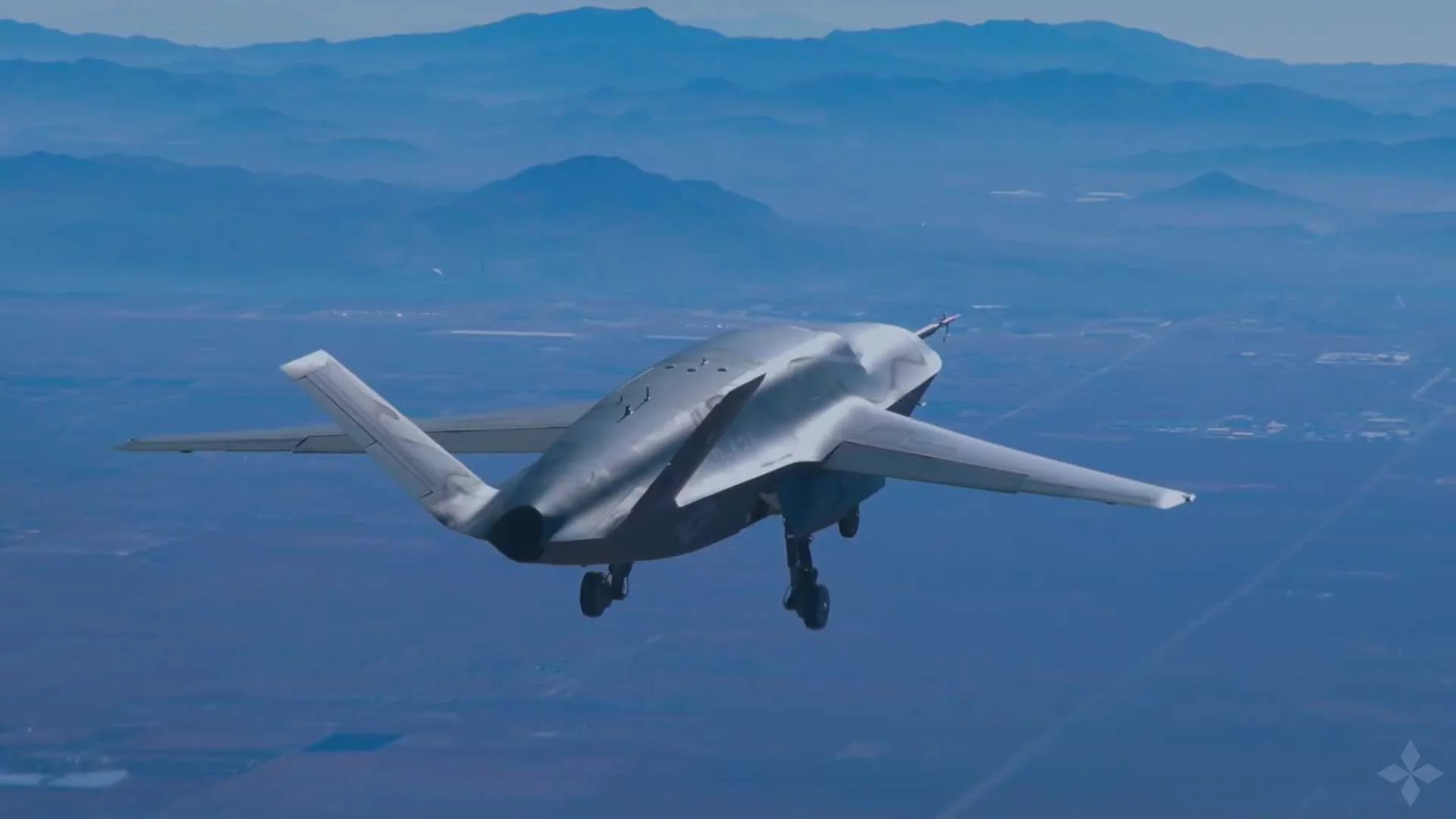
Saudi Arabia is in advanced discussions with General Atomics Aeronautical Systems to acquire up to 200 Gambit-based Collaborative Combat Aircraft (CCAs) and an additional 130 MQ-9B drones, marking one of the largest unmanned aircraft procurement opportunities in the company’s history. The update was revealed at the Dubai Airshow 2025, where the defense giant confirmed that production options inside the Kingdom are being evaluated due to the scale of the potential order.
According to a November 18, 2025 report from Breaking Defense, General Atomics President David Alexander stated that localizing CCA production in Saudi Arabia is “feasible,” given the volume under negotiation. The company displayed a full-size YFQ-42A model at the airshow, demonstrating how its CCA concept would operate alongside advanced fighters—particularly relevant following U.S. intentions to approve the F-35 sale to Riyadh.
YFQ-42A: U.S. Air Force’s Selected CCA for Increment 1
The YFQ-42A is one of only two platforms chosen by the U.S. Air Force for the first increment of its Collaborative Combat Aircraft program. Derived from the XQ-67A Off-Board Sensing Station demonstrator, it features:
- An elongated fuselage
- Slender wings
- A dorsal air intake
- V-tail architecture
- And an internal weapons bay sized for two AIM-120 AMRAAM missiles
Its first flight took place in August 2025, and the aircraft is now undergoing extensive testing across industry and government evaluation campaigns. The U.S. Air Force plans to purchase more than 100 CCAs initially, with future increments expected to expand that number significantly.
Gambit Family: Modular Architecture for Diverse Missions
The Gambit unmanned aircraft family is built around a common core chassis, enabling rapid development of specialized variants while maintaining roughly 70% common components.
- Gambit 1: ISR missions
- Gambit 2: High-maneuverability air combat
- Gambit 3: Adversary air training
- Gambit 4: Low-observable reconnaissance
- Gambit 5 & 6: Carrier operations, strike, and electronic attack
The modular approach reduces cost while allowing operators to tailor fleets to evolving mission requirements.
Saudi Arabia Eyes Domestic Production
Saudi officials are exploring the possibility of producing certain Gambit components domestically, aligning with Riyadh’s broader defense-industrial localization strategy. General Atomics notes that UCAVs can be manufactured at much faster rates and lower cost than crewed fighters, enabling deployment in larger formations that enhance survivability and mission flexibility.
Interest in CCAs is also growing elsewhere in the region, with the UAE’s Edge Jeniah program signaling a similar push toward advanced unmanned combat aviation.
A Major Step Toward Future Manned-Unmanned Teaming
Recent U.S. demonstrations—such as an F-22 pilot controlling a GA-ASI drone via cockpit tablet—underscore the rapid advancement of manned-unmanned teaming. General Atomics says the Gambit family will support missions ranging from air-to-air engagement and strike operations to electronic warfare and off-board sensing, providing additional layers of protection for crewed jets in contested environments.
With negotiations ongoing and interest rising across the region, the Gambit program is poised to become a key pillar of the Middle East’s future air combat architecture.
