

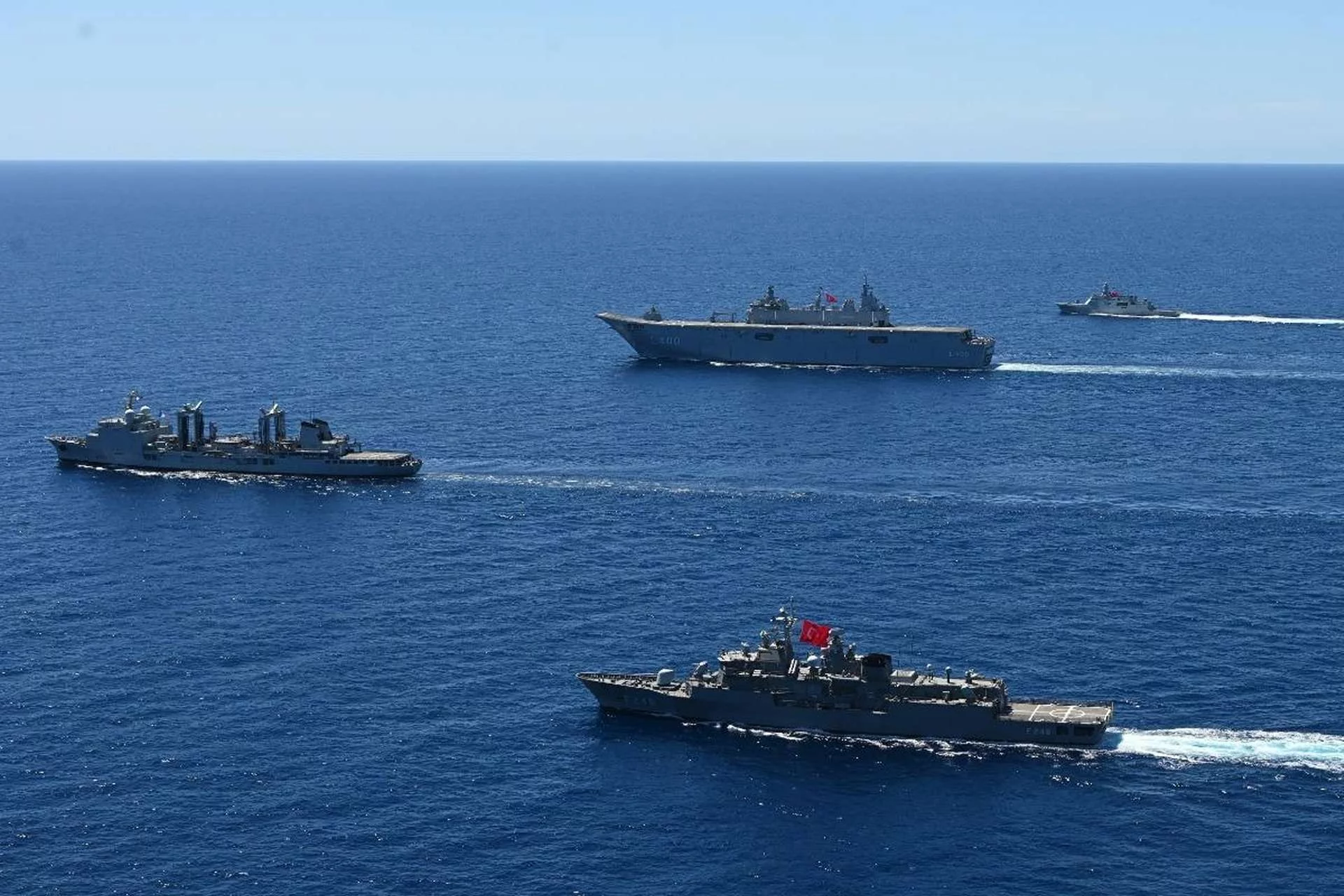
NATO has launched Neptune Strike 25-3, a large-scale maritime exercise running from 22–26 September 2025 across the Mediterranean, Adriatic, North, and Baltic Seas. Bringing together over 10,000 personnel from 13 allied nations, the drill tests interoperability, protects key maritime chokepoints, and ensures freedom of navigation. At a time of renewed great-power competition, the event stands as one of NATO’s most significant demonstrations of maritime strike integration this year.
Directed from Naval Striking and Support Forces NATO (STRIKFORNATO) headquarters in Oeiras, Portugal, under U.S. Vice Adm. Jeffrey T. Anderson, the exercise places a carrier strike group and a variety of surface and amphibious units under NATO operational control. Key participants include the U.S. aircraft carrier USS Gerald R. Ford, Türkiye’s flagship amphibious assault ship TCG Anadolu, Italy’s ITS San Giorgio, and the U.S. command ship USS Mount Whitney, surrounded by a rotating screen of destroyers, frigates, submarines, and aircraft from across the alliance.
Particular attention this iteration falls on Türkiye’s Anadolu Task Group, composed of TCG Anadolu, the frigate TCG Gökova, the corvette TCG Heybeliada, and the submarine TCG I. İnönü. This compact formation allows planners to refine escort operations, aviation handling, and undersea protection. Turkish officers describe it as a version of their Open Sea Task Group concept, previously tested in bilateral operations with Spain, now exercised under a NATO umbrella.
Neptune Strike traces its roots to 2020’s Project Neptune, designed to rapidly knit together allied strike assets and maintain that integration through repeated deployments. The technical payoff lies in seamless communications, quick command handoffs, and realistic scenarios—from carrier air wing sorties to replenishment at sea and submarine tracking operations—that make joint operations feel routine.
By operating simultaneously in northern and southern waters, the exercise tests NATO’s ability to cover key maritime chokepoints from the Danish Straits to the Mediterranean approaches. The message is clear: the alliance can mass a carrier strike group, an amphibious task group, and a protective escort screen in more than one theater if required. When ships eventually return to port, what remains is a shared “muscle memory”—the call signs, procedures, and coordination patterns that enable NATO to move quickly when a real crisis emerges.
