

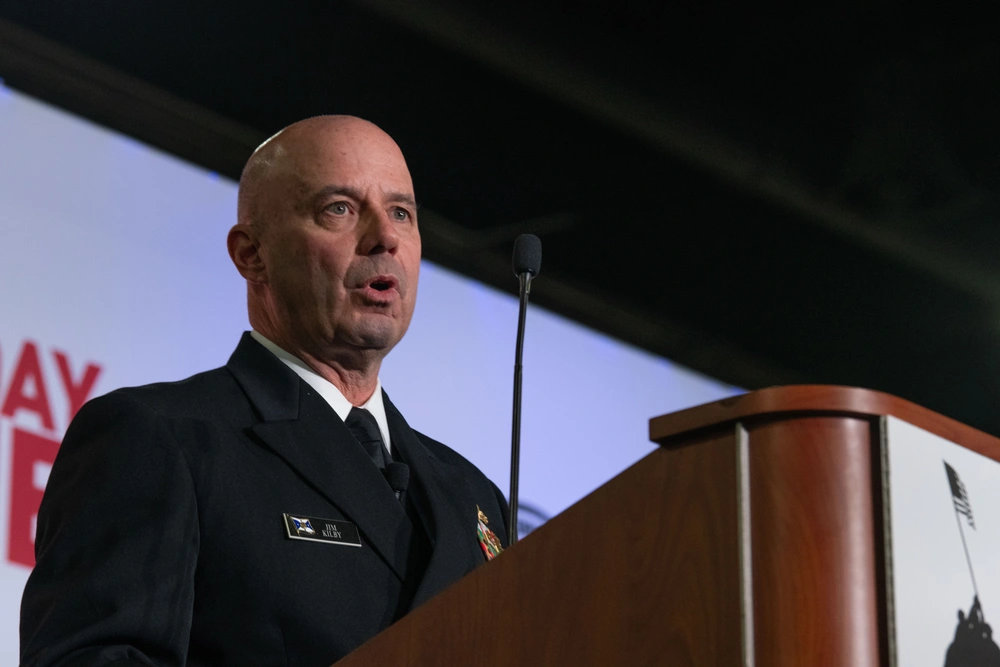
During a tense Senate Appropriations Subcommittee on Defense hearing Tuesday, senior military leaders admitted that the U.S. Navy remains significantly behind in delivering new ships and still lacks clear plans for catching up. The hearing featured testimony from Navy Secretary John Phelan, Marine Corps Commandant Gen. Eric Smith, and Adm. James Kilby, acting Chief of Naval Operations.
Adm. Kilby emphasized that the Navy is “laser-focused” on countering China, which he identified as America’s “most consequential opponent.” He stated that the Navy has set a strategic goal to make 80% of its fleet—including ships, submarines, and aircraft—ready for rapid deployment by January 1, 2027.
But it was the Navy’s proposed budget that drew the sharpest criticism. Lawmakers were not concerned about excess—they were shocked by how little funding was requested. Several senators, echoing recent concerns from Sen. Roger Wicker (R-Miss.), expressed disappointment and alarm over the barebones budget submission.
Phelan defended the request by underscoring the need for both mandatory and discretionary funds. “We need both to meet our operational goals,” he said. “One budget, two bills.”
The discussion became heated at times, as senators from both parties questioned the Navy’s increasing reliance on supplemental reconciliation funding instead of boosting the base budget. Sen. Susan Collins (R-Maine) criticized the budget for continuing what she described as the “previous administration’s inadequate trajectory” on shipbuilding. She insisted that a larger base budget was necessary, stating, “Reconciliation was intended as a one-time surge, not a recurring crutch.”
Lawmakers were also united in their frustration over the lack of delivery timelines. Responding to Sen. Jack Reed (D-R.I.) about the Columbia-class nuclear submarine delays, Kilby acknowledged that the project is now expected to be completed two years late, around March 2029. “We’re doing everything we can to recover lost time,” he said.
Perhaps the strongest rebuke came from Sen. John Kennedy (R-La.), who pointed out the paradox of increasing funding while shrinking the fleet. “In the last 20 years, we’ve doubled your shipbuilding budget and ended up with fewer ships,” he told Kilby. “Explain that to me in 30 seconds.”
Kilby cited reduced production rates, noting that while the Navy built four guided-missile destroyers annually in the 1990s, it’s now only building two. He added that each class of ship is behind schedule—some by multiple years—due to rising costs and production bottlenecks.
Sen. Lindsey Graham (R-S.C.) turned the conversation toward China’s growing naval power, warning that China’s fleet is expected to grow from 400 to 435 ships by 2030. “We don’t know the exact number we need or the timeline, but we do know we’re falling behind,” he said, urging the Navy to seek additional funding beyond the top-line budget to address strategic gaps.
In closing, Graham stressed the urgency of immediate planning and detailed proposals to justify any future funding: “If reconciliation is the path, then plan for it—don’t default to it.”
