

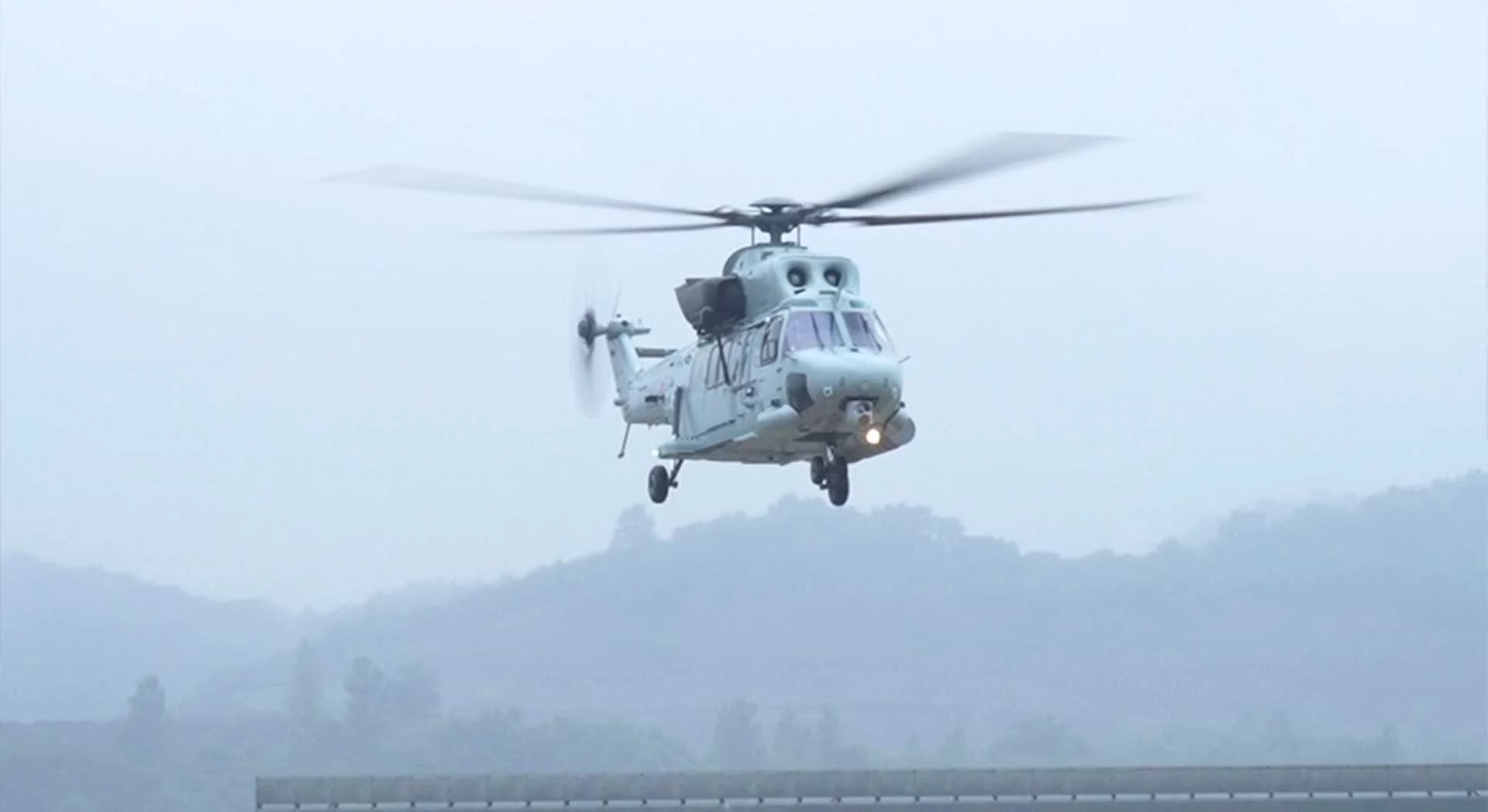
South Korea has successfully completed the maiden flight of its Navy’s new Mine Countermeasures Helicopter (MCH), developed by Korea Aerospace Industries (KAI). The initial flight took place on June 16, 2025, at KAI’s facility in Sacheon and was officially celebrated during a ceremony on June 24, attended by over 100 representatives from the South Korean Navy, Defense Acquisition Program Administration (DAPA), Defense Agency for Technology and Quality (DTaQ), and industry partners. With this achievement, South Korea joins the United States and Italy as one of only three nations to develop a dedicated airborne mine countermeasures helicopter.
The MCH program began after a contract signing between KAI and DAPA in December 2022. The helicopter integrates advanced avionics and three mission-specific systems: the Airborne Laser Mine Detection System (ALMDS), Autonomous Underwater Vehicle (AUV), and Airborne Mine Neutralization System (AMNS). These technologies enable the detection, classification, and neutralization of naval mines in shallow and restricted maritime environments that are inaccessible to surface vessels. The design builds upon the amphibious Marineon helicopter, which was modified for shipboard operations with folding rotors, corrosion-resistant materials, flotation gear, and marine-adapted navigation systems. Full development is expected to conclude by the second half of 2026, followed by operational deployment.
Designed to enhance the Navy’s mine warfare capabilities, the MCH will complement or eventually replace existing minehunter ships by providing agile, low-altitude operations in littoral zones where ships face limitations. It will support mine clearance in port approaches and amphibious landing sites. The Navy plans to establish an MCH battalion responsible for mine countermeasure missions across Korea’s eastern, western, and southern waters. Its systems are optimized for the varying seabed types and water clarity of the Yellow Sea, East Sea, and South Sea.
The MCH project aligns with South Korea’s strategy to boost indigenous defense production and reduce foreign dependence. The total program cost is estimated at around 970 billion won, covering development and the production of eight helicopters. While some critics question the value of producing a limited number of units, importing foreign platforms like the MH-53E Sea Dragon or MCH-101 would have cost more than double. Foreign systems also pose operational challenges in Korean waters and are subject to export restrictions on critical subsystems such as advanced mine detection equipment.
The ALMDS detects floating or shallow-buried mines by sending laser pulses underwater; the AUV performs broad subsurface reconnaissance, and the AMNS—deployed via crane-mounted pylons—identifies and destroys mines with guided charges. Additionally, the MCH can be armed with side-mounted machine guns to engage drifting surface mines directly. The helicopter features engine performance upgrades, optional external fuel tanks for extended endurance, and anti-jamming data links to enhance mission coordination and survivability. Smaller than comparable Western models, the MCH aims to balance cost-efficiency, platform compatibility, and technological sovereignty.
This latest addition is part of the Surion helicopter family, which includes variants such as the Marineon for amphibious transport, KUH-1M for medical evacuation, KUH-1P for police roles, and the armed MAH version. The MAH, sharing the Marineon platform, flew first in December 2024 and provides fire support for Marine operations. These helicopters share common features, including the licensed Hanwha Techwin T700-701K turboshaft engine, Garmin G5000H avionics, and survivability enhancements like crash-resistant structures and electronic countermeasures. The KUH-1 series has been exported to Iraq and is being pursued for markets in Southeast Asia, including Vietnam.
South Korea’s focus on mine warfare stems from the Korean War, during which more than 30,000 naval mines were deployed, severely affecting amphibious assaults. Since then, the country has operated various mine countermeasure ships, but these are costly, slow, and require specialized non-magnetic construction. The MCH offers a safer, more flexible alternative that minimizes risk to personnel and enhances deployment options. Given rising regional tensions, such as Iranian threats to close the Strait of Hormuz, airborne mine countermeasure solutions like the MCH are drawing interest in the Middle East and Southeast Asia. KAI expects the MCH to attract export opportunities as a cutting-edge response to evolving mine warfare challenges.
