

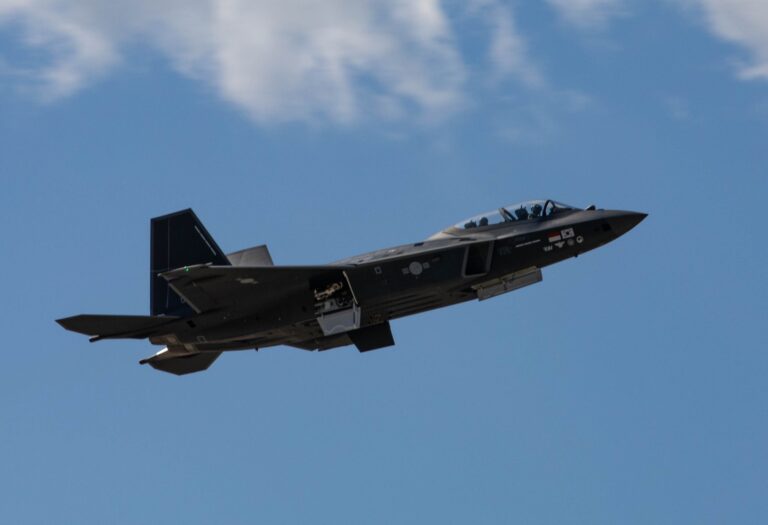
South Korea has launched a 435.9 billion-won ($296 million) program to develop an indigenous short-range air-to-air missile for its KF-21 Boramae fighter jets. According to the Defense Acquisition Program Administration (DAPA), the project is slated for completion by 2032.
The initiative marks a major step in strengthening South Korea’s strategic autonomy in airborne weapons systems. By equipping the KF-21 with domestically developed missiles, Seoul aims to reduce dependence on foreign suppliers while enhancing the export appeal of the fighter program. DAPA underscored that the effort is intended “to diversify weapons systems and boost defense exports.”
The Agency for Defense Development (ADD) will lead the program, with participation from key defense firms such as LIG Nex1 and Hanwha Aerospace. A DAPA spokesperson noted that the missile effort “will represent a significant milestone in advancing the nation’s airborne weapons capability and expanding Korea’s aviation defense industry.”
The KF-21, developed by Korea Aerospace Industries (KAI), is a 4.5-generation multirole fighter that completed its first flight in 2022. The aircraft is undergoing continued development and evaluation, with operational entry expected later this decade.
A homegrown short-range missile is intended to complement or replace foreign systems currently under consideration for the KF-21, including the U.S. AIM-9X Sidewinder and the European IRIS-T. DAPA emphasized that indigenizing critical munitions is vital to ensuring “strategic autonomy” amid shifting export-control environments and increasing geopolitical pressures.
LIG Nex1 brings experience from programs such as the Chiron MANPADS and the KM-SAM medium-range air defense system, while Hanwha Aerospace remains a core supplier of engines, avionics, and aerospace components for both domestic and export aircraft.
As South Korea works to expand its presence in global defense markets, the addition of a domestically engineered missile is expected to strengthen the KF-21’s attractiveness to prospective customers, particularly in Southeast Asia and the Middle East seeking complete, license-free weapons packages.
