

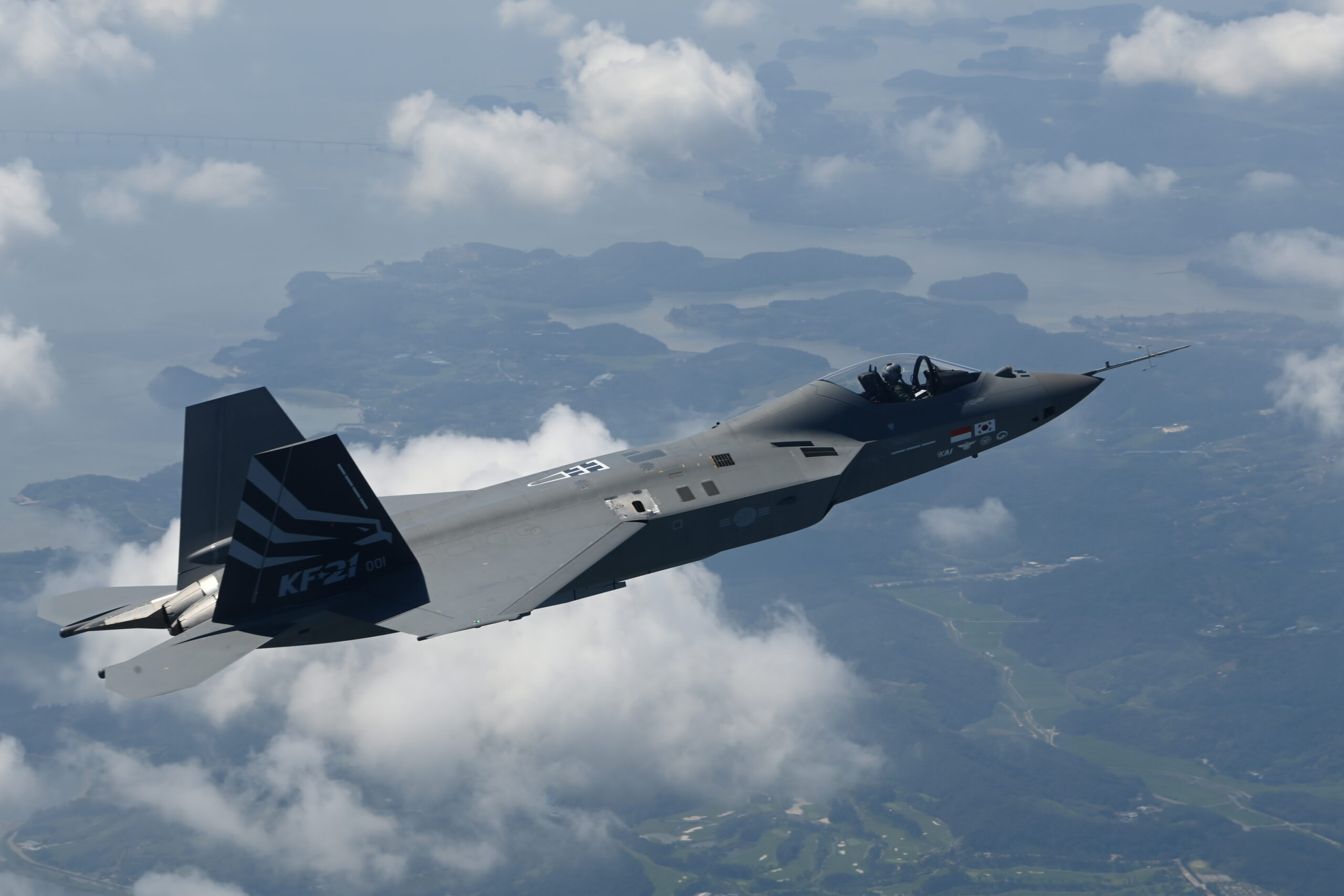
South Korea has officially launched mass production of its indigenous KF-21 Boramae multirole fighter jet, marking a pivotal moment in its emergence as a global defense technology leader. With 100 aircraft now under contract for delivery by 2032, the KF-21 program underscores Seoul’s ambitions to compete with the world’s top-tier aerospace powers and expand its footprint in the international fighter jet market.
The production phase was solidified through two successive contracts signed between Korea Aerospace Industries (KAI) and the Defense Acquisition Program Administration (DAPA). The first, signed in June 2024, covers 20 Block I aircraft, while the second, signed in June 2025, adds another 20 fighters. These initial 40 aircraft will be delivered to the Republic of Korea Air Force (ROKAF) by 2028, with the remaining 60 jets—likely Block II variants—set for completion by 2032.
The KF-21 represents the culmination of over a decade of investment in domestic R&D, aerospace infrastructure, and supply chain integration. Over 250 South Korean firms are involved in the program, including Hanwha Systems for radar development, LIG Nex1 for missile and EW systems, and Korean Air for structural components. Notably, the fighter’s AESA radar, developed locally by the Agency for Defense Development and Hanwha, is a technological milestone in South Korea’s defense evolution.
South Korea’s annual defense R&D budget exceeded $5.3 billion by 2025, with aerospace projects receiving strategic priority. KAI has already proven itself through successful exports of the FA-50 light fighter, with customers in Iraq, the Philippines, Malaysia, Thailand, and most recently Poland. Ongoing talks with Colombia and Peru could further boost exports, especially as the KF-21’s production matures.
The KF-21 Block I configuration focuses on air superiority, with 10 external hardpoints, Meteor BVRAAM compatibility, and a modern digital cockpit. The upcoming Block II will add limited internal weapons bays, enhanced EW suites, and refined stealth shaping for operations in contested airspace.
Crucially, South Korea’s fighter stands out among global contenders:
- Against Turkey’s KAAN, the KF-21 has a head start in production readiness and ecosystem maturity.
- Versus the Eurofighter Typhoon, it offers newer digital systems, lower lifecycle costs, and a modular, future-ready architecture.
- Compared to the Dassault Rafale, it provides a more flexible platform with broader munitions compatibility and lower cost barriers for partners.
- While not matching the F-35 in stealth or sensor fusion, the KF-21 avoids ITAR restrictions and offers an open architecture more attractive to non-aligned nations.
- Compared to the Gripen E, the KF-21 brings greater thrust, payload, and long-range versatility, backed by strong state-supported financing and industry scale.
With Indonesia reaffirming interest in acquiring 48 units and co-production talks underway, the KF-21 is no longer a national project—it is fast becoming a globally competitive fighter platform. KAI’s concurrent development of AI-based autonomous systems, stealth drones, and manned-unmanned teaming further strengthens Korea’s defense aerospace trajectory.
As full-rate production ramps up, the KF-21 Boramae is set to become the cornerstone of ROKAF airpower and a strategic alternative for nations seeking advanced fighters without political constraints.
