

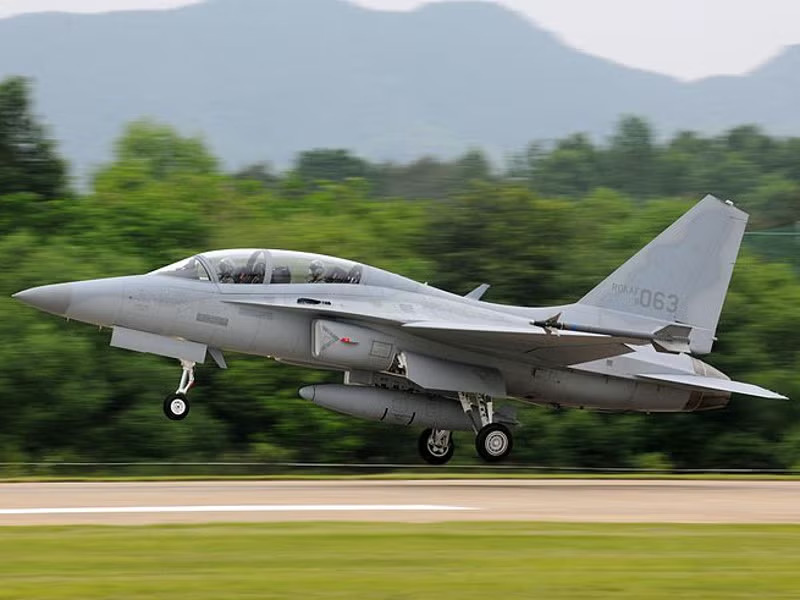
South Korea’s Korea Aerospace Industries (KAI) made a high-profile pitch at Egypt’s EDEX 2025 exhibition, offering the FA-50 light fighter as Cairo’s next multirole combat aircraft and the centerpiece of a domestic assembly line under the Arab Organization for Industrialization. If accepted, the proposal could significantly reshape Egypt’s air fleet and strengthen the country’s position within regional aerospace production.
KAI’s package includes the initial delivery of Korean-built FA-50s, followed by local assembly at AOI’s Helwan facility under a substantial technology transfer program. Egyptian officials have long sought to grow the nation’s aerospace sector, and the FA-50 offer aligns directly with this ambition.
Powered by a single F404 engine, the FA-50 is a compact supersonic fighter capable of reaching Mach 1.5 and operating above 50,000 feet. Its roughly 70% parts commonality with the F-16 gives it a major logistical and training advantage for an air force already centered around the American-built Viper.
The aircraft’s weapon loadout sits at the core of KAI’s marketing effort. The FA-50 carries an internal 20 mm M197 cannon and seven external hardpoints compatible with AIM-9 and AIM-120 air-to-air missiles, AGM-65 Maverick, 70 mm rockets, CBU-97/105 Sensor Fuzed Weapons, and the full range of JDAM, JDAM-ER, and SPICE guided munitions. Targeting pods such as Sniper and Litening support precision strike missions, while self-protection is ensured through RWRs, chaff/flare dispensers, and optional ECM pods.
KAI is promoting its newest export configuration—similar to the FA-50PL for Poland—featuring the PhantomStrike AESA radar, Link 16 data link, air-to-air refueling capability, expanded internal fuel, AIM-9X compatibility, and an advanced helmet-mounted sight. This package gives the aircraft true network-enabled strike performance at a fraction of the cost associated with heavier fighters.
KAI proposes a three-role operational model for Egypt:
• In peacetime, the FA-50 serves as an advanced trainer bridging pilots to F-16s or Rafales.
• During crises, it handles air defense missions with AIM-120 and AIM-9X, preserving high-end assets for strategic missions.
• In sustained conflict, it becomes a precision strike asset capable of delivering affordable GPS-guided bombs and cluster munitions while operating safely in medium-threat environments.
Egypt is reportedly negotiating for up to 100 aircraft, with around 70 to be assembled locally. The plan positions Helwan as an export-oriented production hub for African and Arab customers—similar to AOI’s earlier experience with Alpha Jet and K-8E programs.
Globally, the FA-50 competes against Leonardo’s M-346FA, India’s Tejas Mk1A, and Pakistan’s JF-17 Block III. While each has strengths, the FA-50 offers a unique combination of F-16 lineage, manageable operating costs, and an attractive industrial participation model.
For Cairo, the FA-50 represents a balanced mix of combat capability, affordability, and meaningful local industry involvement. KAI’s message at EDEX 2025 was unmistakable: the FA-50 is no longer a trainer with added weapons, but a fully realized light fighter designed to support national training pipelines, air policing missions, and domestic aerospace growth in a single export-ready package.
