

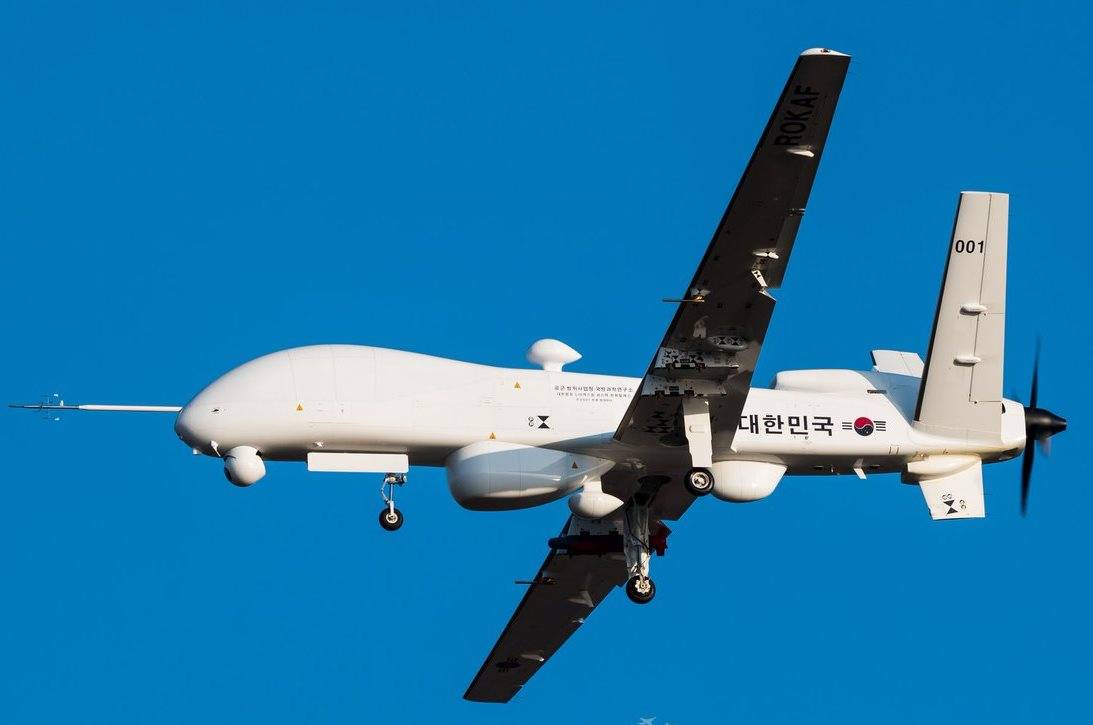
In a bold stride toward enhancing maritime combat capabilities, South Korea is developing a next-generation stealth unmanned combat aerial vehicle (UCAV) designed specifically for aircraft carrier operations. Korea Aerospace Industries (KAI) officially unveiled the ambitious program during the 8th Korea Strait Victory Seminar at the National Assembly on July 8, 2025.
Derived from an ongoing jet-powered drone project for the Republic of Korea Air Force, the new carrier-capable UCAV is built on a reinforced six-ton-class airframe. It’s engineered to launch via catapults and land with arresting gear — a nod to traditional carrier operations. With tail hooks, strengthened landing gear, and modular mission bays, the aircraft is tailored for flexibility in high-risk maritime strike zones.
The UCAV will carry an arsenal of air-to-air missiles, air-to-ground weapons, and smaller deployable drones. Designed for both offensive and ISR missions, it includes low-observable features like internal weapons bays and stealth shaping. KAI’s decision to pursue this platform aligns with the country’s strategic pivot away from manned aircraft like the F-35B following the 2024 cancellation of the CV-X aircraft carrier. Instead, the focus now shifts to deploying uncrewed systems from vessels like the Ghost Commander-II, a 42,000-ton multi-mission ship built by Hanwha Ocean and unveiled at MADEX 2025.
The Ghost Commander-II, measuring 240 meters in length, is armed with electromagnetic catapults, vertical launch systems, and amphibious capabilities — designed to support both kinetic operations and humanitarian missions. It signals a doctrinal shift toward AI integration and manned-unmanned teaming in the maritime domain.
KAI’s naval UCAV is not a stand-alone effort. It stems from the broader unmanned ecosystem that includes the KF-21 Boramae program and the Low Observable Unmanned Wingman System (LOWUS). Although larger and more autonomous than LOWUS, the naval UCAV shares many technologies, including modular radar bays and long-range networking. It boasts a maximum takeoff weight under six tons, an 800 kg payload, and a combat radius of 482 kilometers — powered by a high-bypass turbofan engine and optimized for fuel efficiency with a subsonic cruising speed below Mach 0.6.
The drone’s nose module is adaptable for different sensors — from AESA radar and EOTS to infrared and maritime surveillance systems. Its internal carriage capacity supports advanced missiles like the Meteor and air-launched mini-drones, positioning it as a potential command hub in aerial swarm operations.
If fully realized, the platform could make South Korea only the third country after the U.S. and Türkiye to field a carrier-based, jet-powered stealth UCAV. KAI also hinted at alternative configurations, including a canard-equipped version capable of ski-jump launches — a contingency if electromagnetic launch systems prove too complex or costly.
Interestingly, the project has moved forward without formal directives from the South Korean Navy, DAPA, or ADD. KAI is advancing development independently while remaining prepared to align with official acquisition plans once the Navy finalizes its next-generation fleet strategy.
Supporting this ambitious program is a strong push into AI and autonomy. In March 2025, KAI signed a trilateral agreement with U.S.-based Shield AI and Quantum Aero to integrate the Hivemind autonomy suite into Korean unmanned platforms. The package includes onboard autonomous control (Hivemind Edge), simulation environments (Hivemind Design), and centralized mission planning (Hivemind Commander). These tools will be vital in validating KAI’s indigenous AI flight control system, K-AILOT.
The company is also expanding its domestic ecosystem for autonomous systems. Since 2023, KAI has invested heavily in local firms specializing in AI and big data, such as Konan Technology, PUNZIN, and GenGenAI. A total of $69.7 million has been allocated toward autonomy and simulation research. The AAP drone platform — with a 20 kg payload and 500+ km range — is being used to test many of these technologies and is scheduled for its first demonstration flight by August 2025.
Despite technological momentum, KAI faces structural challenges — especially within South Korea’s defense acquisition landscape. Many government R&D projects remain limited to prototypes with no pathway to serial production. KAI’s Kang Byung-gil called for a clearer division of labor: public institutions like ADD should focus on weapon core tech, while industry takes charge of scalable platforms. He also criticized certification rules that limit the reuse of expendable drones in training and testing environments.
The strategic rationale behind the naval UCAV effort is rooted in South Korea’s evolving military doctrine. With increasing threats from North Korea, the nation is reinforcing its “kill chain” preemptive strike policy, layered missile defense (KAMD), and deterrence capabilities. The drone’s ability to conduct long-range ISR, electronic warfare, and precision strikes fits well into this framework.
South Korea’s military command formally established a drone operations unit in 2023, highlighting the importance of autonomous systems in future conflicts. Paired with loyal wingman roles for the KF-21 and FA-50 fighters, and supported by stealth UCAV prototypes like the KUS-FC and Kaori-X demonstrator, the new naval drone initiative reflects a clear trajectory: transforming South Korea into a leader in autonomous, carrier-based aerial warfare.
With innovation, modularity, and strategic intent at its core, KAI’s program may redefine the future of naval airpower in the Indo-Pacific.
