

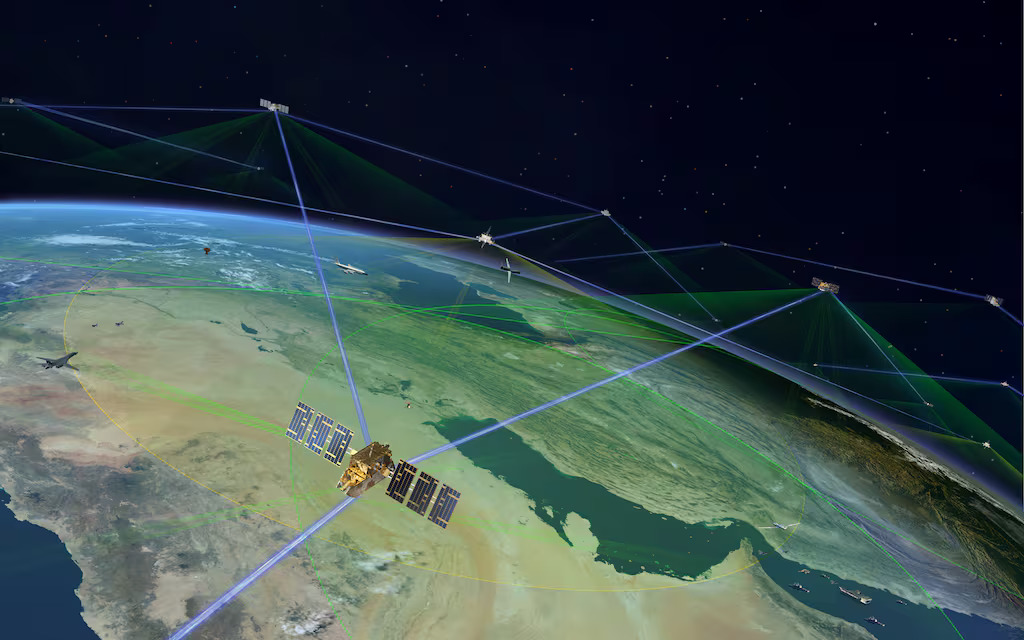
In a surprise strategic pivot, the U.S. Space Force is putting the brakes on expanding its flagship satellite communication constellation to reassess its future data transport architecture—shifting attention to a lesser-known, SpaceX-backed program known as MILNET.
According to the newly released fiscal year 2026 budget request, the Space Force is pausing the procurement of a third tranche of communication satellites through the Space Development Agency (SDA), which had previously spearheaded a competitive, open-architecture approach to building a proliferated network of small satellites in low-Earth orbit.
At a Senate Appropriations Committee hearing last Thursday, Chief of Space Operations Gen. Chance Saltzman confirmed the decision. “We are simply looking at alternatives,” he said. “The goal is to find the best approach to scale our data transport capabilities to meet growing demand on the battlefield.”
The Rise of MILNET
The leading contender for that future is MILNET, a classified and largely under-the-radar satellite network that could ultimately comprise nearly 500 satellites. What sets MILNET apart is its core partnership with SpaceX, which is providing satellites, terminals, and operational support via its Starshield division—a militarized version of its Starlink platform.
This tight alignment with a single commercial provider, however, is raising eyebrows on Capitol Hill. Lawmakers expressed concern that MILNET may undermine the diversity and innovation fostered by SDA’s current model, which includes multiple vendors and a modular, open system.
Senator Chris Coons (D-Del.) warned that the new approach risks concentrating too much control in one company’s hands: “No competition, no open architecture, no leveraging of a dynamic space ecosystem,” he said.
Funding Begins, Details Lacking
The FY26 budget earmarks $277 million for MILNET, marking the first time the program has appeared in public-facing documentation. Yet key questions remain unanswered. What specific capabilities will the funding support? Will MILNET supplement or ultimately replace SDA’s transport layer? And how will the Space Force ensure long-term resilience and security with a single prime contractor?
Secretary of the Air Force Frank Kendall and Assistant Secretary Troy Meink were quick to clarify that while satellite buys under SDA are being paused, no final decisions have been made. Meink emphasized that MILNET is not permanently tied to a single vendor or architecture, and that acquisition strategies remain fluid.
For now, SDA’s existing pipeline—19 satellites already in orbit and 126 more launching later this year as part of “Tranche 1”—will continue as planned. Another 182 satellites are on contract, but future expansion will depend on the outcome of the Space Force’s internal analysis.
Looking Ahead
The decision reflects a broader tension within military space policy: how to balance speed, innovation, and strategic autonomy in a domain increasingly driven by commercial giants. With MILNET entering the budget and SDA’s expansion on pause, 2026 could be a turning point in how the Pentagon builds and manages the next generation of satellite communications.
Until more detailed funding documents are released, however, the true scope and direction of MILNET—and its potential to reshape U.S. space strategy—remains shrouded in orbital uncertainty.
