

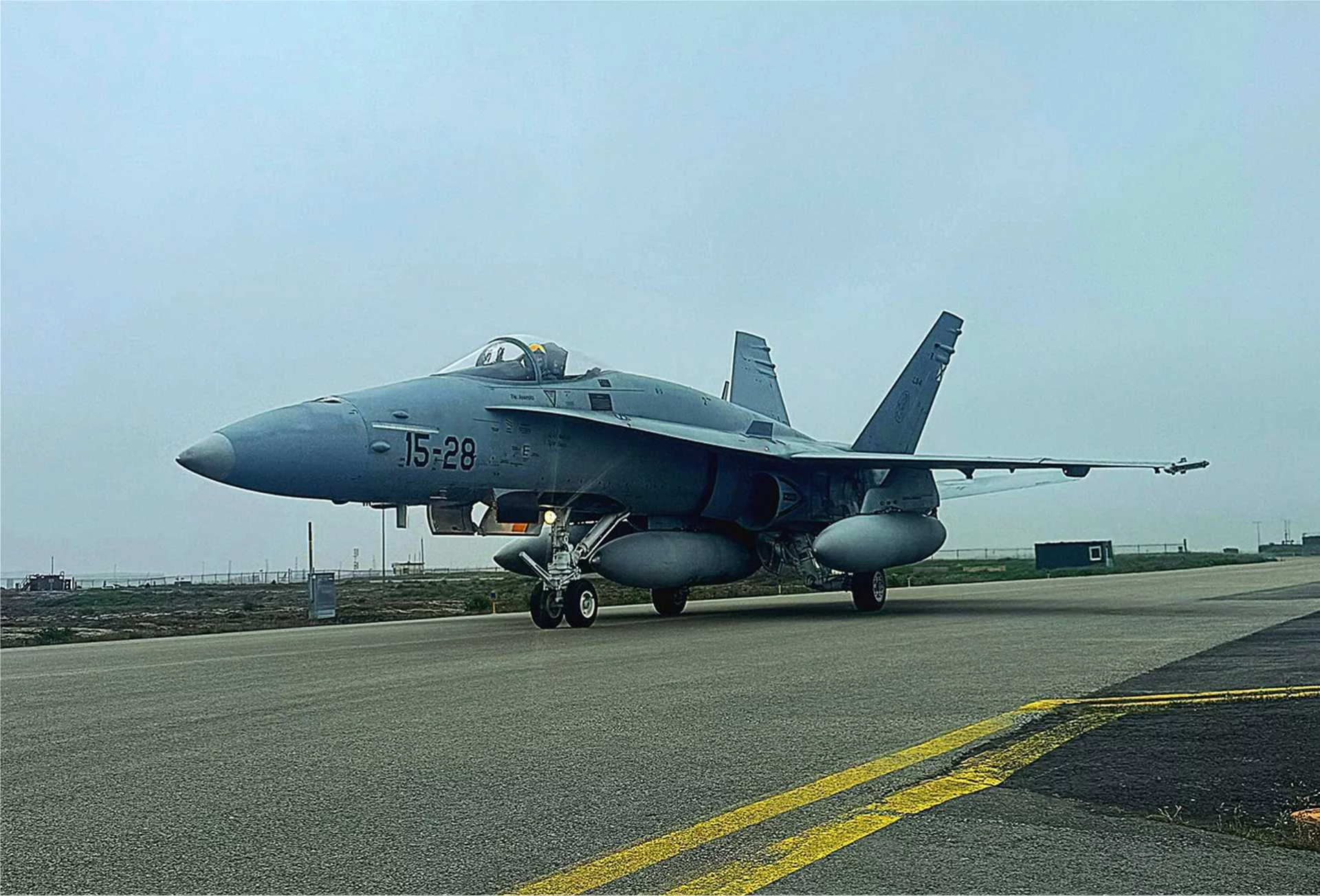
On August 3, 2025, the Spanish Air Force officially deployed its F/A-18 Hornet fighter jets to Iceland for the first time, launching a new phase of Spain’s participation in NATO’s Air Policing efforts. Stationed at Keflavík Air Base, Spanish pilots are now on standby for Quick Reaction Alert (QRA) missions—ready to intercept any unauthorized aircraft entering NATO airspace over the North Atlantic.
This deployment signifies Spain’s inaugural operational role in defending Iceland’s airspace—a strategically crucial area within the Greenland-Iceland-UK (GIUK) gap. The presence of Spanish jets enhances NATO’s deterrence capabilities amid rising Russian aerial activity in the Arctic region and sends a clear message of Allied solidarity.
The F/A-18 Hornets, from Ala 12 at Torrejón Air Base, are equipped for both air-to-air and air-to-ground operations and supported by full logistical and technical teams. Their arrival strengthens NATO’s Integrated Air and Missile Defence System (NATINAMDS), providing round-the-clock monitoring and readiness across the North Atlantic frontier.
Given that Iceland does not operate its own air force, the rotating presence of NATO jets ensures the country’s airspace remains under constant protection. This mission not only reinforces collective defense under Article 5 but also serves as vital training for Allied pilots in Arctic flying conditions—challenging weather, extended patrol ranges, and real-time coordination with NATO command centers.
With a diversified combat fleet that includes EF-18 Hornets and Eurofighter Typhoons, the Spanish Air Force brings proven multirole capability to NATO’s northern flank. This deployment marks a critical evolution in the Alliance’s posture toward persistent Arctic vigilance, signaling a robust response to emerging geopolitical dynamics in the High North.
