

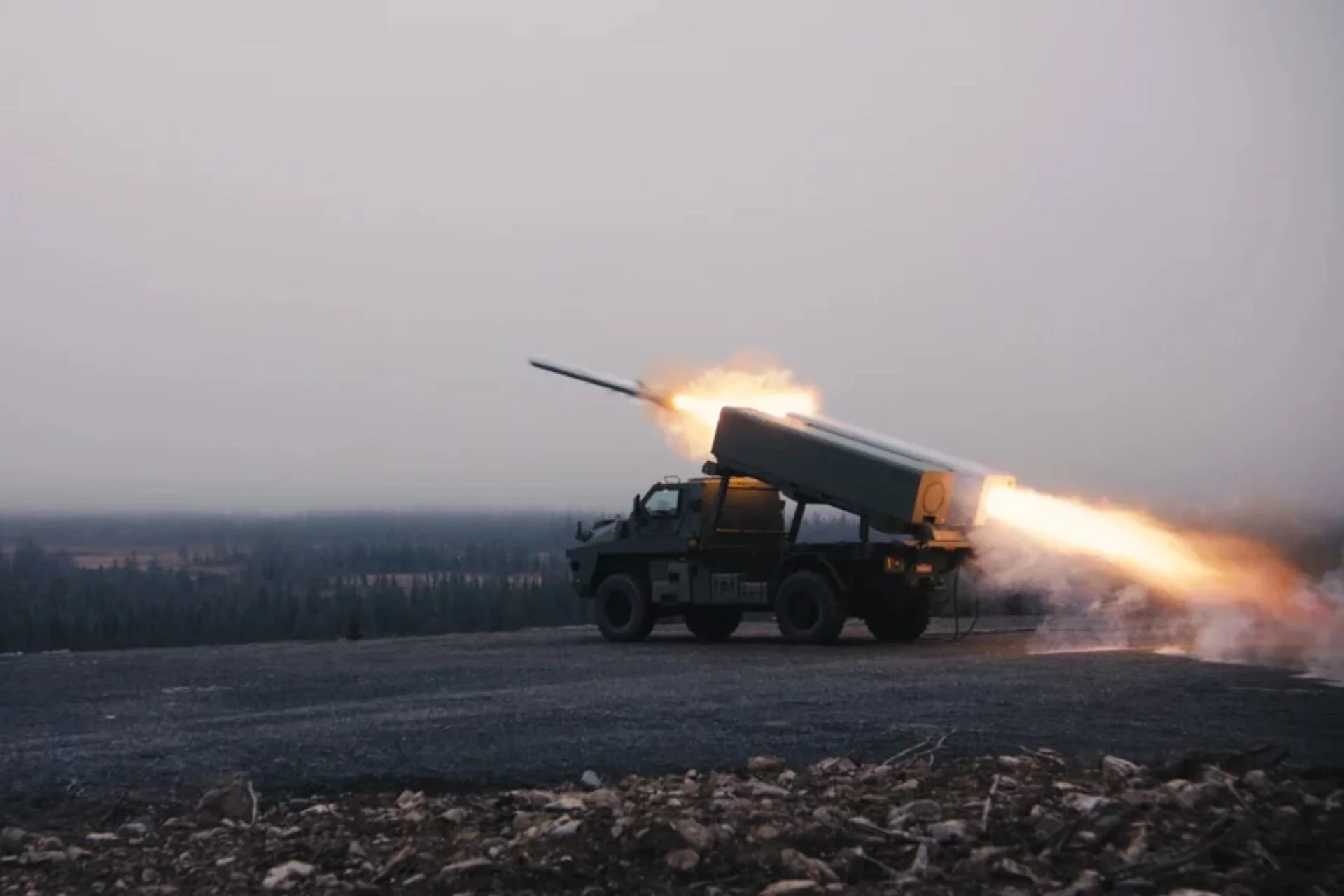
Kongsberg and Thales reported a successful live test launch on 23 October 2025 in Norway, firing a Naval Strike Missile (NSM) test round from a StrikeMaster launcher mounted on a Bushmaster protected vehicle. Companies described the event as a clean launch intended to validate the Australian-configured, land-based maritime strike concept and to support Australia’s upcoming Land 8113 decision as well as partner interest.
The round fired was a Blast-Test Vehicle — a booster-equipped test munition used to confirm safe launch sequencing without expending an operational missile. Such rounds allow validation of launcher mechanics, ejection kinematics, pyrotechnic events and vehicle-launcher interfaces prior to guided firings, and were presented by the firms as a controlled, low-risk verification step on the path to fielding.
StrikeMaster adapts Kongsberg’s Coastal Defence System architecture to an Australian setting by mounting a twin-pack NSM launcher on the Bushmaster Protected Mobility Vehicle, accompanied by a Fire Control Centre and a resupply vehicle to maintain mobility and sustainment. While doctrinal parallels exist with the USMC’s NMESIS deployments, differences in carriage and distribution concepts persist; nevertheless, the approach fosters interoperability across allied formations and eases integration into naval and joint command architectures.
The Bushmaster provides protected mobility, endurance and integration space for the twin launcher. Described platform attributes include a welded V-hull for blast mitigation, externalized fuel and hydraulic tanks with protected emergency reserves, capacity for a driver plus up to nine passengers, an operational range around 800 km and speeds exceeding 100 km/h, and provisions for self-defense machine guns. Those characteristics support shoot-and-scoot tactics, movement along secondary roads or rough tracks, and straightforward incorporation of the fire control and resupply elements in a dispersed coastal posture.
NSM itself is a low-observable, fast subsonic sea-skimmer with high-G terminal maneuvers. Published performance points cited include a range in excess of 300 km, a launch mass of 407 kg and a length of 3.96 m — parameters that shape logistics and vehicle-sizing decisions. Its imaging electro-optical seeker operates fully passively and incorporates Autonomous Target Recognition (ATR), enabling target discrimination under EMCON and limiting emissions that might reveal launch sources.
At the program level, NSM is selected or being delivered to fourteen nations, and the Royal Australian Navy entered the missile into service in 2024, providing a naval baseline that eases sustainment and shared inventory management when a land option is fielded. Australia is pursuing industrial steps as well: a planned NSM production facility near Newcastle is intended to start producing the missile in Australia from 2027, reducing supply-chain exposure and bolstering the Defence Industrial Base.
Tactically, the StrikeMaster/Bushmaster pairing emphasizes mobility and tempo — twin launch capability supports dispersed batteries, movement on secondary routes, and enhanced survivability against counter-fires and sensors. Passive seeker modes and sea-skimming flight profiles compress adversary warning times and preserve the initiative across the littoral. Effectiveness, however, depends on a robust ISR chain feeding a Recognized Maritime Picture and Common Operational Picture — from aerial assets, coastal sensors, naval platforms or space relays — and on precise synchronization of sensor illumination windows under EMCON to maximize first-shot effects and complicate adversary targeting.
Industrial support and assembly are split between Kongsberg Defence Australia (Adelaide) and Thales Australia (Bendigo), with a supplier base exceeding 150 companies and an estimated employment effect of some 700 jobs. When nested into a wider coastal defense layout, a StrikeMaster battery creates a layered denial zone that stretches adversary planning and raises the complexity and cost of coercive maritime actions near archipelagos and chokepoints.
