

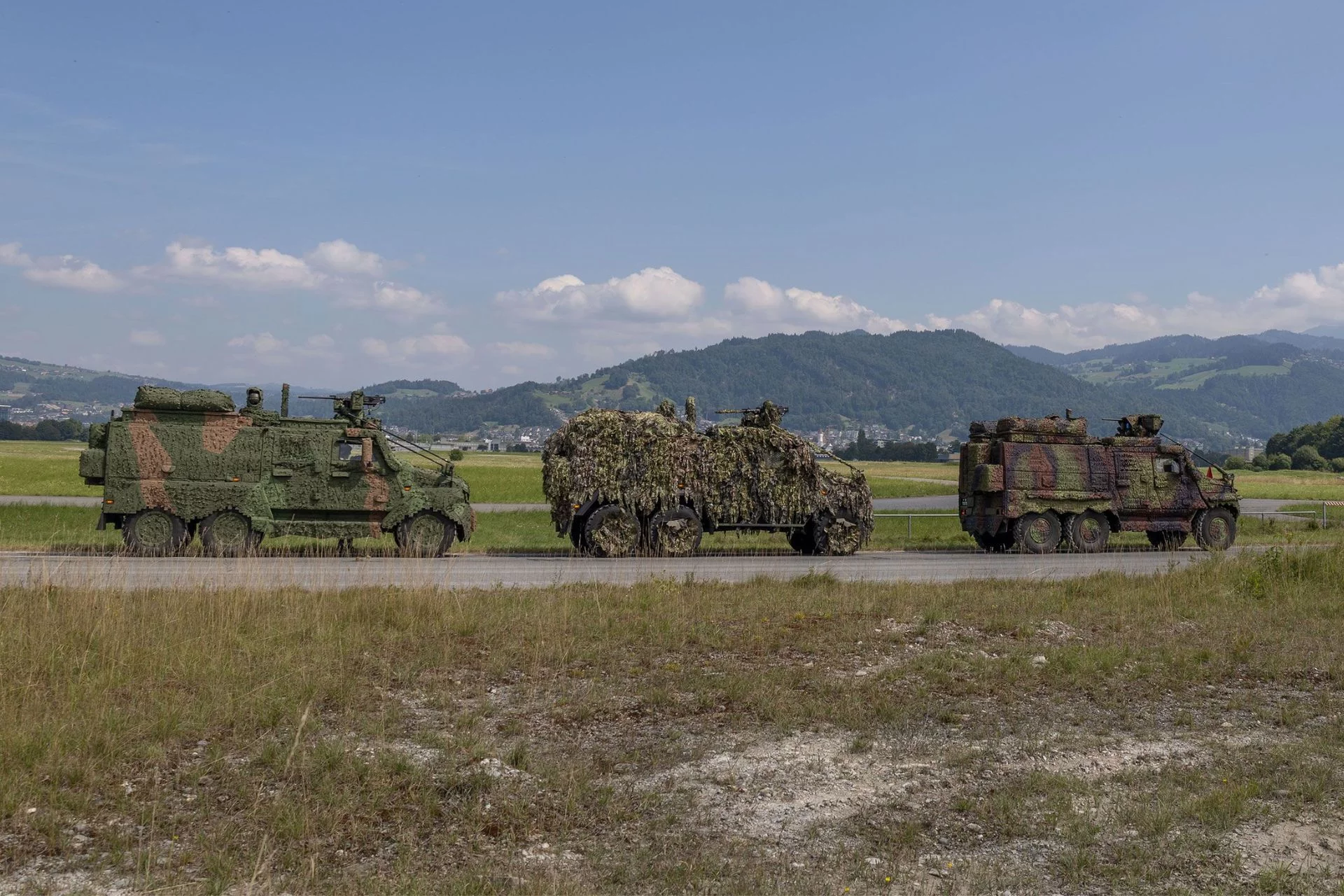
Switzerland has chosen three European companies—SSZ Camouflage AG of Switzerland, Germany’s Saro GmbH, and Sweden’s Saab Barracuda AB—to supply a new generation of multispectral camouflage systems for military vehicles, infrastructure, and defensive positions. The Federal Office for Defence Procurement (armasuisse) confirmed the award of fourteen separate lots on 10 November, marking a significant step in aligning camouflage modernization with the Federal Council’s wider armament priorities.
The newly selected Multispectral Camouflage Systems (MSTS) are designed to reduce signatures across the visual, infrared, and radar spectrum, a necessity in an era where drones, thermal imagers, and high-resolution radar have become an integral part of modern reconnaissance. The decision follows extensive trials conducted between July and September at the Thun and Bure training ranges, where the systems were tested by different branches of the Swiss Armed Forces under varied terrain, weather, and lighting conditions.
The procurement process evaluated not only system performance but also logistics, integration, cost, and industrial considerations. By awarding fourteen distinct lots, Switzerland can tailor specific camouflage configurations to different operational needs—from armored vehicles and static defensive sites to supply depots and temporary shelters. SSZ’s solutions emphasize compatibility with alpine and urban landscapes, while Saro and Saab Barracuda supply modular camouflage nets widely used across European militaries. The result is a comprehensive suite of options rather than a one-size-fits-all solution.
MSTS technology works by modifying how objects reflect light, heat, and radar energy. Visually, the systems break up outlines and replicate environmental textures. More critically, they alter thermal signatures, making vehicles and structures harder to detect with infrared sensors mounted on drones or surveillance systems. Layers designed to disrupt microwave reflections help reduce radar visibility, complicating attempts to identify targets during wide-area scanning.
On the tactical level, these systems provide an advantage in environments saturated with MALE drones and frontline quadcopters. By degrading the accuracy of recognized operational pictures, MSTS delays enemy targeting cycles and reduces the number of assets exposed to precision strikes or loitering munitions. When paired with emission control and dispersal tactics, camouflage becomes a key component of survivability.
The Swiss decision also reinforces interoperability. By adopting camouflage technologies already fielded by several European partners, Switzerland ensures compatibility during joint exercises and multinational operations—an important consideration for a country that maintains political neutrality while participating in cooperative security mechanisms.
More broadly, Switzerland’s move reflects a European trend toward strengthening signature management as drone warfare, synthetic aperture radar, and passive sensors become dominant features of future conflicts. Multispectral camouflage is increasingly viewed as essential to preserving territorial defence capability and protecting forces from constant surveillance by airborne and space-based intelligence systems.
