

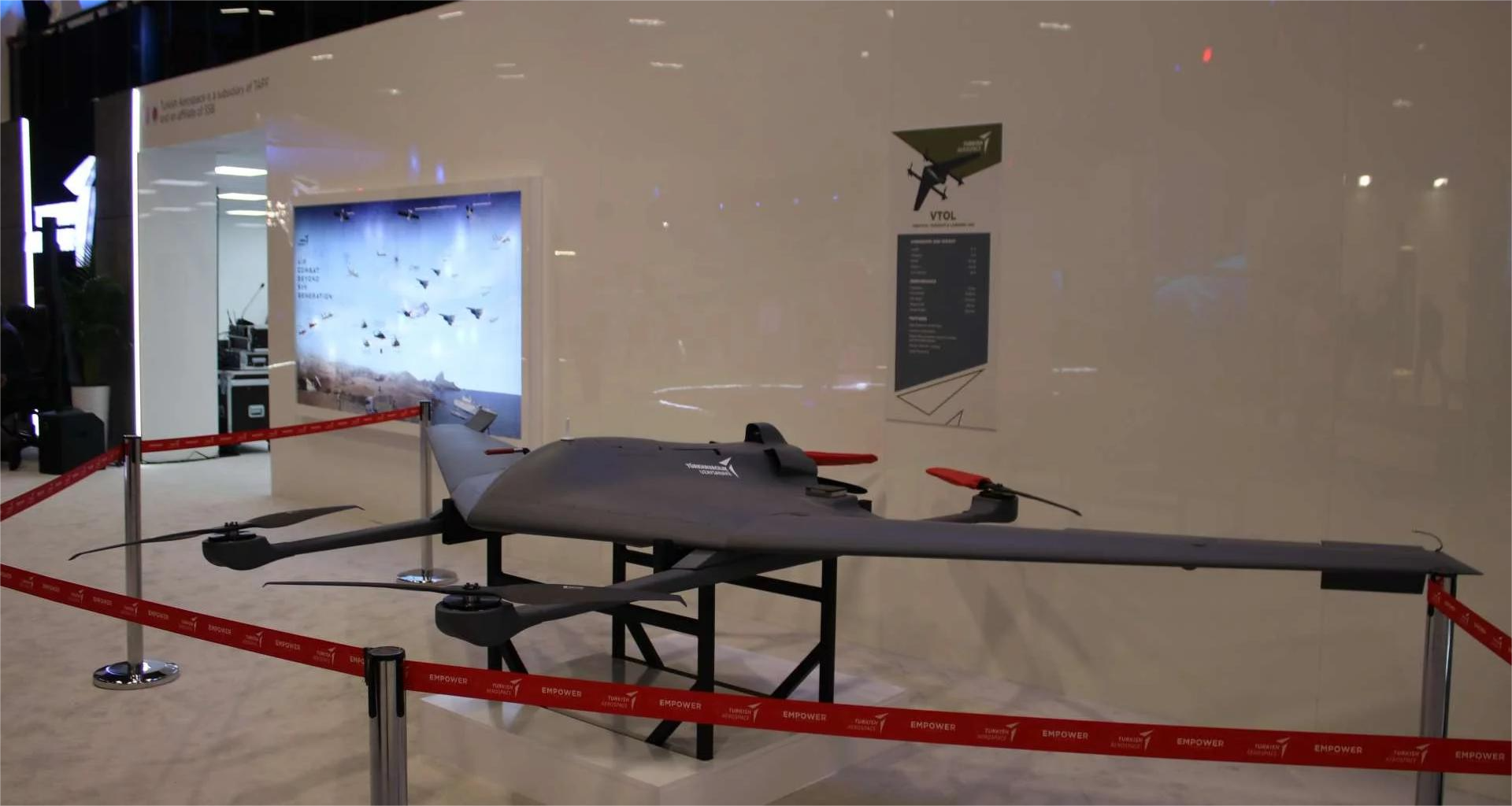
At the IDEF 2025 exhibition in Istanbul, Turkish Aerospace Industries (TAI) revealed a brand-new Vertical Take-Off and Landing (VTOL) unmanned aerial vehicle, signaling another advancement in Türkiye’s expanding UAV ecosystem. Developed for high-endurance Intelligence, Surveillance, and Reconnaissance (ISR) missions in austere environments, this UAV combines compact design with strategic flexibility—bridging a key capability gap in modern military operations.
With a length of 3.1 meters and a wingspan of 5 meters, the UAV boasts a maximum take-off weight of 120 kg and can carry a payload of up to 2.5 kg. Powered by a fuel-based propulsion system, it holds 60 liters of fuel, granting it 10 hours of endurance and a range of up to 1,300 kilometers. The UAV can cruise at altitudes of 9,000 feet with a top speed of 70 knots, and maintain control link communications over 100 kilometers. A foldable modular wing design enables fast field deployment and ease of transportation.
Drawing on lessons from previous programs like ANKA and AKSUNGUR, this VTOL drone was engineered for rapid deployment, minimal logistical dependency, and high persistence over contested or infrastructure-limited zones. It fills the gap between rotor-based short-range drones and runway-dependent fixed-wing UAVs, making it ideal for modern hybrid warfare and border security missions.
Compared to similar VTOL platforms like the Martin UAV V-BAT or Israel’s AirMule, TAI’s approach emphasizes combustion fuel-based endurance and simplified structural engineering. Avoiding complex tilt-rotor mechanisms, the drone utilizes a lift-cruise configuration with modular assembly, improving survivability, maintainability, and deployability. These attributes support tactical operations in mountainous terrain, littoral regions, and expeditionary bases.
Strategically, the UAV provides a robust ISR capability in operational environments where runways are unavailable or denied. It’s also well-suited for naval take-off from small decks, remote surveillance in Africa or Central Asia, and supporting Turkish peacekeeping operations abroad. Its design allows loitering over strategic areas for extended durations, supplying real-time situational awareness to ground commanders.
Although no formal procurement announcement has been made, the UAV’s specifications suggest it is primed for both domestic adoption by the Turkish Armed Forces and international export, especially to countries requiring long-endurance surveillance without dependence on conventional airbases. Given TAI’s history of rapid system fielding, operational deployment could occur within a short timeframe.
TAI’s introduction of this new VTOL UAV demonstrates Türkiye’s intent to lead in versatile, low-footprint unmanned systems capable of meeting 21st-century conflict requirements. The drone’s blend of vertical mobility, fixed-wing endurance, and modular adaptability offers a compelling solution for nations seeking a cost-effective and scalable ISR platform ready for the challenges of asymmetric warfare.
