

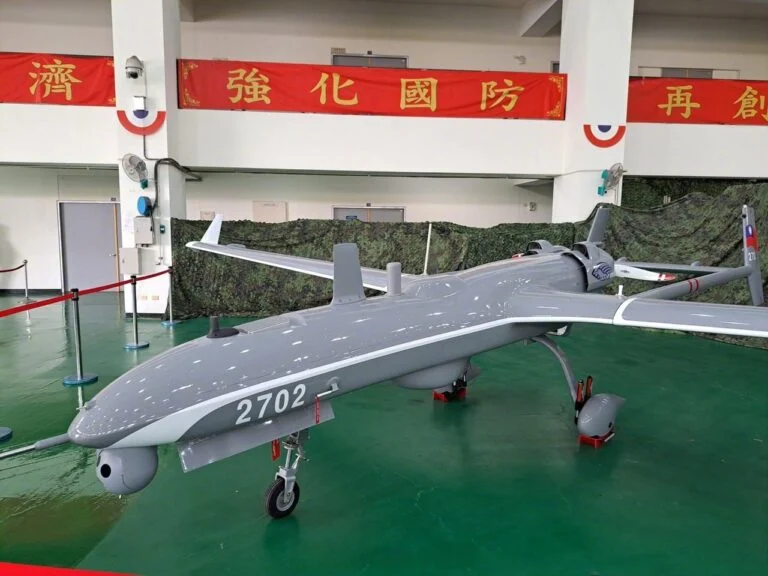
Taiwan’s Ministry of National Defense has officially confirmed the acquisition of 36 Rui Yuan II surveillance drones under a newly approved special defense budget worth NT$12.6 billion (approximately USD $402 million). The procurement, scheduled between 2026 and 2029, is intended to boost long-range ISR capabilities and reduce dependence on manned aircraft.
The announcement follows earlier speculation that the program might face delays due to budget pressures. However, a briefing to Taiwan’s Legislative Yuan confirmed that the Rui Yuan II initiative will proceed as planned and is fully incorporated into the special defense funding package.
The drone fleet is expected to gradually replace piloted surveillance platforms, significantly lowering fuel and operational costs. Internal planning documents identify the effort as “Project Rui Jiu,” which outlines the acquisition of 36 composite airframes and nine electronic intelligence receiver sets, enhancing the UAV’s SIGINT mission performance.
A separate NT$150 million development contract awarded to the National Chung-Shan Institute of Science and Technology (NCSIST) covers the creation of four prototype drones equipped with different payload suites. After testing, one configuration will be selected for full-rate production.
Designed domestically, the Rui Yuan II is a MALE-class UAV built from advanced composite materials. It features a 12-meter wingspan, an air-cooled rotary engine, and a maximum range of 2,000 kilometers. The drone includes frequency-hopping communications, multi-band navigation, and counter-jamming architecture suited for extended ISR missions over land and sea.
In recent live-fire exercises, the Rui Yuan II demonstrated real-time maritime target tracking and transmitted radar and electro-optical imagery via microwave links, Ka-band satellite relay, and 4G/5G uplinks to the command center. The system can operate up to 300 kilometers via line-of-sight control, with satellite links extending its reach far beyond the Taiwan Strait.
The Rui Yuan II follows the earlier Rui Yuan I program and forms part of Taiwan’s broader strategy to strengthen indigenous intelligence-gathering capabilities. As manned surveillance aircraft such as the RC-70 face rising operational costs and increased regional threats, Taiwan is accelerating the transition to advanced UAV systems. Defense industry sources indicate that the drone’s airframe is being evaluated for future modular strike payloads, though the current procurement focuses exclusively on ISR and electronic warfare variants.
