

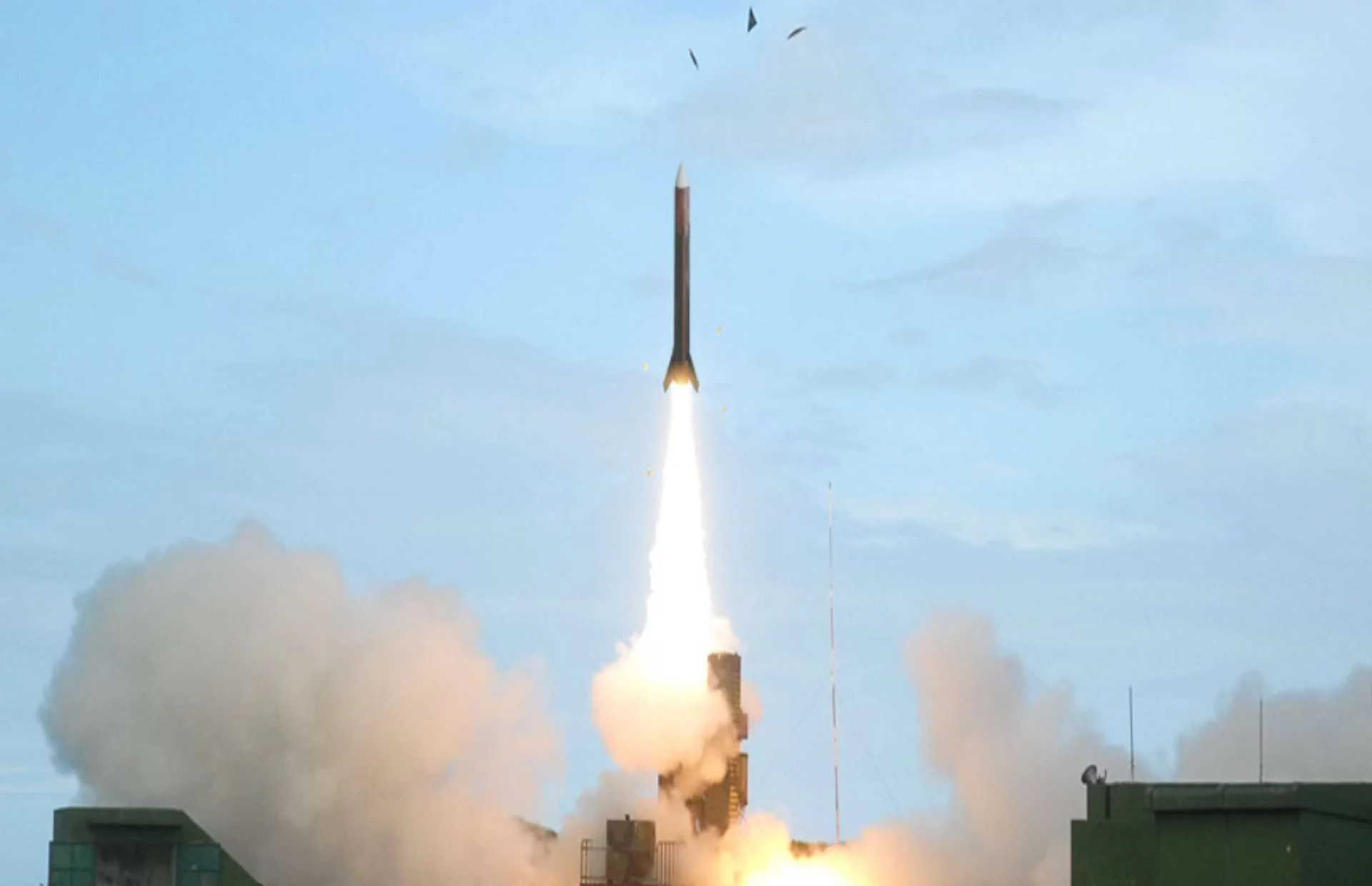
According to a report by the Taipei Times on August 3, 2025, Taiwan’s Ministry of National Defense (MND) plans to start mass production of the indigenous Tien Kung IV (Sky Bow IV) air defense missile system in 2026. The latest military procurement list details the acquisition of 122 missile pods, with 46 units slated for delivery in 2026 and the remaining 76 in 2027. Each pod contains a single interceptor missile, representing a major effort by Taipei to reinforce its layered missile defense network amid escalating regional tensions and emerging threats from high-speed aerial and ballistic weapons.
The Tien Kung IV is the most advanced variant in Taiwan’s native Sky Bow missile family, developed under the Chiang Kung (Strong Bow) advanced air defense program by the National Chung-Shan Institute of Science and Technology (NCSIST). It is a two-stage, solid-fuel interceptor featuring thrust vector control and cold gas attitude control for enhanced mid-course maneuverability and terminal high-G interception. The missile employs an active radar seeker operating in the X-band, capable of autonomous target detection and discrimination in dense electromagnetic environments. Integrated into a mobile vertical launch platform compatible with Taiwan’s existing defense systems, it is controlled via a digital fire control network supported by phased-array radar for simultaneous tracking and engagement of multiple targets.
Designed to counter a wide spectrum of threats—including supersonic cruise missiles, tactical ballistic missiles, and maneuvering reentry vehicles—the Tien Kung IV offers an engagement altitude up to 70 kilometers and a horizontal range exceeding 200 kilometers. Its capabilities place it in a similar strategic category as the U.S.-made THAAD system but with a smaller footprint and domestically integrated C4ISR systems. It is also believed to feature hit-to-kill guidance and kinetic kill vehicle (KKV) technology, enhancing effectiveness against ballistic threats in both exo-atmospheric and upper endo-atmospheric layers.
Tactically, the Tien Kung IV fills a critical gap between the Sky Bow III and imported Patriot PAC-3 MSE systems, allowing Taiwan to deploy a layered, multi-tiered missile defense grid optimized for different threat classes and interception windows. Its mobility facilitates rapid redeployment to vital sites such as air bases, infrastructure nodes, and coastal batteries, enhancing flexibility against evolving threat vectors. The system’s capacity to manage saturation attacks and engage targets beyond the atmosphere significantly strengthens Taiwan’s defense against large-scale missile barrages and decapitation attempts often envisaged in Chinese invasion scenarios.
Taiwan’s accelerated push to produce and deploy the Tien Kung IV stems from the deteriorating security landscape. Over recent years, the People’s Liberation Army (PLA) has ramped up military pressure with frequent large-scale incursions into Taiwan’s Air Defense Identification Zone (ADIZ), naval exercises encircling the island, and deployment of precision strike missile systems like the DF-15, DF-16, and DF-17 near the Taiwan Strait. Chinese doctrine emphasizes rapid force projection and area-denial strategies aimed at neutralizing Taiwanese air power and command infrastructure early in a conflict. In this context, the Tien Kung IV serves as both a deterrent and active defense tool to disrupt missile salvos and protect Taiwan’s strategic depth in a cross-strait confrontation.
Simultaneously, Taiwan is progressing on a new generation eight-wheeled armored fighting vehicle based on the CM-33 Yunpao platform. This variant mounts a 105mm rifled cannon in an unmanned turret, supported by a coaxial 7.62mm machine gun and a roof-mounted 12.7mm heavy machine gun, all integrated into a stabilized remote weapon station with digital fire control. After successful initial operational tests demonstrating mobility and firing precision on the move, full-rate production is expected to start in 2028 with an order for 500 units.
Together, the mass production of the Tien Kung IV missile system and the new 105mm wheeled AFV reflect Taiwan’s commitment to developing a resilient indigenous defense ecosystem capable of countering multi-domain threats. As Beijing intensifies military and diplomatic pressure, Taipei is increasingly focusing on strategic autonomy, survivability, and denial-based deterrence.
