

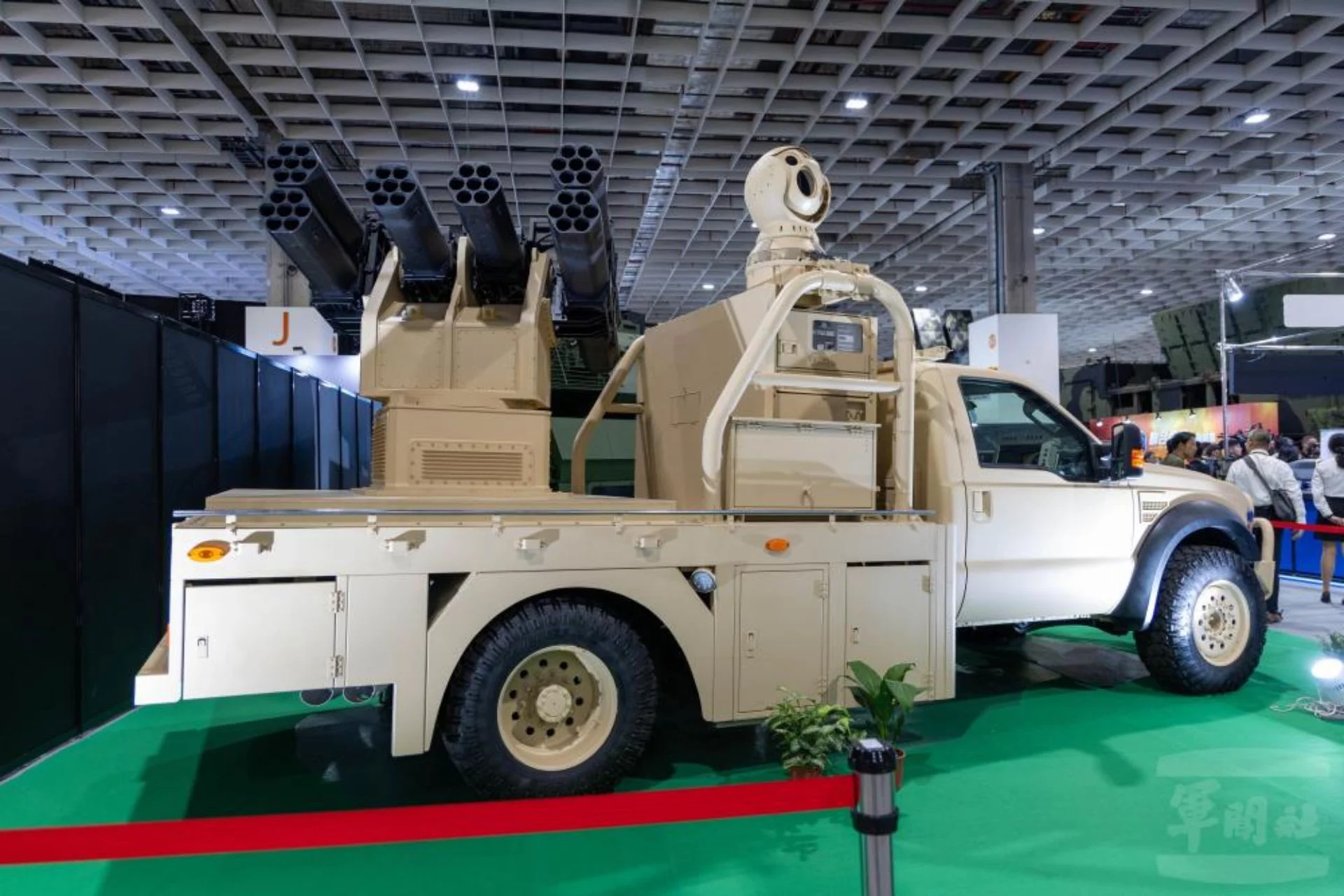
Taiwan’s NCSIST showcased a 2.75‑inch (70 mm) rocket‑turreted ground vehicle at TADTE 2025 in Taipei. Paired with a day‑night electro‑optical sensor, the seven‑tube platform is designed for Coast Guard use against unmanned aerial vehicles (UAVs) and small surface threats; it supports multiple munition types and can receive radar cueing for rapid response.
At the September 18, 2025 presentation, officials said the system combines an EO/IR block — including a camera, thermal imaging and a laser rangefinder — with a fire‑control computer that computes the ballistic solution and controls firing once an optical lock is achieved. The system can also accept external track/designation from a radar for backup tracking or aim guidance. According to Jane’s, the system has been ordered for Coast Guard use; such mobile, cost‑effective solutions are in demand for coastal areas with busy ports and straits.
The turret uses 70 mm munitions — a caliber known from aircraft that has been adapted to ground launchers. NCSIST lists available effects as high‑explosive, a steel‑ball fragmentation round with dense fragment patterns, and a sonic/acoustic warhead that delivers a strong pressure impulse at short range. This variety provides flexibility to match the effect to the target type — from a light quadcopter to a fast unmanned surface vessel (USV). The digital fire‑control core completes the firing calculations as soon as the sight locks the target, enabling rapid shots and reducing hesitation at critical moments.
The sensor suite offers advantages for short and very short‑range detection and identification, particularly over water and against civilian infrastructure where radars often suffer clutter. The ability to hand off a radar track to an optical sensor for confirmation before engaging helps save ammunition and reduce misidentification. The architecture therefore favors a networked sensor approach rather than relying on a single “silver‑bullet” munition.
Ergonomics and employment are kept simple: the vehicle patrols, observes, stops briefly to fire, and then moves on. Firing from semi‑covered positions or via remote operation reduces crew exposure — important where adversaries might use booby‑trapped drones or try opportunistic fire after spotting launch flashes. The stop‑and‑shoot profile fits fluid coastal incidents where a micro‑USV can cross a boundary in seconds or a quadcopter can appear against busy port backgrounds. Standardizing on the 70 mm caliber, which is produced on multiple lines, also eases sustainment through access to proximity fuzes and configurable effect settings while keeping cost per shot well below that of a conventional surface‑to‑air missile.
Tactically, the system is straightforward: in a port, on a jetty or at an energy terminal, teams can maintain mobile surveillance, relocate to a blind angle where optics outperform radar, gain optical lock, and engage swiftly. For clusters of multicopters a steel‑ball load gives the best fragment density; for tougher surface craft the high‑explosive option raises the chance of stopping the target. The sonic warhead is intended to create an intense overpressure impulse at very short range against fragile targets. Crews prioritize sight discipline, positive identification and tempo rather than complex firing procedures.
Orienting the system toward Coast Guard missions reflects geographic and operational demands: fixed defenses poorly and expensively cover very low altitudes and congested channels. A wheeled launcher that can link to radar networks yet still identify and fire by sight fills that gap. It absorbs routine intrusions, frees scarcer assets for higher‑end threats, and preserves freedom of action in areas with heavy civilian activity. Durability, weather tolerance and modest support needs are important for repeated interventions — the employment profile targeted by the turret.
The strategic context explains the timing and presentation: air and maritime activity around the strait has intensified and the growing use of unmanned systems presses Taiwan to multiply interception points and local response capacity. The chosen approach aligns with an asymmetric defense logic emphasizing mobility, dispersion and cost sustainability. The system is not meant to replace higher‑tier air defenses but to maintain continuity around key infrastructure, save expensive interceptors for threats only they can defeat, and manage day‑to‑day pressure affordably. Shown at a trade fair that features both prototypes and deployable systems, the NCSIST 2.75‑inch turret appears as a pragmatic addition to existing sensor and engagement networks; if low‑cost threats persist, the logic of high volume at lower cost per shot remains valid.
