

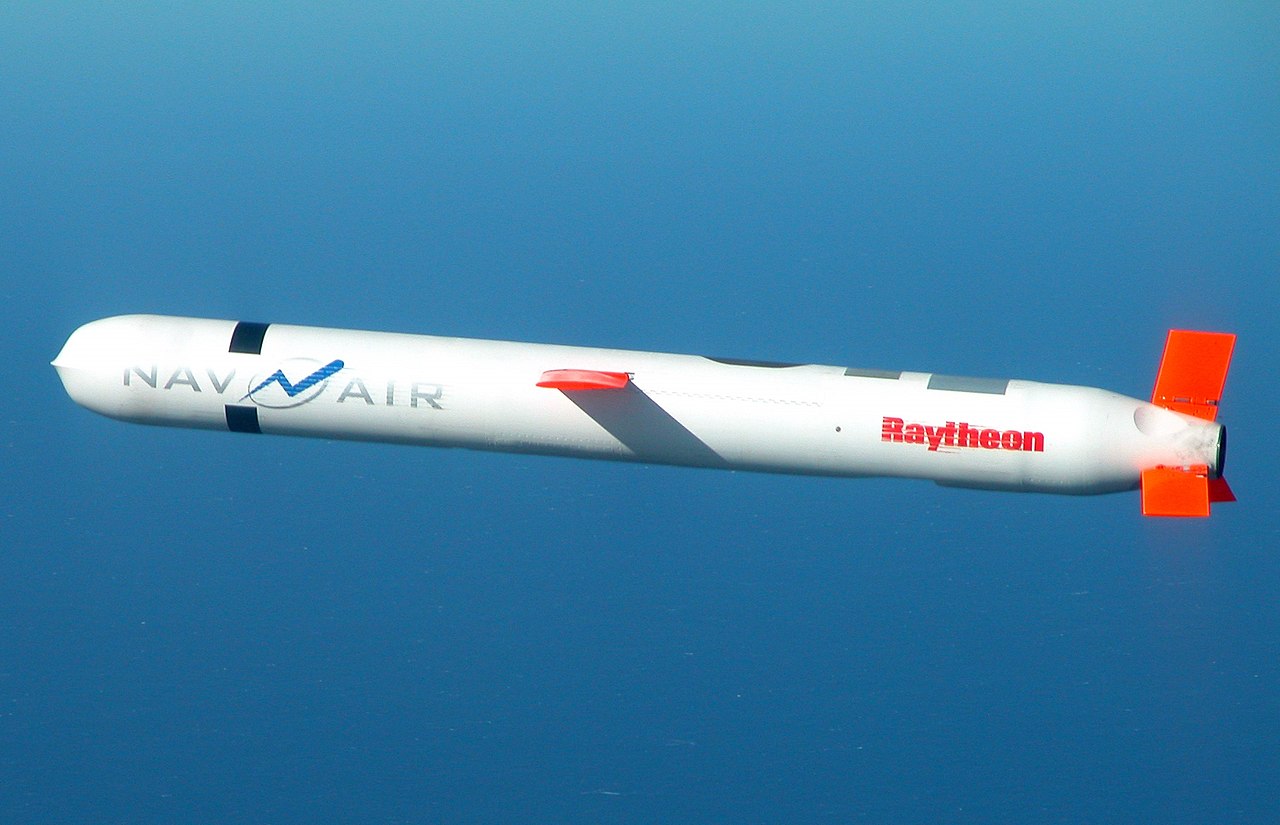
The BGM-109 Tomahawk, officially known as the Tomahawk Land Attack Cruise Missile (TLAM), is a long-range, all-weather, subsonic cruise missile designed primarily for precision land-attack missions. It can be launched from surface ships, submarines, and in certain variants, from land platforms.
Variants and Roles
The Tomahawk exists in multiple versions tailored for different mission profiles:
- Land-attack variants (from ships, submarines, or ground-based platforms)
- Anti-ship versions (featuring active radar guidance)
- Submarine-launched models (UGM-109)
- Land-based and ship-launched nuclear and conventional variants
The Tomahawk program was developed alongside the AGM-86 ALCM/CALCM air-launched cruise missile, sharing many common components and design principles.
Development and Manufacturers
The missile was first designed in the 1970s under the direction of James Walker at Johns Hopkins University’s Applied Physics Laboratory, through a contract with the U.S. Navy. It was originally manufactured by General Dynamics, later by McDonnell Douglas, and eventually Hughes Aircraft Company. Today, the only active production variant is manufactured by Raytheon Missiles & Defense.
From 1992 to 1994, McDonnell Douglas was the sole supplier of Block II and Block III Tomahawk variants. In 1994, Hughes took over as the primary contractor. As of 2019, Raytheon produces the latest conventional sea-launched Tomahawk variants.
Cost
As of recent reports, the unit cost of a Tomahawk missile is approximately $1.4 million. However, the Tactical Tomahawk, a more cost-effective and advanced version, is projected to cost around $500,000 per unit.
Launch Platforms and Storage
Each missile is stored and launched from a sealed pressurized canister, which also functions as a launch tube. These canisters were originally integrated into Armored Box Launchers (ABL) aboard reactivated Iowa-class battleships such as the USS Iowa, USS New Jersey, USS Missouri, and USS Wisconsin. They were also deployed on Spruance-class destroyers, Virginia-class cruisers, and the USS Long Beach nuclear cruiser.
Today, Tomahawks are commonly launched from:
- Vertical Launch Systems (VLS) aboard surface ships
- Capsule Launch Systems (CLS) or torpedo tubes aboard submarines
All ABL-equipped ships have since been decommissioned.
Launch and Flight
Submarine-launched Tomahawks (UGM-109) can be ejected either:
- Vertically using gas pressure (VLS)
- Horizontally via torpedo tubes using a water pulse
Once airborne, the missile deploys its wings and air intake. A turbofan engine then powers the cruise phase. Over water, the missile navigates using inertial guidance and/or GPS. Over land, the missile uses Terrain Contour Matching (TERCOM) for mid-course guidance and Digital Scene Matching Area Correlation (DSMAC) or GPS for terminal guidance, achieving a Circular Error Probable (CEP) of about 10 meters.
Navigation and Guidance Systems
Tomahawk missiles fly at low altitudes, closely following the terrain to avoid radar detection and increase survivability.
The guidance system operates in three phases:
- Inertial Navigation: Guides the missile to a general area — crucial for long-range shots over oceans or deserts.
- TERCOM: Compares real-time terrain elevation data with pre-programmed digital maps.
- DSMAC: Matches the target scene with onboard stored images for final targeting precision.
Block III and later versions also integrate GPS-based navigation.
Weight, Speed, and Range
- Launch weight (with booster): ~1,440 kg
- Weight without booster: ~1,190 kg
- Range: Over 600 nautical miles (1,100+ km)
- Cruise speed: Approximately 880 km/h
Warhead Types
The Tomahawk can be equipped with several types of warheads:
- Penetrator warhead (Bullpup) – used in Block C variants
- Submunitions dispenser – used in Block D
- W80 nuclear warhead (200 kilotons) – found in earlier Block A variants
- WDU-36 – general-purpose high-explosive warhead
Operational History
The Tomahawk missile was first used in combat during the 1991 Gulf War. Of the 297 missiles prepared for launch by the U.S. Navy, 290 were successfully fired, with 242 striking their targets.
Tomahawks have since been used in:
- Iraq (1993, 1996, 1998, and 2003)
- Bosnia and Serbia (1995 and 1999 NATO operations)
- Afghanistan (2001 Operation Enduring Freedom)
- Syria (2017 Shayrat Airbase strike and the 2018 chemical weapons site attack — 66 missiles launched)
Operators
As of 2016, the U.S. Department of Defense procured 149 Block IV Tomahawk missiles for approximately $202.3 million.
The United Kingdom remains the only foreign operator of the Tomahawk, having purchased it for use on its Royal Navy submarines.
