

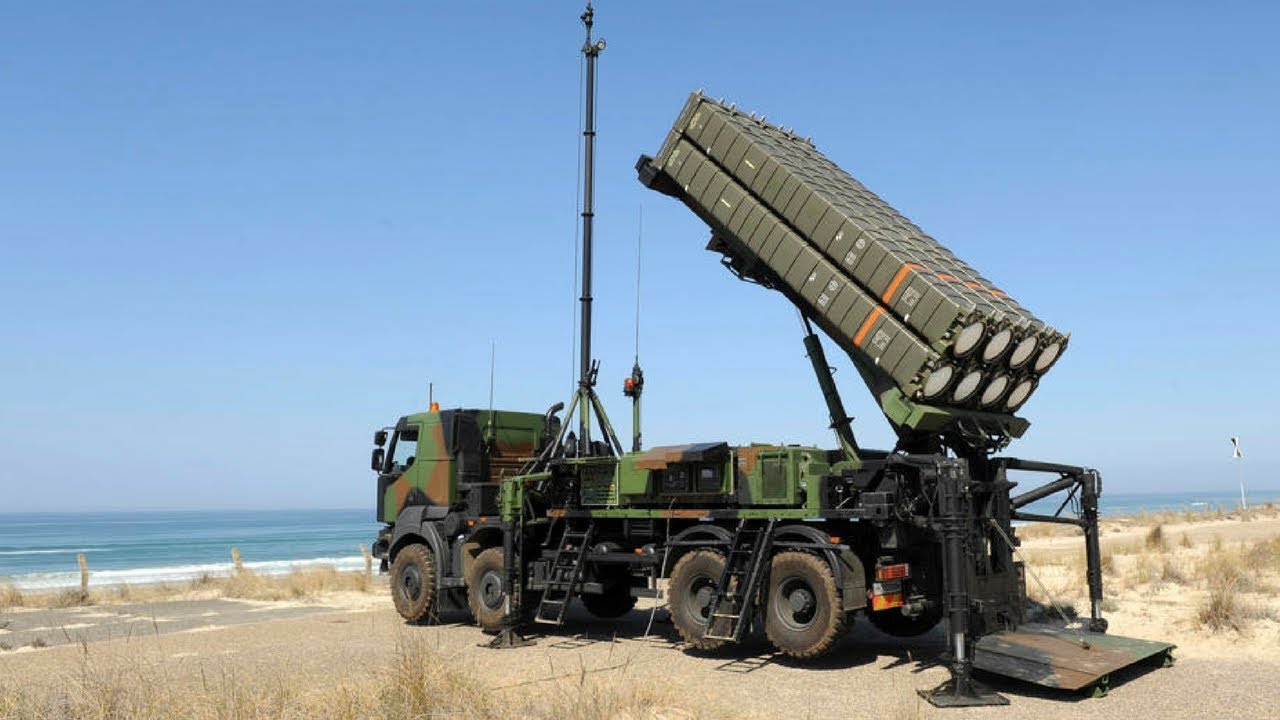
President Recep Tayyip Erdoğan has called on French President Emmanuel Macron to lift the political blockade that has been preventing the sale and co-production of the Franco-Italian Eurosam SAMP/T air defense system. During a bilateral meeting held as part of the NATO Summit, Erdoğan emphasized that Turkey—possessing NATO’s second-largest land force and ranking among the top five contributors to alliance operations—should not be excluded from European defense projects.
According to Turkish officials, a positive response from Macron would accelerate the activation of Turkey’s national multi-layered air defense network, the “Steel Dome,” within the next two to three years. Erdoğan also argued that non-EU NATO members—especially Turkey—must be granted a voice in shaping the future of Europe’s defense architecture. The SAMP/T deal has gained renewed momentum, particularly in light of growing regional threats following the Iran-Israel conflict earlier this year. In response, Turkey has ramped up production of its domestically developed medium- and long-range missile systems.
Ankara views the acquisition and co-production of the Eurosam SAMP/T as a key step to complement domestic missile defense efforts and to enhance integration with NATO’s air and missile defense infrastructure. Turkish defense officials have expressed concerns that the absence of European systems undermines NATO interoperability in Turkish airspace, asserting that France’s resistance is driven more by political rather than technical factors. While no formal response has yet been issued by France, Italy remains committed to the tripartite partnership and continues to support technical preparations for co-development.
The SAMP/T project first came under consideration in January 2018, when a memorandum of intent was signed. The agreement—signed by Eurosam, Aselsan, Roketsan, Thales, Leonardo, and MBDA—sought to co-develop a long-range air defense system tailored to Turkey’s needs. However, political tensions with France following Turkey’s 2019 Operation Peace Spring in northern Syria led to a freeze in progress. Despite renewed talks in 2022 and 2023, disagreements on Syria, Turkish operations in Africa, and Eastern Mediterranean maritime disputes have persisted. Italy, however, has continued to back the project without interruption.
Turkey’s earlier purchase of the Russian-made S-400 air defense system further complicated its relationships with NATO allies. The $2.5 billion deal led to Turkey’s removal from the U.S.-led F-35 program and triggered U.S. sanctions under CAATSA. Though Turkey has not activated the system and insists it will not integrate it into NATO infrastructure, the issue remains contentious. At the June 2025 NATO Summit, Erdoğan reportedly told U.S. President Donald Trump that the S-400 would be used only in limited and specific circumstances.
The Steel Dome project stands at the center of Turkey’s national strategy for countering aerial and missile threats. Designed as a layered defense network, it integrates a range of assets including the Korkut self-propelled anti-aircraft gun, the Sungur portable missile system, and the medium-range Hisar-A+ and Hisar-O. The long-range layer is built around the Siper missile family, which has a range exceeding 150 kilometers. Future components of the system will include directed-energy weapons such as Alka and Gökberk. Its command-and-control architecture will rely on the HERİKKS air defense management system and the RADNET radar network, incorporating artificial intelligence to support real-time decision-making.
Turkish officials have clearly stated that the S-400 system will not be part of the Steel Dome. Instead, the project will focus exclusively on NATO-compatible and domestically produced systems. The Ministry of National Defense has reiterated that the Steel Dome aligns with Turkey’s objective to reduce foreign dependency while maintaining full NATO compliance. On June 26, Rear Admiral Zeki Aktürk declared that nationwide deployment of the system is now a top priority. Turkey currently spends about 3.5% of its GDP on defense, surpassing NATO’s 2% target and progressing toward the new 5% goal proposed for 2035.
The SAMP/T system, jointly developed by France and Italy, uses the Aster 30 missile and is capable of intercepting ballistic missiles, cruise missiles, and aircraft. It has been operational in France and Italy since 2010 and is also used by Singapore and Ukraine. The next-generation SAMP/T NG incorporates AESA radars using GaN technology—France employs the Ground Fire 300 radar, while Italy uses the Kronos GM HP. The Aster 30 B1NT missile variant has a 150-kilometer range and is capable of defending against hypersonic threats.
For Turkey, the system represents more than just a technological investment; it’s a strategic opportunity for greater NATO integration and a boost to domestic defense manufacturing. Increased local participation in radar, fire control, and missile production could also open new avenues for Turkish defense exports. Turkish officials emphasize that integrating the SAMP/T system would fill the upper tier of the Steel Dome and enhance Turkey’s role as a frontline NATO actor.
Often compared to Israel’s Iron Dome, Turkey’s Steel Dome is broader in scope, offering extended range, radar fusion, and potential future hypersonic defense capabilities. Though still in its early stages, timely integration of the SAMP/T system could accelerate its operational deployment.
At a time when NATO leaders are highlighting vulnerabilities in Europe’s air and missile defense, Erdoğan presented the Steel Dome as a national contribution aligned with NATO’s strategic goals. He warned that excluding Turkey from key programs on political grounds would weaken alliance unity. Lifting the political roadblocks to the SAMP/T partnership, he argued, would benefit not only Turkey but Europe’s collective defense. The outcome of this diplomatic push may ultimately shape Turkey’s place within the future of European air defense.
