

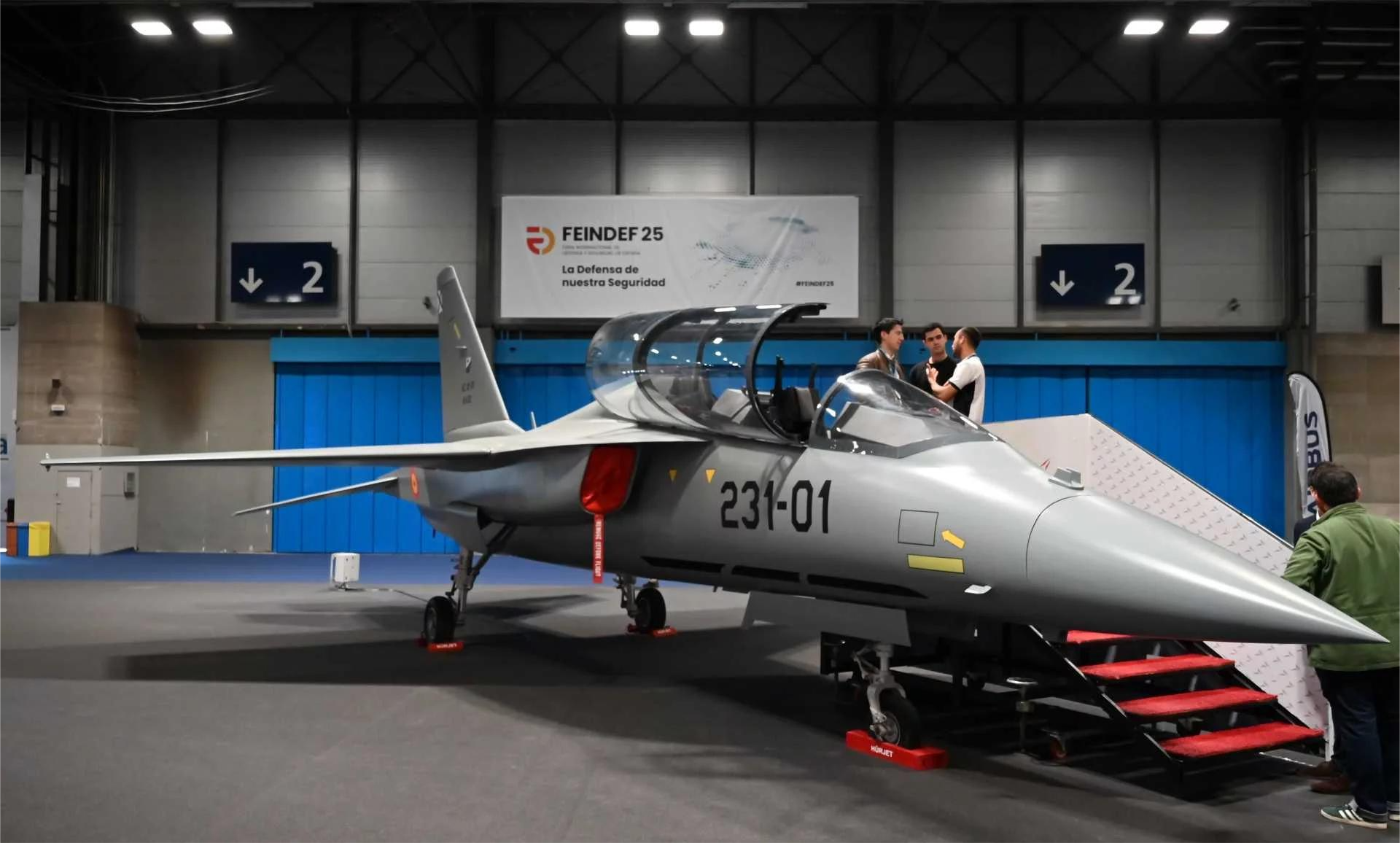
Turkish Aerospace Industries (TAI) announced the signing of a strategic cooperation agreement with Airbus for the export of HÜRJET, Turkey’s first indigenously developed supersonic advanced jet trainer and light attack aircraft, to Spain. This not only marks the first confirmed export of the HÜRJET platform to Europe but is also regarded as a significant breakthrough in Turkey’s ambitions to become a leading defense and aerospace supplier within NATO and the European Union.
The agreement for the Turkish-made HÜRJET jet trainer and light attack aircraft extends beyond procurement, paving the way for a comprehensive industrial and strategic partnership between TAI and Airbus. It includes co-production of components, potential final assembly activities in Spain, and system and configuration adaptations tailored to the operational needs of the Spanish Air Force. Sources close to the negotiations indicate that HÜRJET may replace the aging F-5 Freedom Fighter aircraft currently operated by Spain’s aerobatic team, Patrulla Águila, and also serve as a future-oriented lead-in fighter trainer for advanced aircraft such as the Eurofighter Typhoon and the upcoming FCAS sixth-generation platform.
The development of HÜRJET began in 2017 under the auspices of Turkey’s Presidency of Defense Industries (SSB), aiming to design a fully indigenous aircraft that would reduce reliance on foreign platforms like the T-38 Talon. The project advanced rapidly, with the first prototype unveiled at TAI’s Ankara facilities in 2022. HÜRJET made its maiden flight on April 25, 2023, followed by a structured flight test campaign. By mid-2025, the aircraft had accumulated over 120 flight hours, including supersonic speeds, high-G maneuvers, weapons carriage trials, and night flying operations. The Turkish Air Force declared Initial Operational Capability (IOC) in early 2025, and live-fire tests with indigenous precision-guided munitions are ongoing.
Technically, HÜRJET is designed to fulfill the roles of an advanced jet trainer and light fighter. Powered by a single General Electric F404-GE-102 turbofan engine, it can reach speeds up to Mach 1.4 and offers an excellent thrust-to-weight ratio for supersonic flight. Measuring 13.6 meters in length with a wingspan of 9.5 meters, the aircraft incorporates advanced aerodynamic surfaces and a digital fly-by-wire flight control system that enhances stability and maneuverability even at high angles of attack. The avionics suite is fully modern, featuring a digital glass cockpit, multifunction displays, HOTAS (hands-on throttle and stick) controls, and an open mission system architecture. HÜRJET integrates NATO-standard systems as well as Turkish-developed technologies such as targeting pods, electronic warfare systems, and communication equipment. It also offers embedded simulation for in-flight pilot training and real-time data link capabilities for network-centric operations.
In terms of armament, HÜRJET has seven external hardpoints and can carry over 3,000 kilograms of payload, enabling secondary combat roles such as close air support, air policing, and tactical strike. Compatible munitions include the L-UMTAS laser-guided anti-tank missile, CİRİT 70mm rockets, Roketsan’s precision-guided Teber and HGK bomb kits, and air-to-air missiles like the indigenous Bozdoğan and Gökdoğan. TAI is also developing modular mission configurations, including ISR (intelligence, surveillance, reconnaissance) variants and maritime patrol adaptations.
The deal with Airbus positions HÜRJET as a serious competitor in the global advanced jet trainer market alongside platforms like the Leonardo M-346, KAI T-50 Golden Eagle, and Boeing-Saab T-7A Red Hawk. Beyond its tactical and technical strengths, this industrial partnership with a major European aerospace company enhances the aircraft’s credibility and opens doors for future joint developments, such as Europe-specific variants or integration into broader training ecosystems.
This strategic export agreement represents a major milestone for Turkey’s defense industry, combining national technological progress with international industrial cooperation. It strengthens Ankara’s position as an aerospace exporter and deepens bilateral ties with Spain. Amid increasing efforts by European countries to diversify defense suppliers and reduce reliance on U.S.-centric platforms, the success of this agreement could pave the way for future Turkish-European aerospace collaborations and accelerate the global presence of Turkey’s next-generation military aircraft.
