

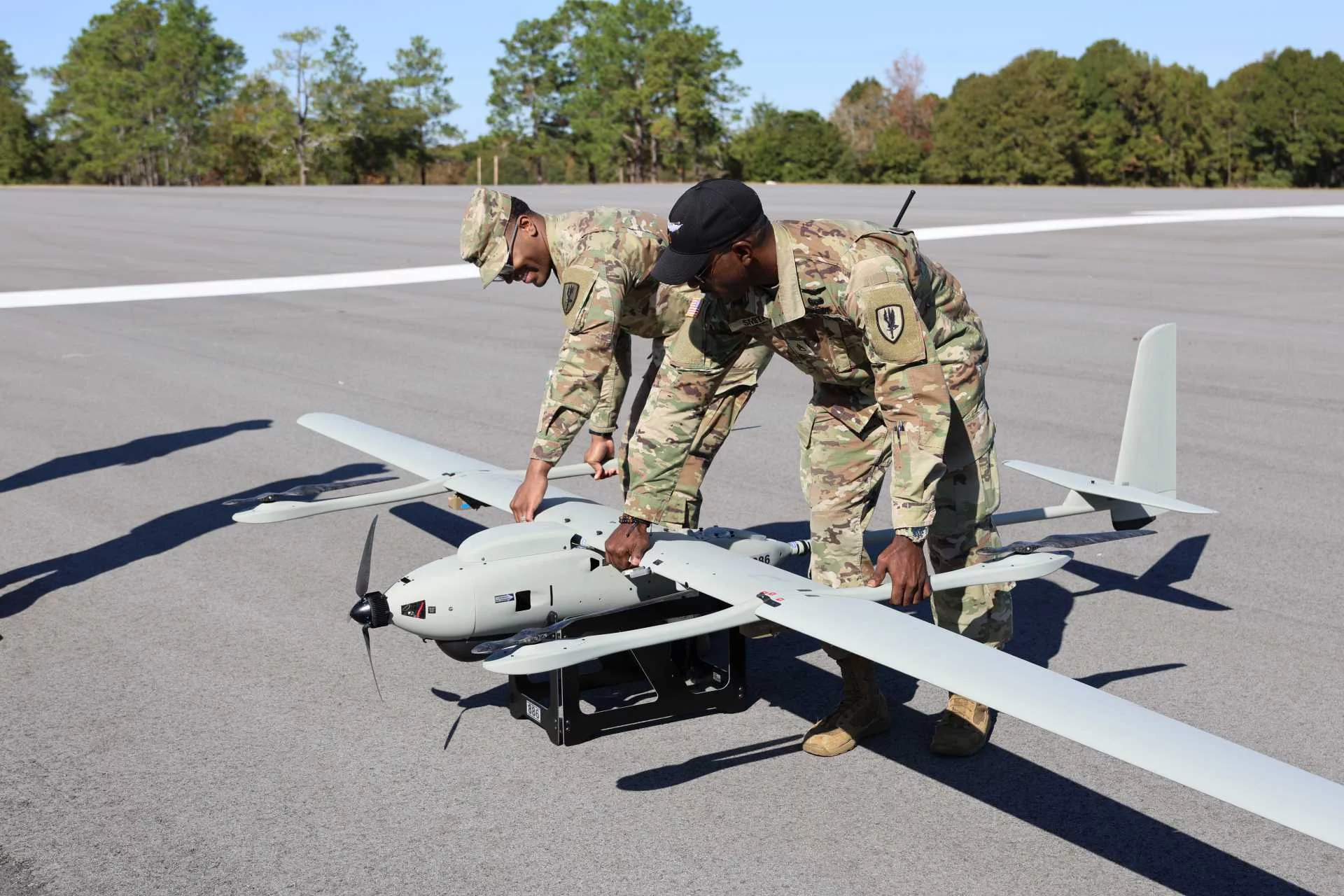
The U.S. Army has officially begun training aviation soldiers on the VXE30 Stalker Unmanned Aircraft System, marking a significant leap forward in the Army’s unmanned reconnaissance and precision-effects strategy. Training commenced November 18 at Fort Rucker, ahead of formal fielding scheduled for next month.
Hands-On Training Launches at Fort Rucker
According to a November 24 announcement from the U.S. Department of War, early training includes:
- Flight rehearsals
- Maintenance instruction
- Mission planning exercises
These steps will prepare aviation units to integrate the Stalker into a wider layered reconnaissance and strike architecture designed for future combat aviation brigades.
VTOL Capability Enables Operations Without Runways
The Stalker’s vertical takeoff and landing (VTOL) design allows it to launch from confined spaces without any runway requirements. This is especially valuable for dispersed teams and units operating in difficult terrain such as forests, mountains, or urban environments.
Fort Rucker and Fort Huachuca are the first U.S. Army installations to introduce the system before broader servicewide adoption.
Enhanced Endurance, Lower Acoustic Signature, Greater Payload Options
Army officials emphasize that the VXE30 provides major improvements compared to earlier systems:
- Significantly longer endurance
- A reduced acoustic footprint for stealthier operations
- A modular payload bay adaptable for ISR, navigation tools, or mission-specific equipment
Weighing just 49 pounds (22 kg), the Stalker can be transported in standard military vehicles and assembled by two soldiers in roughly 10 minutes.
Dual-Power System: 8+ Hours of Flight Time, 160 km Range
The VXE30 can operate using:
- A propane fuel cell—allowing 8+ hours of flight, or
- A rechargeable battery for low-acoustic missions.
Communication range extends up to 100 miles (160 km), enabling deep reconnaissance and over-the-horizon targeting support.
Modular Open Systems Architecture for Rapid Upgrades
The drone is built around a modular open systems architecture that supports:
- EO/IR sensor upgrades
- Alternative navigation methods
- Mission-specific payloads
- Integration with the Army’s Common Lethality Integration Kit, enabling user-selectable munitions such as 81 mm mortar–based effects.
Changing the Structure of Army Aviation
The introduction of the VXE30 aligns with the Army’s transition from centralized UAS detachments to integrated unmanned capabilities inside aviation brigades. Stalkers will work alongside manned helicopters to provide:
- Real-time targeting
- Route reconnaissance
- Battle damage assessment
- Persistent intelligence collection
This adaptation is critical as the Army pushes forward with its Future Vertical Lift ecosystem.
Training Continues Through December
Training at Fort Rucker will run into December, with courses focusing on:
- Vertical takeoff and landing procedures
- ISR payload employment
- Mission planning
- Integration with battalion and brigade operations
Full operator proficiency is expected before the system expands across Army aviation units in 2026.
Strategic Impact
Fielding the VXE30 Stalker strengthens the U.S. Army’s ability to conduct long-endurance ISR, deliver precision effects, and maintain operational tempo in contested environments—all while requiring minimal logistics and manpower.
