

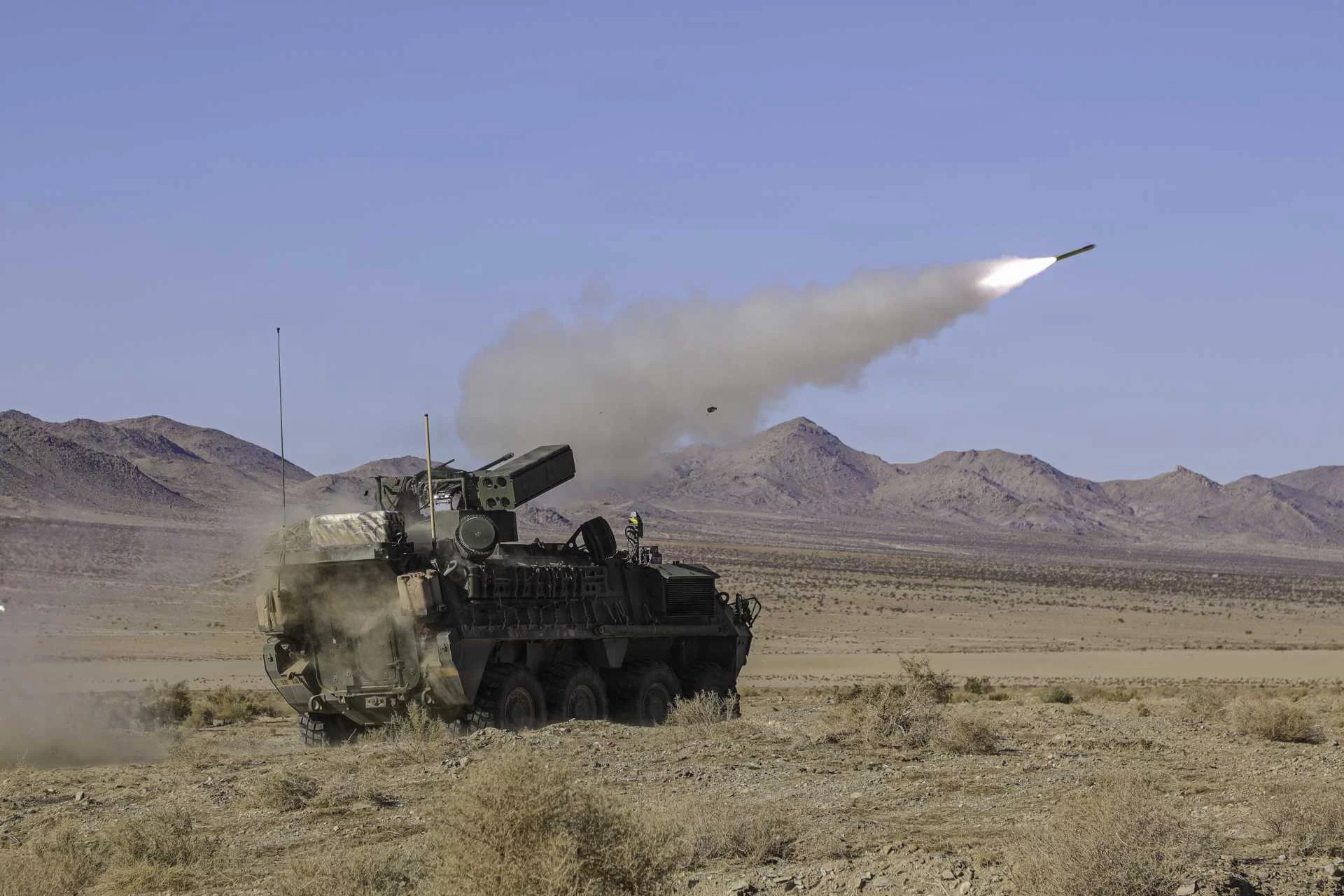
The U.S. Army has confirmed the first live Stinger missile launch from a Stryker M-SHORAD air defense vehicle, carried out during National Training Center Rotation 26-01 at Fort Irwin in October 2025. The milestone, announced on November 28, validates the system’s ability to detect, track and engage aerial targets under realistic tactical conditions.
A crew from Able Battery, 4th Battalion, 60th Air Defense Artillery Regiment detected an Outlaw drone executing a figure-eight flight path, used its onboard EO/IR sensors to classify the target, and fired an FM-92 Stinger that successfully struck the moving aircraft. The mission proved that the Stryker M-SHORAD can rapidly transition from search to engagement while maneuvering alongside mechanized brigade elements.
Throughout the rotation, “Vanguard” Battalion supported the 1st Armored Brigade Combat Team and attached reconnaissance units by engaging simulated helicopters and small unmanned systems with consistent accuracy. Commanders highlighted the return of mobile short-range air defense as a necessary asset in modern brigade-level operations.
The Stryker M-SHORAD—officially designated Sergeant Stout—combines the Stryker A1 chassis with a mission package developed by Leonardo DRS and General Dynamics Land Systems. The turret includes an XM914 30 mm cannon, an M240 7.62 mm machine gun, advanced radar, EO/IR sensors and four Stinger missiles. An earlier two-Hellfire configuration was removed due to vibration issues, and the vehicle now carries two Stinger pods for a total of eight ready-to-fire missiles. Stinger will eventually be replaced by the Next Generation Short Range Interceptor (NGSRI) featuring extended range and multi-mode seekers.
Looking ahead, the Army is developing multiple future variants:
- Increment 2 (DE M-SHORAD): a 50-kW laser system tested in 2024
- Increment 3: integration of NGSRI and the XM1223 proximity airburst round
- Increment 4: a lighter, air-deployable capability adaptable to JLTVs and robotic vehicles
Four additional National Guard M-SHORAD battalions are planned for activation between 2026 and 2030.
The Stinger missile used in the test is a combat-proven, man-portable IR-guided interceptor with an effective range of up to 8 km, a top speed of Mach 2.2, and a 3-kg fragmentation warhead. Later variants incorporate IR/UV dual detectors, improved software and advanced countermeasure resistance. As current inventories age—exacerbated by transfers to combat zones like Ukraine—the U.S. is pursuing a comprehensive modernization and the upcoming NGSRI program aimed at producing up to 8,000 next-generation interceptors.
This first operational firing from a Stryker M-SHORAD marks a major step forward in rebuilding mobile short-range air defense capabilities across the U.S. Army.
