

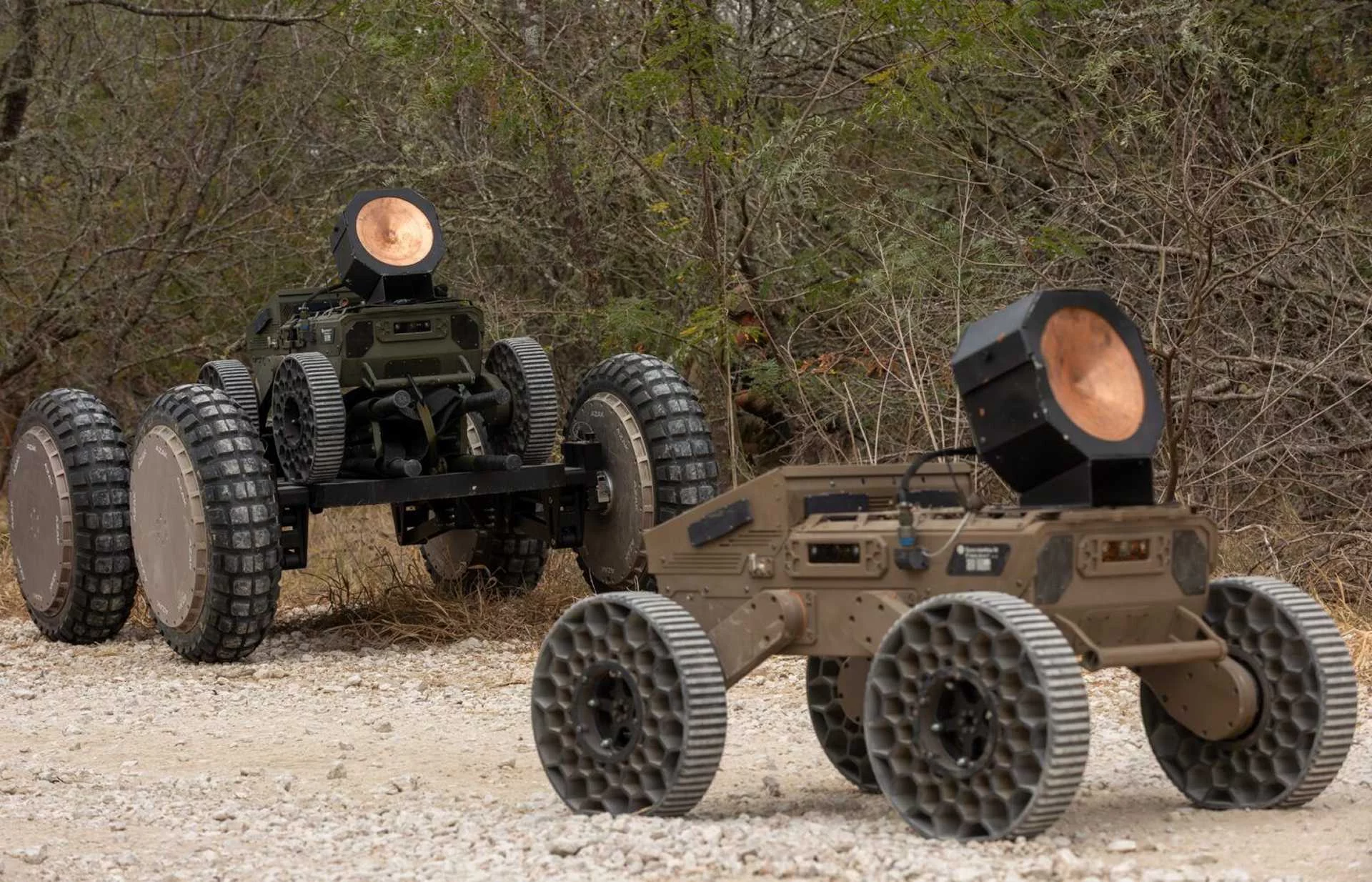
The U.S. Army has conducted a multi-day field evaluation of the FireAnt robotic anti-tank system, assessing its ability to locate, track, and disrupt armored vehicles in contested environments. The trials took place from October 27–29, 2025, at the Innovation Proving Ground in Bryan, Texas, as part of the xTechOverwatch event for unmanned systems.
Developed by Swarmbotics AI, FireAnt is a compact unmanned ground vehicle (UGV) engineered for autonomous anti-armor missions, capable of operating independently or in coordinated swarms to engage armored threats using low-cost precision munitions.
Compact, Low-Signature, and Built for High-Risk Frontline Missions
Weighing under 90 kg and measuring just over one meter in length, FireAnt can be carried by a two-soldier team or deployed via helicopter or UAV.
Key mobility features include:
- Hybrid-electric drive
- Minimal thermal signature
- Low-profile tracked chassis optimized for dense, rugged terrain
Its modular payload bay supports a range of anti-armor weapons, including:
- Loitering munitions
- Explosively formed penetrator (EFP) charges
- A lightweight recoilless launcher comparable to the U.S. M72 LAW
During the Army trials, FireAnt demonstrated autonomous movement, target acquisition through onboard sensors, and synchronized mock engagements against simulated armored vehicles.
AI-Driven Sensing and Targeting
Each FireAnt is equipped with a multispectral sensor suite—infrared, electro-optical, and laser rangefinding—connected to an onboard neural processing unit. These systems enable:
- Real-time target classification
- Threat prioritization
- Operation in GPS-degraded environments via inertial navigation
This allows the UGV to function effectively even in complex, cluttered battlefields.
Swarm Capability: One Operator Controls up to Eight Robots
Perhaps the platform’s defining feature is its swarm-enabled behavior.
A single operator can manage six to eight FireAnt units through a secure touchscreen interface. The robots communicate via a decentralized mesh network, maintaining:
- Coordinated spacing
- Shared targeting
- Adaptive formation changes based on enemy maneuver
This allows FireAnt swarms to probe defenses, draw fire, and funnel armored units into ambush zones.
Beyond Tank Destruction: A Mobile Targeting and Disruption Platform
Swarmbotics AI is implementing a sensor-to-shooter framework that will allow FireAnt robots to relay targeting data to overhead loitering munitions and indirect fire systems. Future variants will support multi-domain operations under the U.S. Army’s Project Convergence initiative.
With an anticipated unit cost below $50,000, FireAnt represents a scalable and attritable solution for high-intensity conflicts where massed autonomous systems can overwhelm traditional armored forces.
Aligned With the Pentagon’s Replicator Initiative
The Pentagon’s Replicator program emphasizes mass-produced, intelligent autonomous systems to saturate the battlefield. FireAnt fits this concept precisely—an expendable yet lethal ground robot capable of denying armored adversaries freedom of movement without relying on tank-on-tank engagements.
Swarmbotics AI confirmed that additional testing, including live-fire evaluations, will resume in early 2026. Although still in prototype form, FireAnt is emerging as one of the most closely watched unmanned combat platforms and may serve as a foundation for next-generation robotic ground vehicles.
