

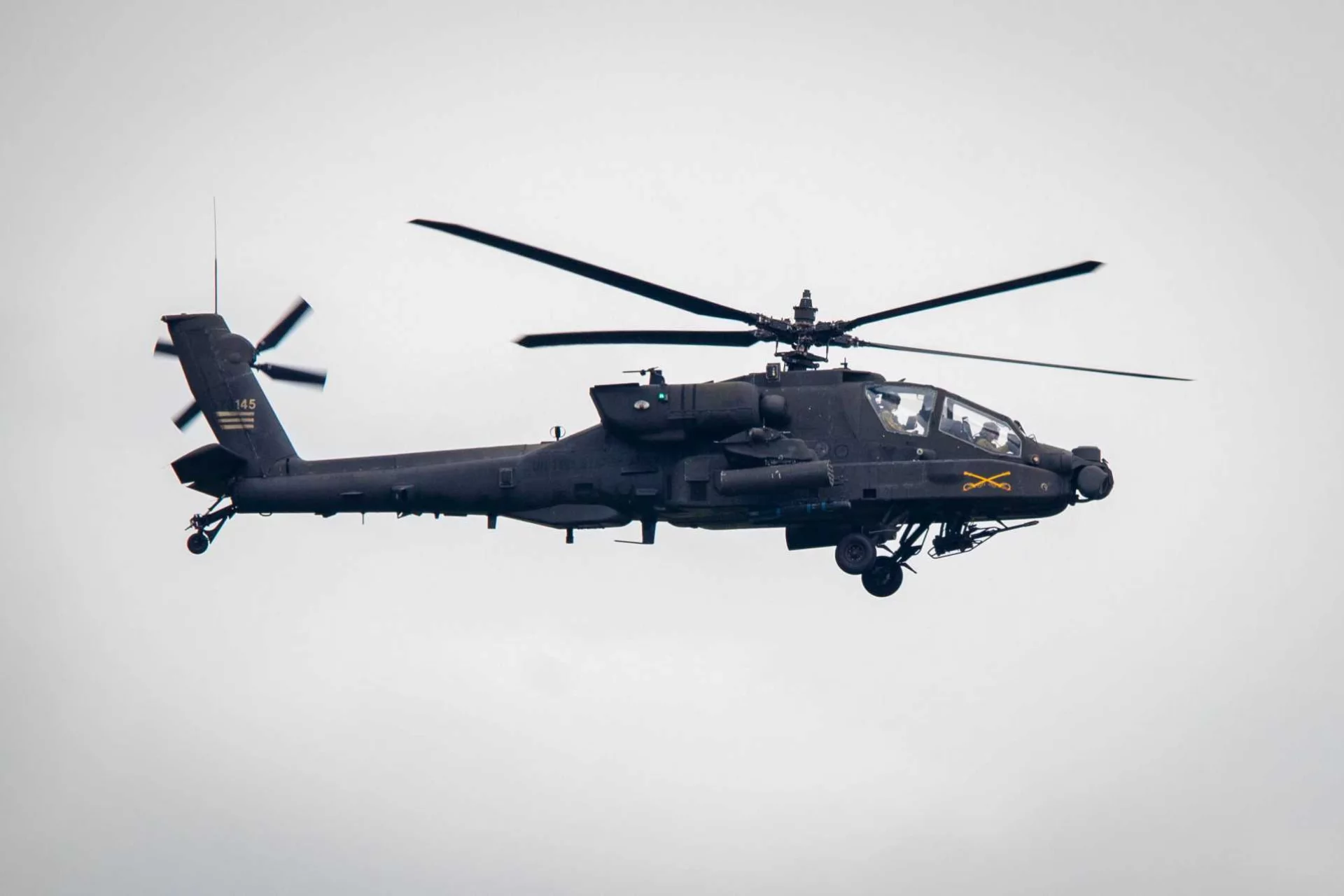
On August 29, 2025, the U.S. Department of Defense highlighted the AH-64E Apache helicopter’s evolving role in modern warfare, demonstrating its ability to detect, track, and neutralize hostile unmanned aerial systems (UAS) in a live exercise in South Carolina. The trial involved the Program Manager Apache, Tactical Aviation and Ground Munitions teams, and the South Carolina Army National Guard, focusing on the Apache’s emerging role as a versatile counter-drone asset.
During the demonstration, crews employed a variety of munitions, including Joint Air-to-Ground Missiles (JAGM), multiple HELLFIRE variants, Hydra-70 rockets with APKWS guidance kits, and 30mm cannon fire. The helicopters successfully intercepted and disabled drones and other targets, proving the platform’s multi-layered capability and adaptability for both long-range and close-in engagements.
The Apache’s combat effectiveness relies on the combination of advanced sensors and diverse armament. Its AN/APG-78 Longbow radar provides 360-degree target detection and classification, even under poor visibility, while the M-TADS/PNVS targeting system ensures high-resolution day-and-night imagery and laser designation. Linked with secure datalinks like Link 16, Apache crews can share targeting data with other aircraft and ground-based air defenses in real time.
Weapons options offer layered counter-UAS effects: AGM-114 Hellfire for larger aerial targets, JAGM for extended range precision, APKWS-guided Hydra-70 rockets for mid-range drones, and the M230 30mm cannon with proximity-fused rounds for close-in threats. This combination forms a comprehensive airborne counter-drone system.
Originally developed for anti-armor operations and close air support, the AH-64E has been adapted to meet the growing threat of swarming drones on modern battlefields. Lessons from conflicts in Ukraine, Nagorno-Karabakh, Syria, and Iraq demonstrate that small, low-cost drones can overwhelm static defenses, creating a need for mobile, flexible platforms like Apache that can move with ground forces and engage aerial threats before they strike.
Compared to fixed air defense systems like Patriot or NASAMS, AH-64E helicopters provide mobility, persistence, and cost-effective engagement, filling gaps against low-flying drones in complex environments. Unlike fast jet fighters optimized for air superiority, Apache helicopters can remain on station longer, coordinate with ground units, and maintain continuous situational awareness.
U.S. Army leadership emphasized that the trial confirmed Apache’s adaptability against evolving threats while maintaining its traditional attack capabilities. The exercise reaffirms the AH-64E as not just a tank killer, but a flexible, economical, and highly effective counter-UAS platform, enhancing battlefield protection and operational dominance in drone-dense environments.
