

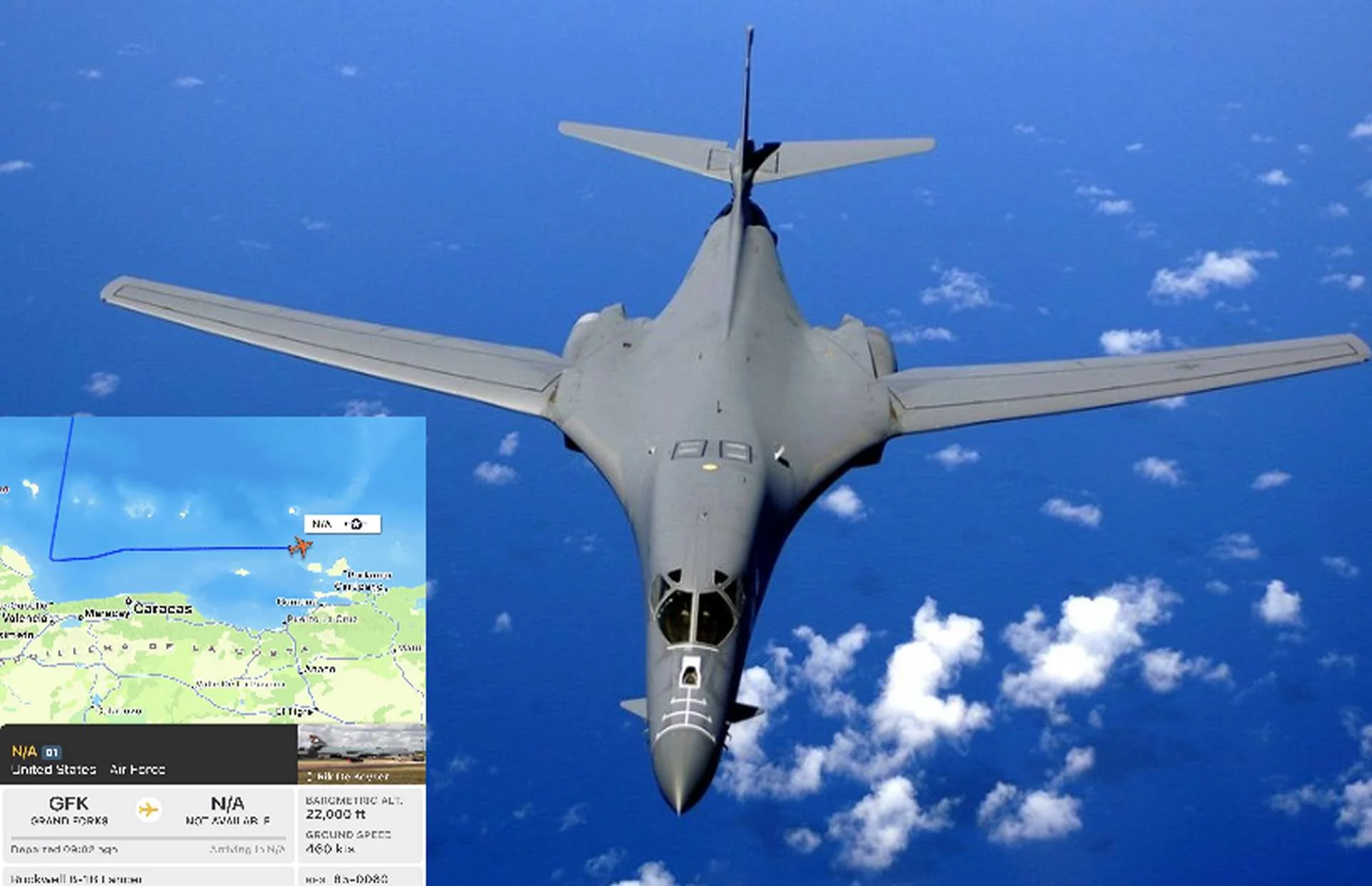
On 24 October 2025, two U.S. Air Force B-1B Lancer bombers departed Dyess Air Force Base in Texas and conducted tanker-supported training arcs over the Caribbean. Pentagon releases and flight-tracking data show the aircraft operated in international airspace off Venezuela’s coast. While U.S. officials describe the missions as routine training and counter-narcotics activity, analysts view the flights as a deliberate demonstration of Washington’s ability to threaten Venezuelan military and maritime targets from standoff distances.
The flights are part of a broader uptick in U.S. military activity in the region since August, which has included additional frigates, combat aircraft, amphibious assets and deployable carrier strike group elements. Within this heightened posture, the B-1s flew tanker-enabled tracks north of the Dominican Republic and across the southern Caribbean, preserving options to strike from outside heavily defended airspace.
Redesigned for conventional missions after the Cold War, the B-1B is the USAF’s highest-payload conventional bomber. It can carry roughly 34,000 kilograms of internal ordnance across three bays, reach dash speeds near Mach 1.2, and operates with a four-person crew. The platform can employ long-range cruise missiles from the AGM-158 family (including JASSM-ER) and anti-ship variants such as LRASM, providing the capability for precision strikes against coastal radars, air-defense nodes, naval units, or high-value command-and-control targets without penetrating robust air defenses.
Although much of the theater focus is on disrupting narcotics trafficking—where B-1s can disable maritime transfer points, small ports, airstrips or vessels—their operational success depends on local support: human intelligence, coast guard and naval patrols, shore radars and boarding teams provide persistent surveillance, legal authority for seizures, and post-strike evidence for prosecutions. Regional basing, tanker tracks and diplomatic clearances increase sortie rates and responsiveness.
Repeated bomber sorties paired with public rhetoric from senior U.S. officials compress Venezuela’s decision timeline by placing credible strike options within hours of Caracas. That posture aims to raise the cost of allegedly illicit or repressive actions while keeping U.S. activity below the threshold of invasion—missions remained in international airspace and were framed as Bomber Task Force training.
Still, proximity to a capital with active air defenses and foreign advisors raises escalation risks. Intercepts, tense communications or inadvertent weapons employment could turn coercion into combat. The presence of foreign contractors and materiel, notably from Russia, further complicates targeting and raises the prospect of third-party countermeasures.
Planners therefore face difficult trade-offs. Limited, proportional kinetic options exist, but they carry legal, operational and political consequences that require coalition messaging and crisis-management channels. Non-kinetic measures—tighter sanctions, intensified intelligence sharing with regional partners, lawful maritime boardings and precision interdiction of narcotics shipments—can sustain pressure while minimizing immediate blowback. The current B-1B missions serve both as operational preparation and political signaling: they put substantial standoff strike options on the table, compress Venezuelan decision space, and pressure adversaries to reveal posture or intentions.
