

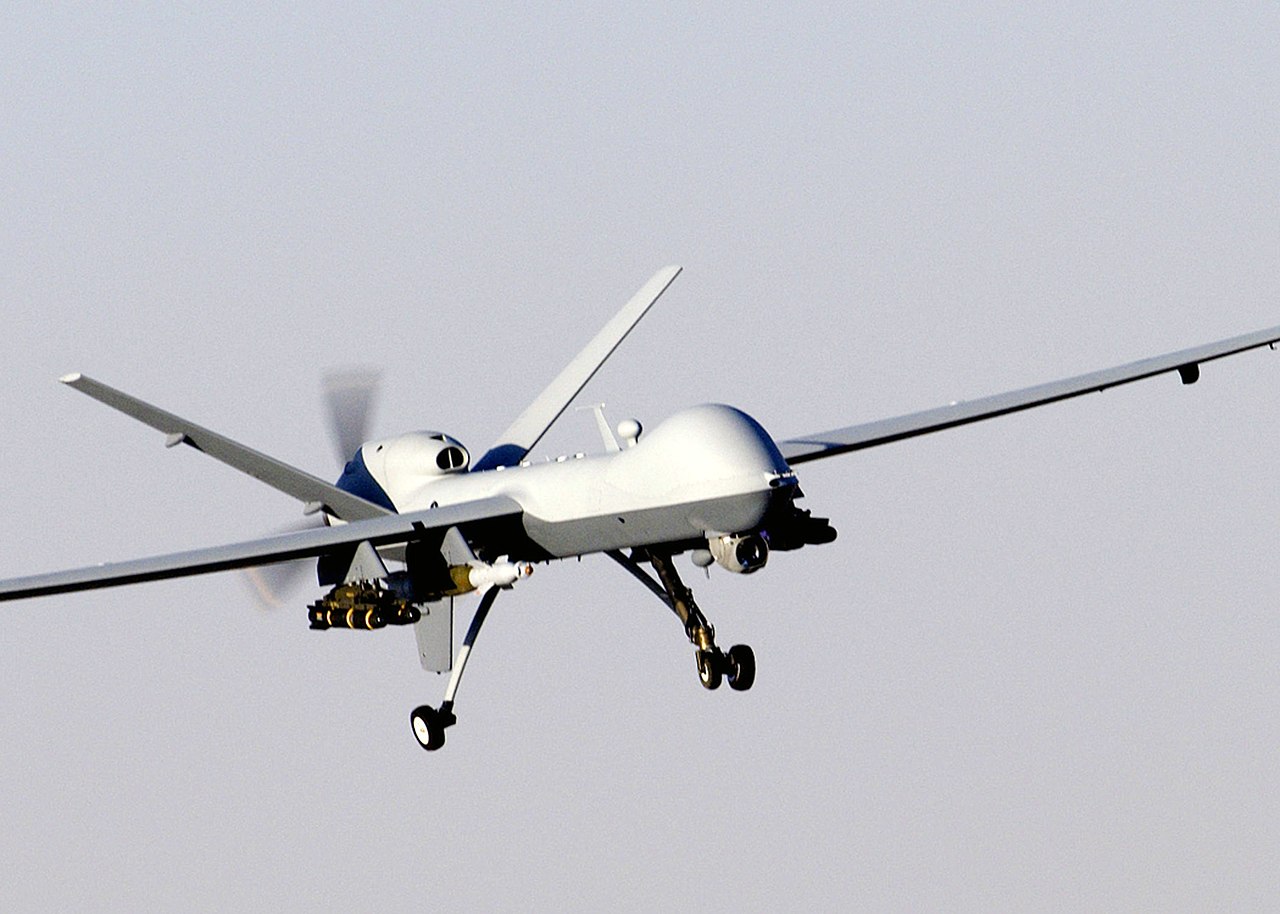
The U.S. military has achieved a major milestone in unmanned combat systems. Between July 22 and 24, 2025, at Yuma Proving Ground, the Switchblade 600 (SB600) loitering munition was successfully air-launched for the first time from a General Atomics MQ-9A Block 5 unmanned aerial vehicle. This test marks the evolution of the MQ-9A from a traditional remotely piloted strike platform into a networked, long-range precision strike “mothership.”
During the test, two SB600 munitions—one inert training round and one live high-explosive anti-armor round—were released from the Reaper. After launch, control of the munitions was handed over to a tactical operator positioned closer to the target area, enabling them to transition into loitering flight profiles. This operational model combines long-endurance surveillance with real-time target acquisition, creating a more flexible strike chain.
The MQ-9A Reaper is a medium-altitude, long-endurance UAV designed for both reconnaissance and strike missions. With a 20-meter wingspan, a service ceiling of 15,240 meters, and an endurance exceeding 43 hours, it can conduct persistent surveillance and execute multi-target engagements over vast distances. The Block 5 configuration is the most advanced Reaper variant in U.S. service, featuring upgraded power systems, high-bandwidth datalinks, and modular weapons integration.
Integrating the Switchblade 600 gives the MQ-9A the ability to carry out precision strikes without entering enemy air defense zones. Produced by AeroVironment, the SB600 weighs approximately 23 kg, carries a high-explosive anti-armor warhead, and is equipped with dual electro-optical/infrared sensors, encrypted data links, and 40 minutes of loiter time. This enables it to conduct real-time surveillance and precision strikes against armored targets and fortified positions.
This new capability transforms the MQ-9A from a pure ISR (intelligence, surveillance, reconnaissance) platform into a versatile, precision-strike system capable of engaging targets in high-risk areas. The ability to retarget the SB600 in mid-flight provides a significant advantage in defeating mobile or time-sensitive threats.
Operationally, this integration allows the U.S. and its allies to neutralize targets faster and with lower risk under a distributed command model. Handing off munition control to ground elements further enhances joint and coalition strike coordination.
Strategically, this development supports the U.S. Department of Defense’s Joint All-Domain Command and Control (JADC2) doctrine. Air-launched loitering munitions speed up decision-making cycles and improve survivability for high-value assets in anti-access/area-denial (A2/AD) environments.
General Atomics’ open-architecture design allows the MQ-9A to integrate loitering munitions alongside electronic warfare pods, radar warning receivers, and advanced communications systems. Future tests are expected to involve multiple simultaneous launches, extended-range operations, and multi-platform control scenarios.
This breakthrough significantly expands the MQ-9A’s mission profile, enhancing its long-range precision strike capability and accelerating the U.S. military’s transition toward modular, cost-effective, and risk-tolerant warfare concepts.
