

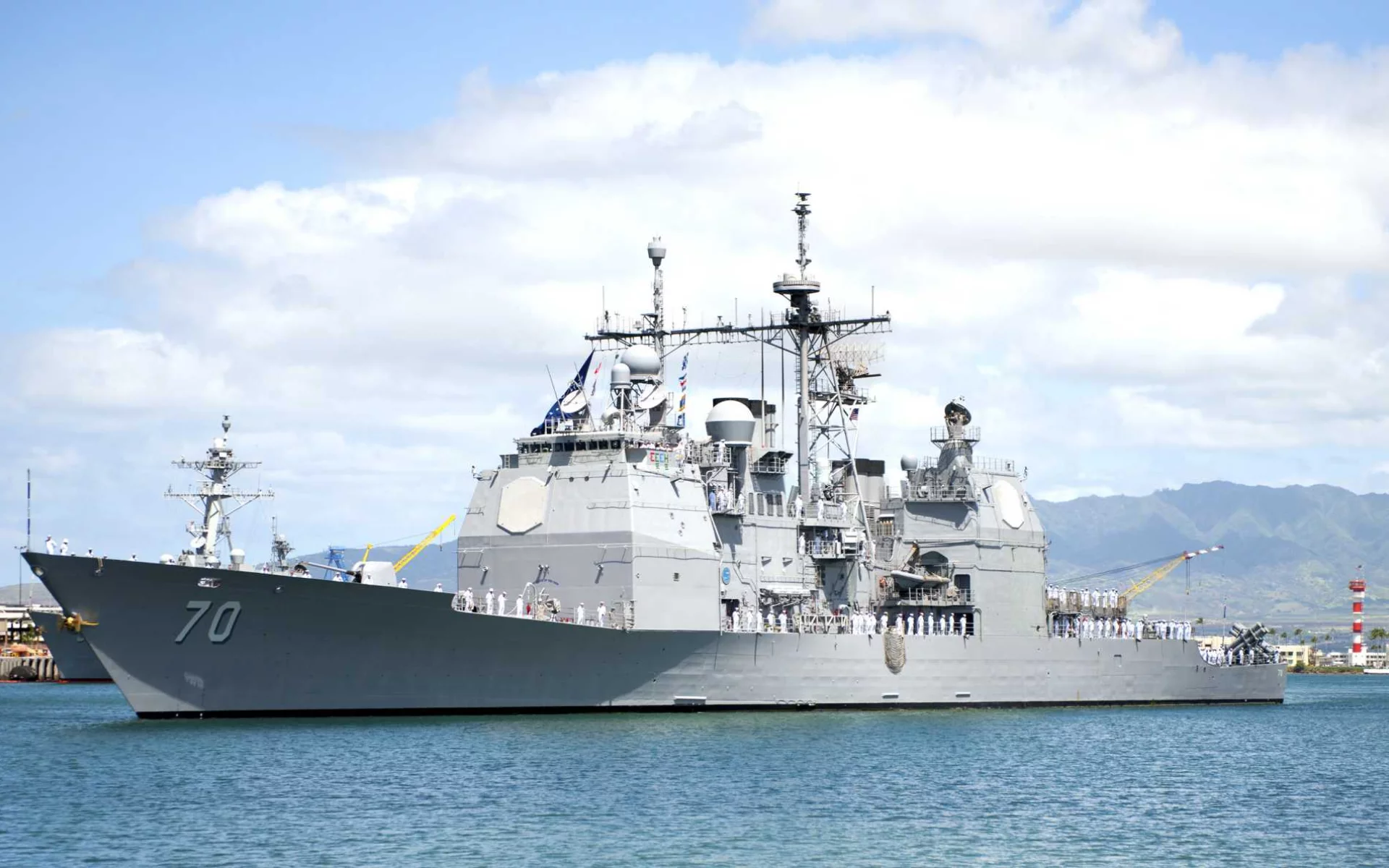
The United States has launched its most extensive maritime operation in Latin America in more than two decades, deploying a full carrier strike group near Venezuelan waters. According to Army Recognition on August 30, 2025, the formation is led by the Ticonderoga-class cruiser USS Normandy and reinforced with Arleigh Burke-class destroyers, a nuclear-powered attack submarine, amphibious assault ships carrying over 4,000 Marines, and advanced surveillance and electronic warfare platforms.
While officially framed as a counter-narcotics mission, the scale and composition of the deployment point to broader strategic aims. Washington accuses the Maduro government of fostering transnational criminal groups, harboring Colombian rebel factions, and strengthening ties with Iran, Russia, and China through covert arms transfers and cyber operations.
Recent weeks have seen a rise in hostile activities against U.S. aircraft, including GPS jamming, radar lock-ons, and electronic interference. In response, the U.S. has established a forward-operating presence in the southern Caribbean to control maritime corridors, enforce embargoes, and, if necessary, conduct precision strikes or rapid-response missions.
The inclusion of amphibious units and strike-capable destroyers highlights Southern Command’s readiness for scenarios ranging from humanitarian operations to limited military engagements. The Trump administration has elevated the mission’s importance by directly linking Maduro’s government to narcoterrorism and the fentanyl crisis, framing it as essential to U.S. and hemispheric security.
Venezuela has placed its armed forces on high alert. Its 123,000 active troops, backed by nearly 220,000 reserves and regime-loyal militias, are supported with T-72B1 tanks, BM-21 Grad rocket launchers, and Chinese VN-1 armored vehicles. The Air Force fields around two dozen Su-30MK2 fighters, K-8W attack trainers, Mi-17 utility helicopters, and Mi-35 gunships, protected by an S-300VM missile defense system and radar coverage from Russia, Iran, and China.
The Venezuelan Navy, though limited in blue-water capability, can still disrupt coastal zones with two Type 209 submarines, patrol vessels, missile boats, and riverine craft. Elevated activity has been observed at bases in Puerto Cabello, La Guaira, and Punto Fijo, while over four million regime-aligned civilian militia are being mobilized to secure coastal areas, oil sites, and industrial facilities.
State media in Caracas portrays the U.S. deployment as an “imperialist provocation” while lobbying for diplomatic backing from BRICS and OPEC members. Analysts warn that even a single misstep, such as a drone interception or radar-guided engagement, could rapidly escalate into a broader regional conflict.
