

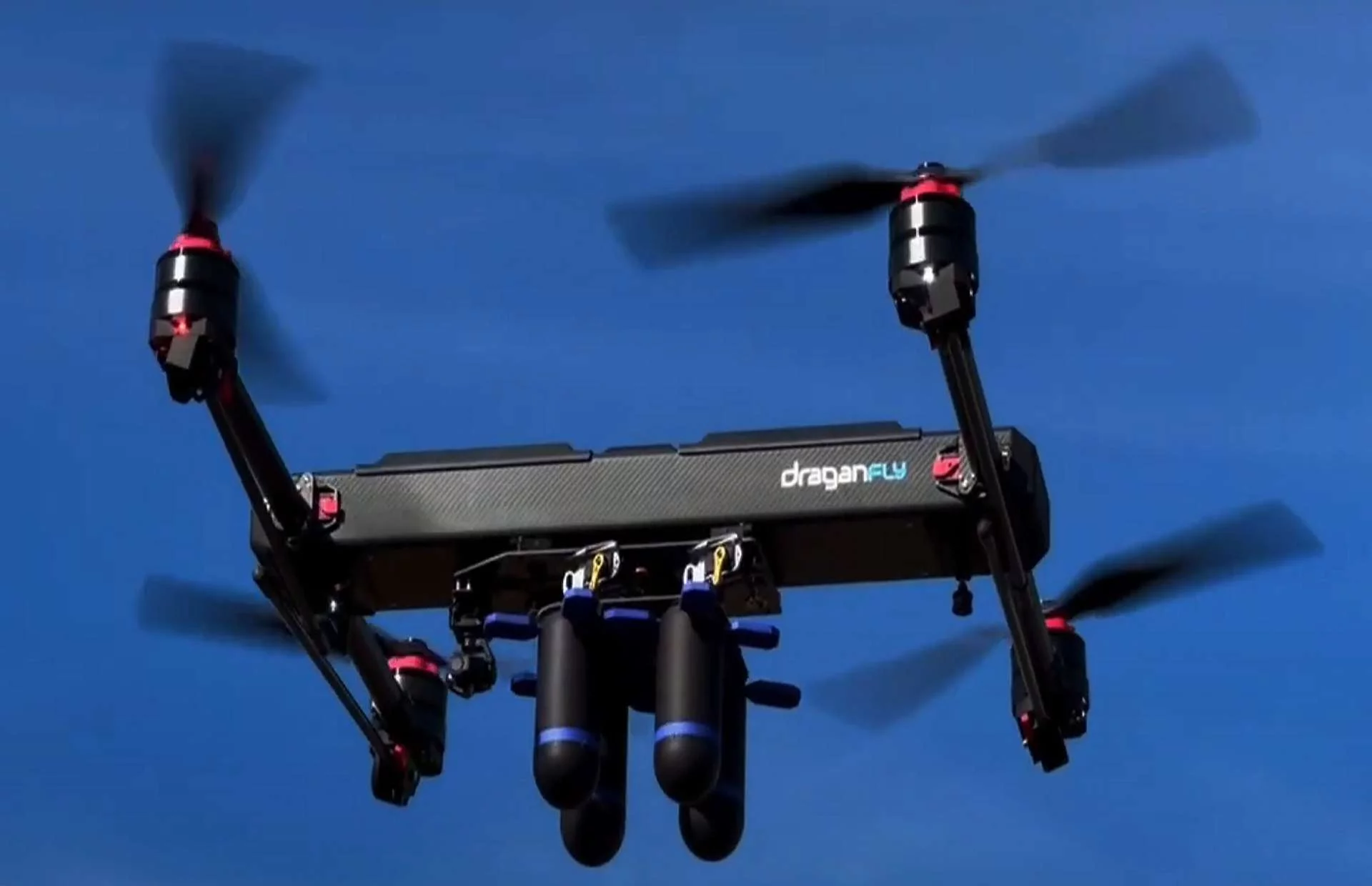
On August 5, 2025, Draganfly Inc. announced the successful demonstration of its Integrated Tactical Strike System during a closed event at the Pentagon, held under the U.S. Department of Defense’s Low-Cost Uncrewed Combat Attack Systems (LUCAS) initiative. The system integrates Draganfly’s Group I UAV with MMS Products Inc.’s combat-tested Mjolnir Modular Munition System, offering a scalable and autonomous strike capability for modern battlefields. Senior U.S. defense officials and international military delegations attended the event, which showcased next-generation technology aimed at boosting lethality, flexibility, and survivability in contested environments.
The demonstration featured the UAV’s surveillance-to-strike autonomy and a multi-drop payload launcher for high-precision munition delivery. During simulated engagements, the drone deployed Mjolnir munitions against multiple battlefield targets, validating the accuracy and versatility of the system. Configurations demonstrated included anti-personnel, anti-vehicle, and armor-piercing effects, delivering rapid, low-signature strikes in varied mission profiles. This capability stems from a 2024 development agreement between Draganfly and MMS to co-produce tactical UAV strike solutions aligned with emerging joint force requirements.
The Mjolnir system itself is a lightweight, fully modular drone-compatible munition weighing about 2.3–2.5 kg, featuring an internal stabilizer, programmable fuze, and swappable warheads. Current variants include high-fragmentation, explosively formed penetrator (EFP), and shaped-charge types for engaging a range of targets from personnel to light and medium armor. Designed for either impact or delayed detonation, the munition is optimized for both urban and subterranean warfare. Draganfly’s launcher can carry four munitions for sequential or simultaneous release, offering flexible targeting in dynamic scenarios.
Operationally, the Draganfly-Mjolnir integration marks a significant leap for Group I UAVs, traditionally limited to reconnaissance roles. Its compact, low-signature design supports precision strikes in denied environments, enabling missions such as high-value target suppression, logistics disruption, and overwatch for special operations. The system’s modularity ensures rapid reconfiguration to match evolving threats, while its affordability supports attritable deployment in swarm operations or distributed force postures.
CEO Cameron Chell stated that the Pentagon demonstration validates Draganfly’s strategy in tactical drone innovation, combining modular lethality with adaptability to meet modern conflict demands. As U.S. and allied militaries increasingly prioritize low-cost, precision-capable drones under the LUCAS initiative, systems like this are poised to redefine small UAV combat roles, delivering distributed, survivable, and responsive strike capabilities for future battlefields.
