

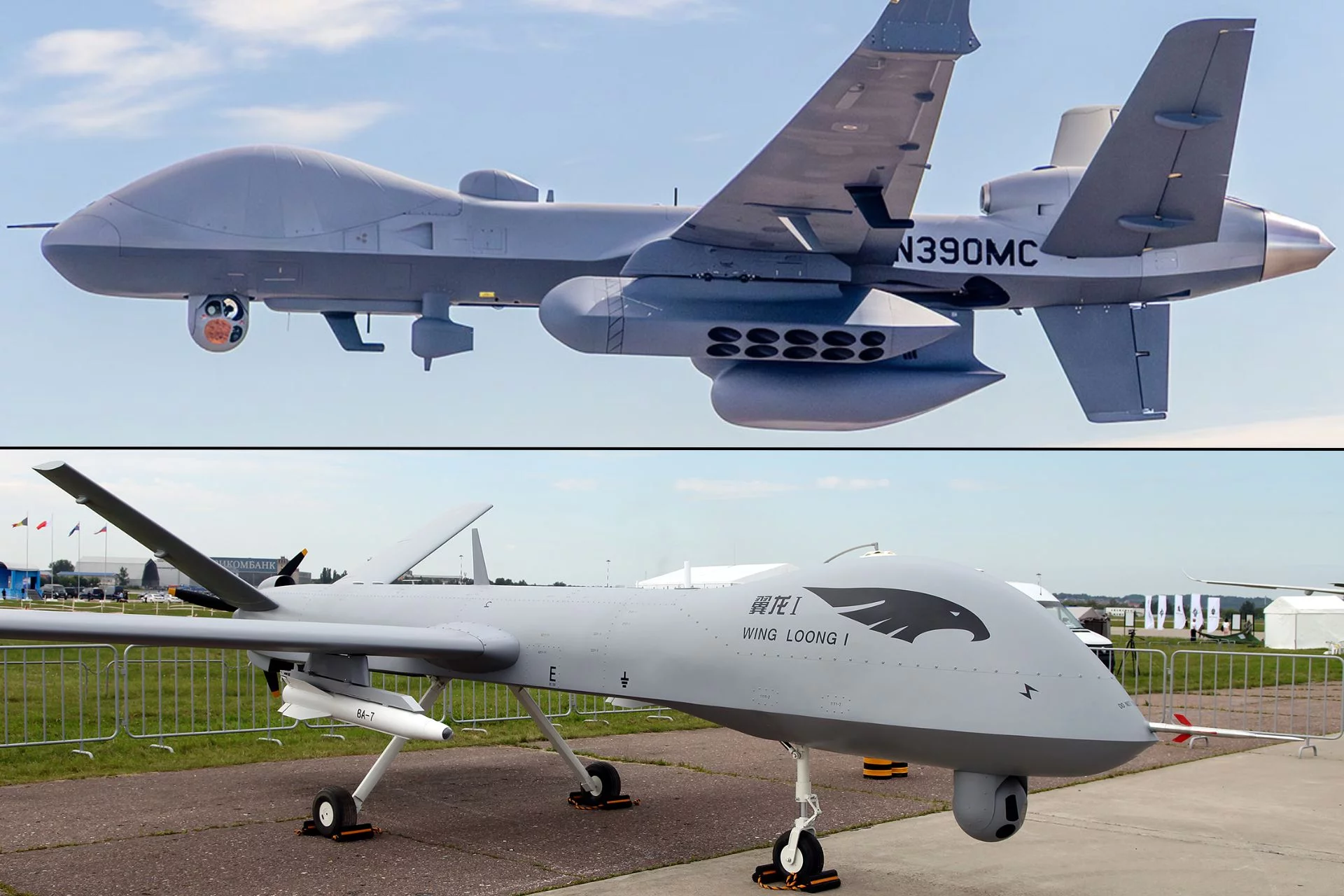
Since 2017, Washington has sought to relax the Missile Technology Control Regime (MTCR) rules limiting armed drone exports. In September 2025, the State Department confirmed that long-range UAV sales will now be reviewed under the same framework as fighter jets — a move aimed at strengthening U.S. industry and offsetting China’s growing presence in the armed drone market.
American Platforms and Policy Shift
General Atomics’ MQ-9 Reaper has become the symbol of this policy. With 27 hours of endurance, a 15,000-meter ceiling, and a payload capacity of over 1,700 kilograms — from Hellfires to JDAMs — the Reaper remains the backbone of U.S. drone exports. It is already operational with France, Italy, the U.K., Belgium, and Germany, while Japan uses it for maritime surveillance. India and Australia are negotiating potential purchases, signaling closer alignment with Washington’s Indo-Pacific strategy. U.S. sales remain conditional, with strict end-use monitoring and limits on re-export and weapon configurations.
China’s Aggressive Market Push
Outside the MTCR framework, China has seized market share with its Wing Loong and CH-series UAVs. The Wing Loong III, boasting 40-hour endurance and up to 10,000 km range, competes directly with the Reaper. The cheaper CH-4 has become a popular choice for Middle Eastern, African, and South Asian states. Beijing’s competitive edge lies in lower cost, faster delivery timelines, and a lack of political strings.
Global Competition and Strategic Stakes
The U.S. emphasizes quality, NATO interoperability, and controlled transfers, while China offers affordability and speed. This competition could erode Western influence over global drone norms, especially in the Global South. Washington’s policy shift fills an urgent capability gap for allies, bolsters deterrence in Europe and the Indo-Pacific, and signals that supporting partners now takes priority over rigid multilateral restrictions. Long term, the race may be determined less by quality than by sheer numbers.
