

The United States has launched Operation Southern Spear, a SOUTHCOM-directed campaign aimed at dismantling narco-terrorist networks in the Western Hemisphere, announced by Secretary of War Pete Hegseth on November 13, 2025. Ordered by President Donald J. Trump, the operation prioritizes stopping illicit drug flows and hostile criminal organizations before they threaten the homeland.
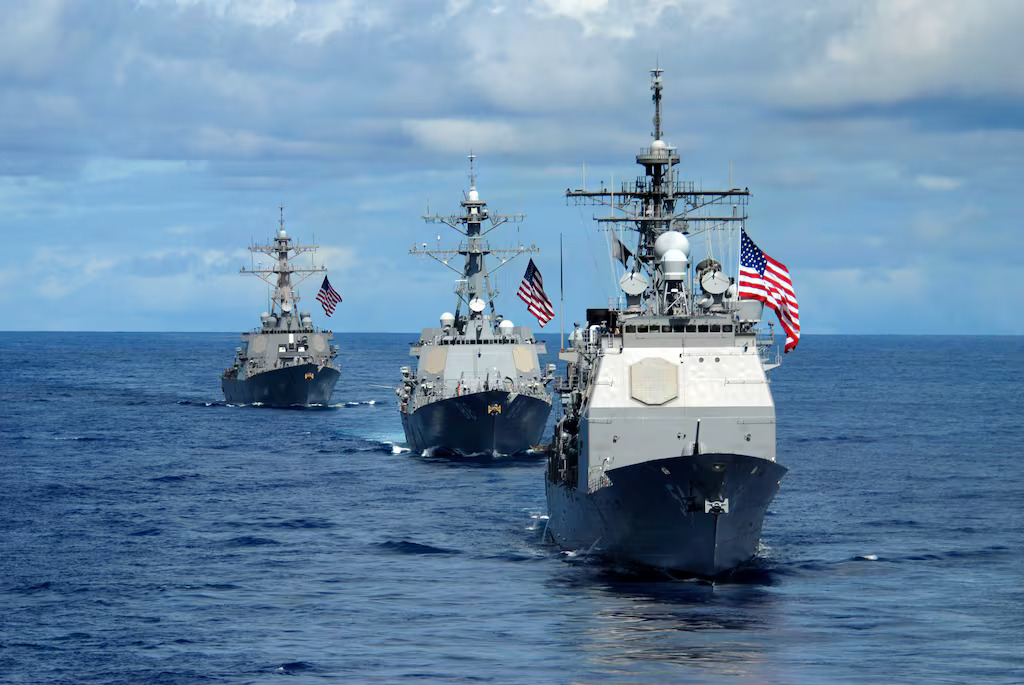
For the first time in over a decade, U.S. naval and expeditionary forces are operating in concentrated formations near Venezuela. Open-source tracking confirms a major build-up in the southern Caribbean, including the USS Gerald R. Ford (CVN‑78) carrier strike group, elements of the USS Iwo Jima (LHD‑7) Amphibious Ready Group, Arleigh Burke-class destroyers, and maritime patrol aircraft based in Puerto Rico and the U.S. Virgin Islands.
Surveillance data indicates continuous maritime patrols by P-8A Poseidon aircraft and MQ-9 Reaper drones, likely supporting interdiction and intelligence, surveillance, and reconnaissance (ISR) tasks. U.S. sources suggest that embedded special operations units, including Marine Raiders and Navy SEALs, are positioned aboard amphibious platforms for potential direct-action missions against cartel leadership and infrastructure.
Venezuela, aligned with Iran and Russia under Nicolás Maduro, has reacted by mobilizing coastal artillery and activating its Integrated Aerospace Defense System. Open-source imagery shows Venezuelan Su-30MK2 fighter jets conducting coastal patrols and mock interception exercises in proximity to U.S. naval activity.
Operation Southern Spear blends modern naval power with a multi-domain approach. Manned and unmanned assets, amphibious platforms, and rapid-response capabilities reflect a shift in operational posture, while framing drug cartels as terrorist threats signals a willingness to use combat-level rules of engagement.
The campaign underscores broader strategic implications: regional allies, intelligence networks, and defense contractors providing ISR, littoral combat systems, and expeditionary support may all see expanded operational roles. Whether the mission remains counter-narcotics-focused or evolves into a multi-domain pressure campaign remains unclear, but U.S. forces have clearly positioned hard power at the center of hemispheric security.
