

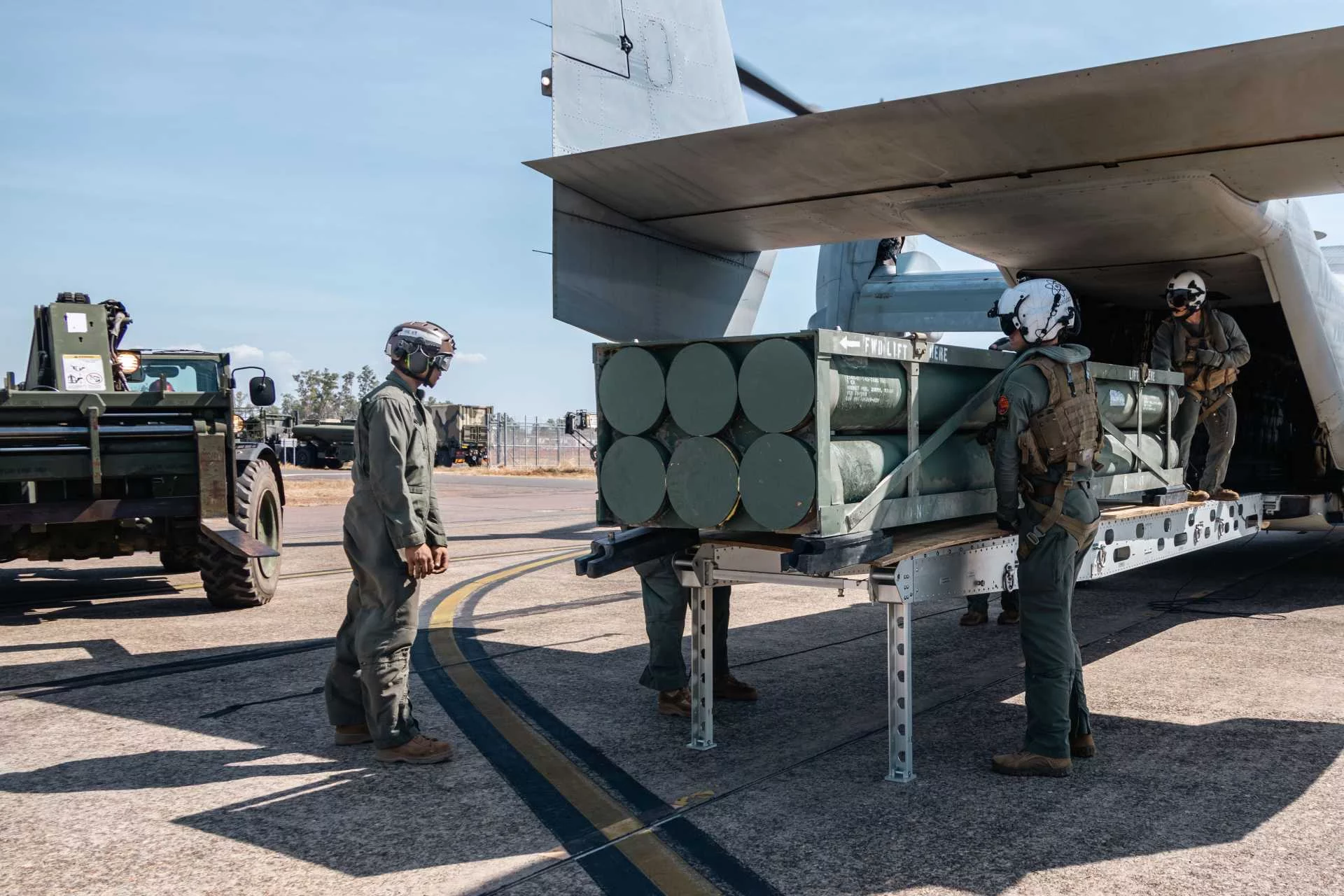
During the Talisman Sabre 2025 exercise in Australia’s Northern Territory, U.S. Marines from Marine Medium Tiltrotor Squadron 363 (VMM-363), part of Marine Rotational Force–Darwin 25.3, executed an aerial logistics operation using the MV-22B Osprey to deliver M142 HIMARS rocket pods. The mission marked a significant step in enhancing operational coordination between allied forces by demonstrating how aerial assets can provide rapid, flexible resupply to artillery units operating in remote or contested environments.
The MV-22B Osprey, developed by Bell Boeing, combines helicopter-like vertical lift with the speed and range of a fixed-wing aircraft. Capable of transporting up to 9,000 kg internally or 6,800 kg externally, the Osprey cruises at over 430 km/h and can access hard-to-reach zones, making it ideal for time-critical missions.
In this mission, the Osprey directly delivered rocket pods to forward positions, enabling ground-based HIMARS systems to maintain continuous firepower without relying on slower, ground-based resupply routes. This flexibility allows artillery units to remain agile, even in dynamic or isolated combat zones.
HIMARS plays a vital role on today’s battlefield with its long-range precision capabilities. Its combat effectiveness depends on a steady supply of munitions. Integrating MV-22B into its logistics chain ensures that resupply missions can be carried out swiftly and securely, even under threat or in areas lacking infrastructure.
This operation reflects a broader strategy by the U.S. Marine Corps to integrate aviation assets into ground support logistics. Talisman Sabre 2025 showcased how joint air-ground mobility can maintain the tempo of combat operations. The Osprey’s ability to bridge naval platforms with land-based artillery positions underscores a new level of maritime-to-land interoperability—an essential advantage in Indo-Pacific scenarios where vast distances and island terrain challenge traditional supply routes.
As the Marine Corps moves forward with Force Design 2030, such integrated logistics capabilities will be crucial to maintaining battlefield dominance in contested and high-threat environments.
