

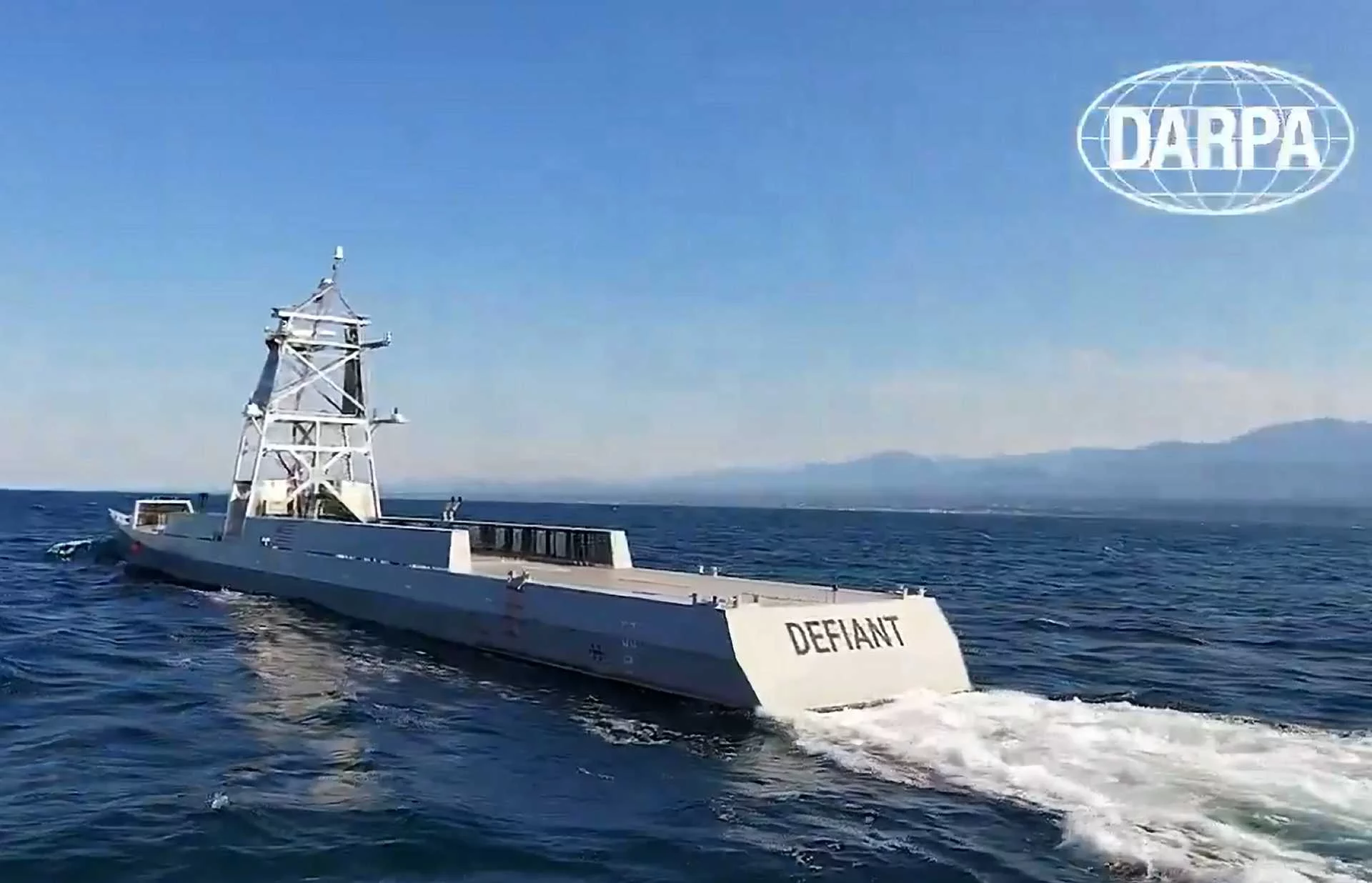
The U.S. Navy has launched the initial open-ocean trials of the USX‑1 Defiant, marking a milestone for DARPA’s No Manning Required Ship (NOMARS) initiative. On September 4, 2025, the vessel departed from Port Angeles, Washington, completing its final pre-trial systems checks before navigating the Strait of Juan de Fuca and entering the Pacific Ocean. This operation represents the first operational test of a warship engineered to function entirely without human presence.
A Revolutionary Design for Unmanned Operations
Unlike previous unmanned surface vessels (USVs), which are often adapted from manned designs, the USX‑1 Defiant was built from the keel up with zero requirement for crew facilities. The 55-meter (180-foot) ship, displacing 240 metric tons (265 US tons), eliminates traditional human-oriented features such as bridges, corridors, and life-support systems. Instead, it incorporates autonomous navigation, onboard diagnostics, machine-learning-based fault detection, and modular payload capabilities, all within a hull optimized for endurance, efficiency, and high-sea survivability.
Constructed at Everett Ship Repair in Washington and formally commissioned on August 11, 2025, Defiant embodies DARPA’s goal of challenging conventional naval architecture. According to program officials, the vessel can operate continuously in sea state 5 conditions without degradation and can autonomously resume missions after severe weather events. Its streamlined design also enables rapid construction and maintenance at civilian Tier III shipyards, bypassing the need for traditional naval dry docks.
Optimized for Mission, Not Crew
“Defiant proves that a ship can operate safely and effectively in open-ocean conditions without a crew onboard,” said Greg Avicola, DARPA’s NOMARS Program Manager, during the commissioning ceremony. “Every component is purpose-built for operational capability, not human accommodation. This allows a level of efficiency and modularity impossible in conventional warships.”
The ongoing sea trials aim to test endurance, mechanical reliability, mission flexibility, and autonomous decision-making under real-world maritime conditions. The outcomes will guide the Department of Defense’s plans for developing large-scale unmanned vessels capable of supporting manned fleets or executing independent operations in high-threat areas.
Advanced Capabilities and Future Potential
Defiant’s systems include long-range EO/IR sensors, encrypted satellite communications, and modular mission bays for rapid payload changes. While the demonstrator is unarmed, it is compatible with containerized payloads such as loitering munitions, vertical launch systems, electronic warfare suites, and UAV integration for reconnaissance or strike support. Its autonomy stack allows the vessel to self-diagnose faults, replan routes, and respond to emerging maritime threats without real-time human intervention.
The strategic advantage of vessels like Defiant lies in persistent naval presence, distributed surveillance, and attritable combat capability in areas where manned ships face operational, political, or cost limitations. Rising tensions in the Indo-Pacific, combined with China’s expanding naval and anti-access capabilities, have accelerated U.S. Navy investments in autonomous systems capable of penetrating contested zones independently.
The NOMARS program aligns with the Navy’s Distributed Maritime Operations doctrine and its broader Unmanned Campaign Framework, which envisions mixed fleets of manned and unmanned vessels operating collaboratively or independently. Success of the Defiant trials could pave the way for integration into Navy acquisition programs, with potential production scaled through commercial shipyards across the United States.
