

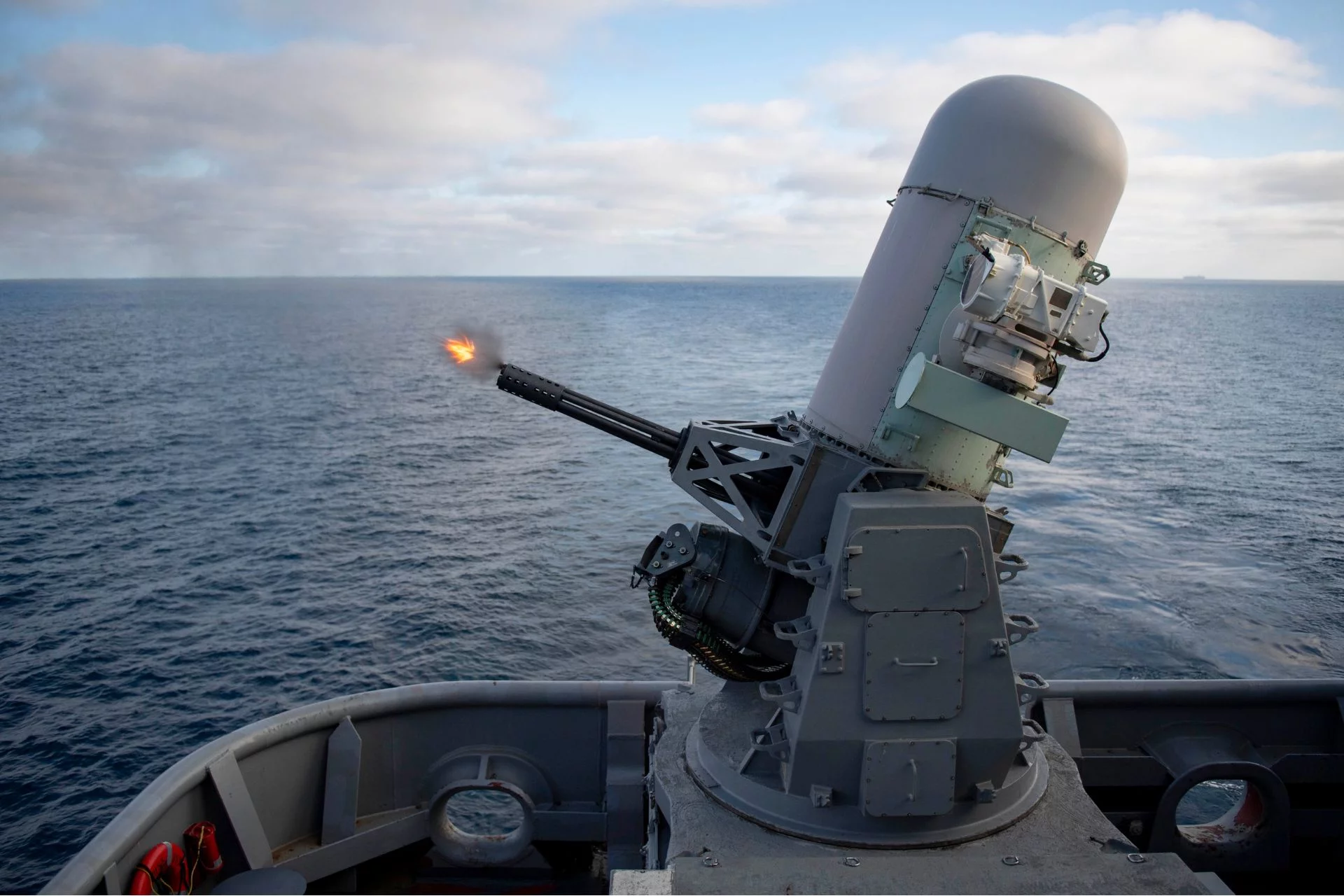
The U.S. Navy is moving ahead with a multi-year sustainment and modernization campaign for the MK-15 Phalanx Close-In Weapon System (CIWS) across its surface fleet. Announced in planning documents seen in early September 2025, the initiative aligns new production, conversions, overhauls and upgrade kits to preserve the service’s last-line ship-defense capability through the remainder of the decade.
Phalanx functions as the terminal layer of layered defense—activated when longer-range interceptors and countermeasures fail to stop an incoming threat. The compact mount combines a 20 mm Gatling cannon capable of roughly 4,500 rounds per minute, a Ku-band search/track radar and a stabilized electro-optical channel for target identification and fire-support. The current baseline, Block 1B Baseline 2, added an effective surface engagement mode and stabilized IR imaging to cope with cluttered littoral environments, low-slow UAS, and small boat threats.
The multi-year approach is designed to deliver permanence and predictability: balancing fresh production with recapitalization work, scheduling sensor and firmware upgrades, and synchronizing ammunition and spares pipelines with shipyard availabilities. In practice that means synchronized work packages timed to maintenance avail windows, multi-year visibility for industry, and kit compatibility across different platform integrations—from Arleigh Burke destroyers to carrier and amphibious decks.
Operational effectiveness rests on a low-latency sensor-to-firing loop. Ku-band radar searches and locks, electro-optics confirm targets amid sea clutter, and the control loop computes engagements measured in seconds. Recent operating tempos—high alerts, combined drone and cruise-missile threats, and frequent short-fuse engagements—increase the demand for mounts that return to ready status quickly and are maintainable without sidelining the ship.
Phalanx remains widely fielded across the fleet—even as some newer vessels opt for missile-based solutions like SeaRAM—so sustainment must accommodate diverse interfaces and retrofit needs. The multi-year plan therefore aims not just to maintain quantities but to ensure mounts are installed, upgraded, and mission-ready when ships cycle through depot periods or prepare for deployment.
Allied navies face similar pressure on their close-in defenses, and the Navy’s new sequence seeks to keep the final safety net reliable when decoys and long-range missiles are degraded or bypassed. The practical objective is clear: when a sea-skimming threat emerges at very close range, the CIWS must be loaded, the sensor-computer loop responsive, and crews trained to use it. The planned multi-year program is intended to deliver that assurance through at least 2029.
