

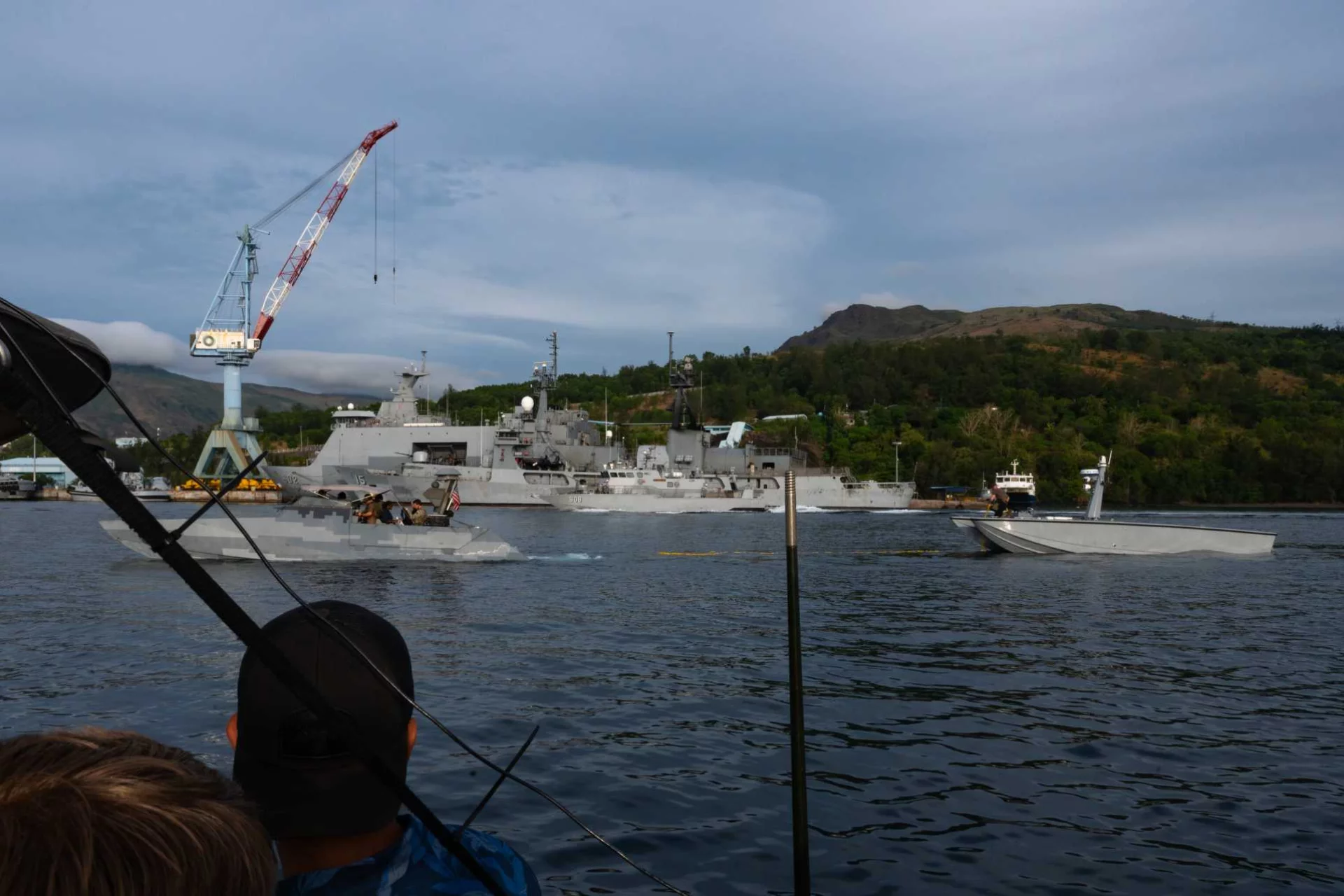
During the Balikatan 2025 exercise held in Subic Bay, Philippines, U.S. Navy Special Operations demonstrated a cutting-edge collaboration between manned and unmanned maritime systems. In a live operation, Naval Special Warfare Command deployed the high-speed Combatant Craft Assault (CCA) alongside the MARTAC T-38 Devil Ray unmanned surface vessel (USV), emphasizing the Navy’s increasing reliance on autonomous technology in complex mission environments.
As the maritime arm of U.S. Special Operations Command, the Naval Special Warfare Command (NSWC) specializes in executing high-risk missions across coastal and littoral zones. Composed of Navy SEALs, Special Warfare Combatant-Craft Crewmen (SWCC), and elite support units, the command focuses on missions requiring rapid mobility, precision, and stealth—particularly in politically sensitive or denied areas.
The CCA, a stealth-oriented, agile vessel, played a pivotal role in the demonstration. Designed for fast insertion and extraction of SEAL teams, it features low radar signature, shallow draft capability, and modular systems for flexible mission configurations—ideal for special reconnaissance and direct action in coastal environments.
Accompanying it was the T-38 Devil Ray, an unmanned craft developed by Maritime Tactical Systems Inc., engineered for both autonomy and endurance. With speeds exceeding 80 km/h and the ability to navigate high sea states, this USV supports ISR missions, electronic warfare, and tactical logistics. Operable autonomously or remotely, the T-38 expands situational awareness while minimizing risk to human operators.
The integration of the T-38 ahead of the CCA enables early threat detection and environmental assessment, significantly enhancing mission safety. Unmanned systems also act as communications relays, decoy platforms, and logistical couriers in scenarios requiring minimal human exposure. In real-world operations, they can conduct beach reconnaissance, simulate vessel movements, and support covert operations through distraction and deception tactics.
This demonstration reflected the U.S. Navy’s commitment to next-generation special warfare. The manned-unmanned pairing increases operational reach, survivability, and precision—critical for missions in contested maritime zones like the Indo-Pacific.
By integrating advanced USVs into exercises like Balikatan 2025, the U.S. Navy signals a clear intent: to lead in unmanned maritime innovation and ensure mission superiority. As regional competition escalates, such capabilities will prove decisive in maintaining maritime security, deterring aggression, and enabling highly responsive special operations across the world’s most strategically significant waters.
