

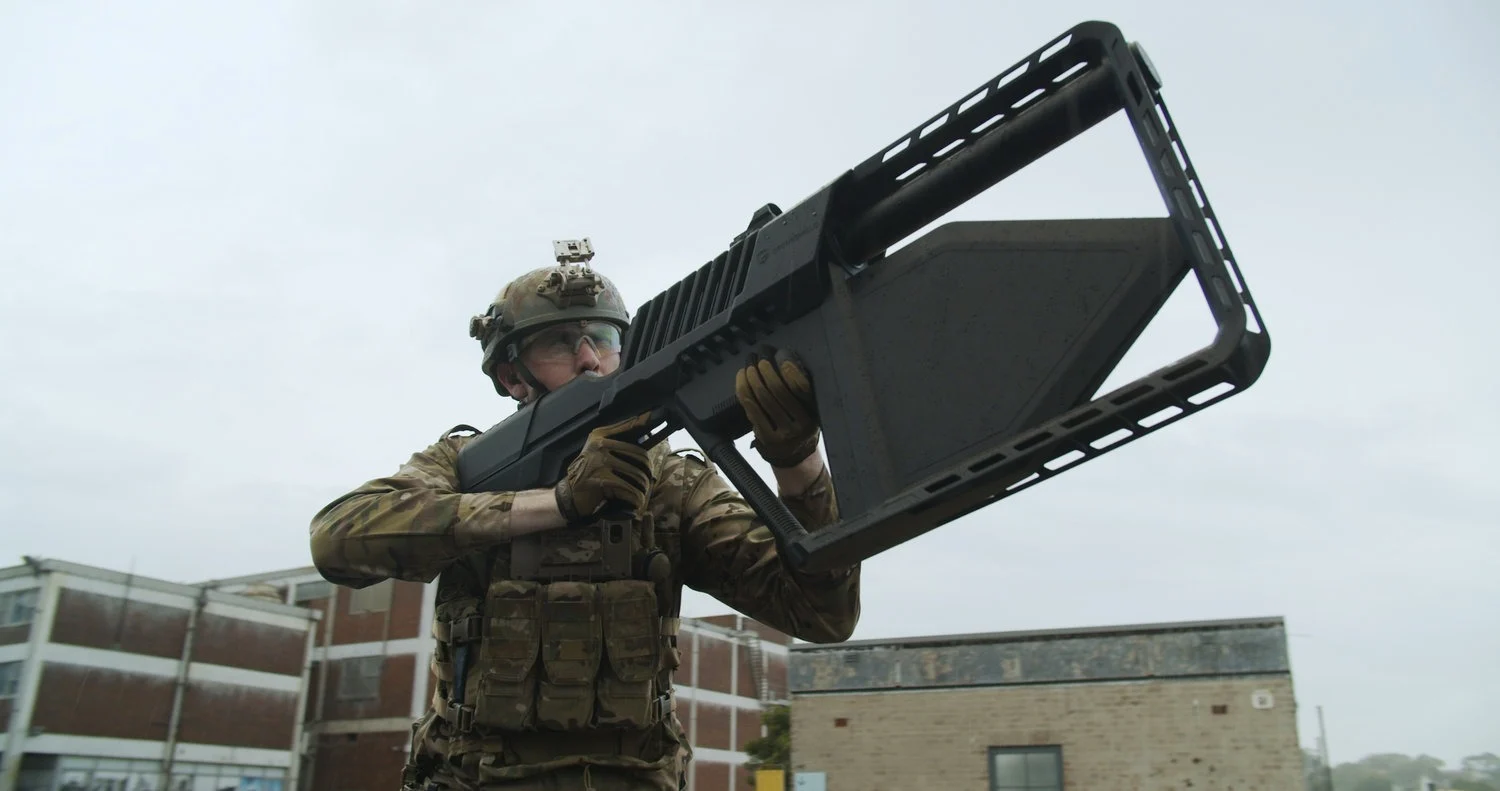
U.S. soldiers stationed at Reedo Barracks in southern Estonia disabled an unidentified drone using a handheld anti-drone rifle, after two UAVs were detected near the base earlier this month. The incident highlights NATO’s growing focus on counter-UAS defense along the alliance’s eastern flank.
According to Estonia’s public broadcaster ERR, the event occurred on October 17 at around 4:30 p.m. near Reedo Barracks — a site hosting U.S. and Estonian troops. The Estonian Defense Forces (EDF), supported by the Police and Border Guard Board, conducted a search for the wreckage but found none. EDF spokesperson Liis Vaksmann declined to share additional operational details, citing security reasons.
Reedo Barracks houses the U.S. Army’s 5th Squadron, 7th Cavalry Regiment, a reconnaissance unit whose advanced sensors make the site strategically sensitive. Located roughly 30 kilometers from the Russian border, the base’s proximity explains why even small drones trigger immediate defensive actions.
No information has been released about the type or origin of the UAVs. However, the weapon described — a handheld jamming device — matches capabilities of systems like the Dronebuster or EDM4S, which disrupt radio control and satellite navigation links on 2.4 GHz, 5.8 GHz, and GNSS bands. Such jamming causes drones to descend, hover, or return to preset home points, making debris recovery in wooded areas unlikely.
Experts note that the absence of wreckage is consistent with the effects of non-kinetic jamming, not evidence of concealment.
The incident is significant for several broader reasons:
- Reedo Barracks serves as a key forward position for U.S. forces near Russia, making it a natural focus for surveillance or probing attempts.
- The routine use of anti-drone rifles reflects how counter-UAS measures have now reached the squad level within NATO bases.
- It fits a pattern of hybrid activity in the Baltic region, where gray-zone provocations have become increasingly frequent.
Estonia is reinforcing its defenses with a €20 million “drone wall” project to secure its eastern border by 2027, integrating sensors and electronic countermeasures.
Ultimately, the Reedo incident illustrates the new normal of constant low-level aerial probing along NATO’s frontier — and the readiness of allied troops to respond swiftly and proportionally whenever an unidentified drone crosses into their airspace.
