

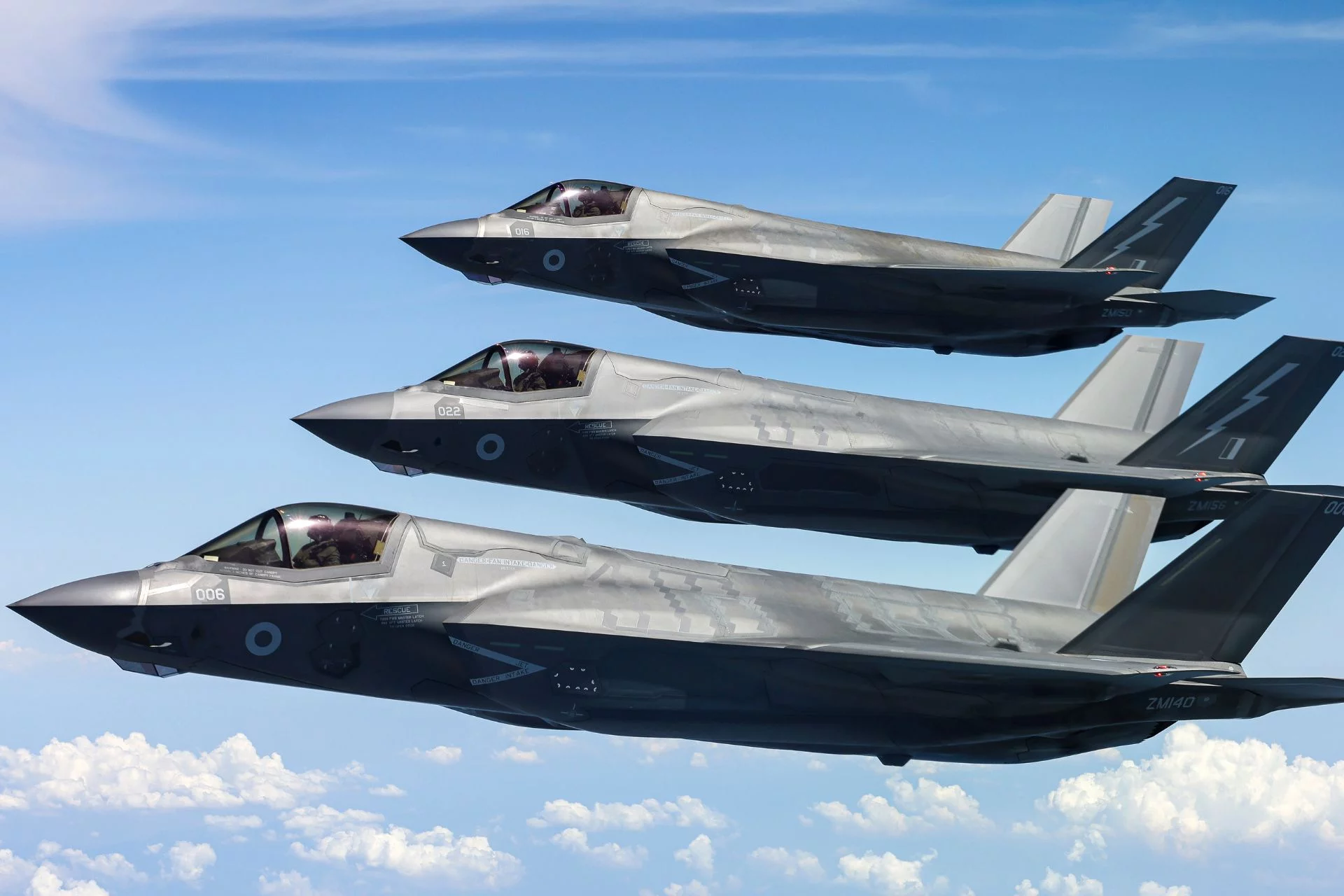
Japan is taking a significant step in its defense capabilities with the initial operational deployment of its F-35B Lightning II stealth fighters. According to USNI News on August 4, 2025, this deployment coincides with a joint exercise alongside the British Carrier Strike Group (CSG) in the Philippine Sea near Japan’s coastline. The primary objective of the exercise is to enhance interoperability among Japanese, British, and U.S. forces, all operating this advanced fifth-generation STOVL (Short Takeoff and Vertical Landing) aircraft.
The F-35B, developed by Lockheed Martin for the U.S. Marine Corps, is currently the only stealth fighter capable of short takeoffs and vertical landings. It combines radar evasion, supersonic speeds, advanced electronic warfare, sensor fusion, and seamless network integration with allied units. Its unique STOVL capability stems from the patented Shaft-Driven LiftFan engine, allowing operation from short runways, highways, or smaller ships, including modified helicopter carriers.
Japan has ordered 42 F-35Bs as part of its 2018 defense modernization plan. By 2024, 18 are operational, intended for deployment both from land bases and the Izumo-class helicopter destroyers, which have been retrofitted for STOVL jets. The first four aircraft were recently stationed at Nyutabaru Air Base in southern Japan’s Miyazaki Prefecture. Their deployment starting August 7, 2025, aims to bolster defenses around the strategically critical Nansei Islands near Taiwan, a frequent hotspot for Chinese military flights.
The UK currently operates 18 F-35Bs aboard HMS Prince of Wales, flagship of Carrier Strike Group 25. Since April, this group, led by Commodore James Blackmore, has been on Operation Highmast, an eight-month deployment involving over 2,500 personnel from the UK, Norway, Canada, and Spain. The task force has been conducting joint missions across the Mediterranean, Middle East, Southeast Asia, Japan, and Australia alongside NATO and Indo-Pacific partners. Recently, the group participated in Australia’s Talisman Sabre exercise before moving to Japan for further drills.
Joint operations in the Philippine Sea include cross-deck takeoffs and landings of F-35Bs, integrated flight training, and the possibility for Japanese observers to embark on the British carrier. Meanwhile, three UK F-35Bs are detached in South Korea as part of a related Operation Hightower mission. U.S. Marine Corps F-35Bs from VMFA-242 have also flown from HMS Prince of Wales, highlighting trilateral cooperation.
This exercise allows Japan to assess its ability to operate the F-35B from naval platforms, leveraging British and American operational experience. Japanese pilots, currently training with U.S. Marines, will closely observe launch, recovery, and maintenance activities. This builds on prior steps such as Japanese observers aboard HMS Prince of Wales in 2023 and engagements with Italy’s carrier Cavour.
Strategically, integrating the F-35B prepares Japan for a full-fledged sea-based air capability by 2028, when Izumo-class ships complete conversion. This reintroduces fixed-wing naval aviation to Japan for the first time since World War II, enhancing operational flexibility amid escalating regional threats from China, particularly in the Taiwan Strait and around the Senkaku Islands.
With a combat radius of 1,667 km, a top speed of 1,600 km/h, and a payload over 6,800 kg, the F-35B is engineered for complex, contested operations. It features the AN/APG-81 AESA radar, AN/ASQ-239 electronic warfare suite, and networked sensors that provide shared situational awareness and coordinated targeting.
This inaugural joint deployment of F-35Bs by Japan, the UK, and the U.S. represents more than a technical exercise; it signals a deliberate effort to deepen trilateral military cooperation and collective security in the Indo-Pacific. For Japan, it marks a transition toward an expeditionary air and naval force capable of operating in challenging maritime security environments.
