

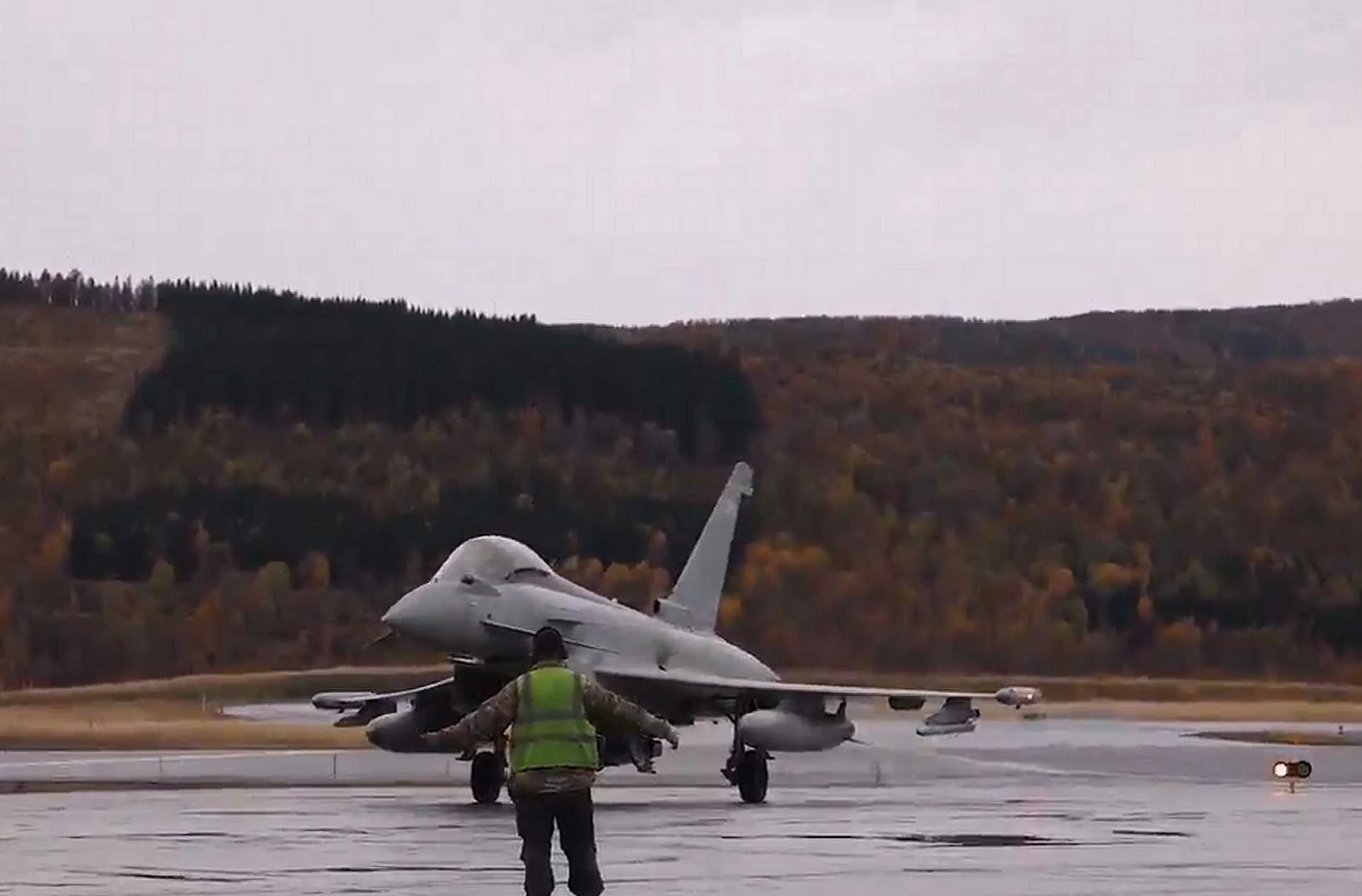
Between October 7 and 9, 2025, the United Kingdom’s Royal Air Force (RAF) deployed its Typhoon fighter jets to Evenes Air Base within Norway’s Arctic Circle as part of Exercise HILLSTREAM. Conducted under the UK-led Joint Expeditionary Force (JEF) framework, the operation demonstrated Britain’s defense capabilities and regional deterrence posture across Europe’s northern flank.
Typhoons from IX(B) Squadron provided close air support to the 3rd Commando Brigade Royal Marines during an amphibious landing exercise. The deployment strengthened the UK’s military presence in the Arctic and showcased its ability to project precision airpower under extreme environmental conditions.
The exercise tested JEF’s capacity to conduct multi-domain operations simultaneously across the Arctic, North Atlantic, and Baltic regions. Despite challenges such as freezing weather, limited infrastructure, and reduced visibility, RAF personnel excelled in weapons loading, maintenance, and joint operations with Norwegian air defense systems.
Operating from RAF Lossiemouth in Scotland, IX(B) Squadron is a front-line Typhoon unit specializing in both air-to-air and precision air-to-ground missions. With a history dating back to World War I, the squadron was reformed in 2019 after transitioning from the Tornado GR4 to the Typhoon. Exercise HILLSTREAM marked a milestone in operational maturity and joint mission integration for the unit.
During the exercise, 3 and 40 Commando Royal Marines conducted amphibious assault drills along Norway’s rugged coastline. Typhoon jets provided real-time close air support and tactical overwatch, coordinating with land and maritime elements to form a cohesive, multi-domain force package.
HILLSTREAM was conducted under the JEF doctrine, involving ten non-NATO partner nations — including Norway, Sweden, Finland, Denmark, and the Baltic States. The framework enables rapid and flexible responses to hybrid and gray-zone threats across Northern Europe.
Although the exercise did not name any specific adversary, its strategic message was clear: the UK and its partners possess the capability to deliver a fast, integrated, and multinational response to any attempt to destabilize the Arctic or Baltic regions.
The strategic importance of the Arctic—particularly the Greenland-Iceland-UK (GIUK) gap—continues to grow amid melting ice, expanding maritime routes, and increasing competition for seabed resources. RAF operations in the region aim to strengthen NATO’s readiness against emerging anti-access/area denial (A2/AD) systems, maritime strike assets, and long-range precision threats.
Exercise HILLSTREAM demonstrated that the UK is not only ready but capable of sustaining combat operations in one of the world’s harshest environments. Equipped with advanced sensors, Litening III targeting pods, and precision-guided munitions, the Typhoon once again proved itself as a central pillar of Britain’s northern deterrence posture.
The most critical takeaway from HILLSTREAM was that key future-war capabilities — agile basing, distributed operations, joint fires coordination, and rapid force generation — are no longer theoretical concepts but operational realities, now executable and effective in the field.
