

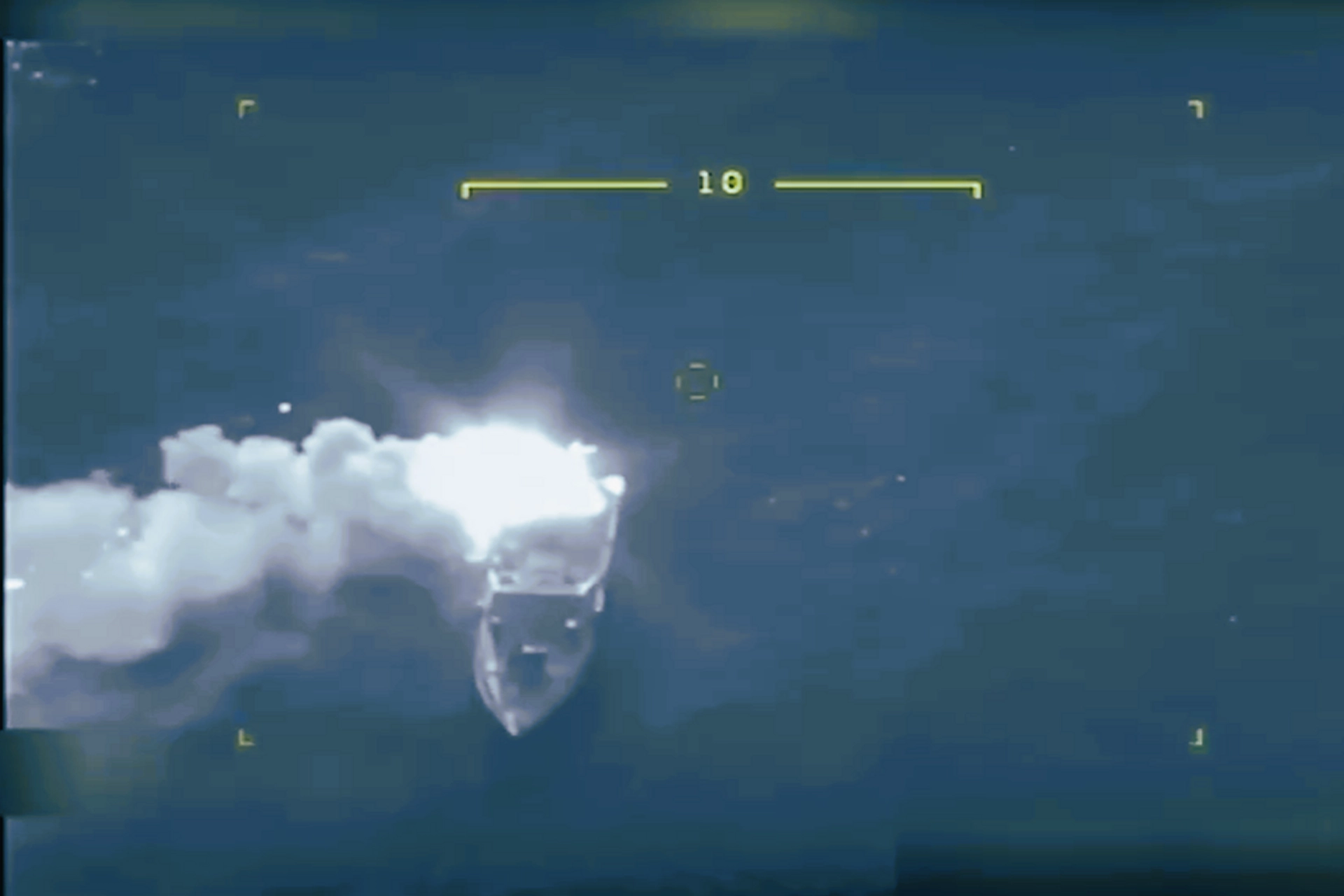
Turkey-made Baykar TB2 unmanned combat aerial vehicle (UCAV) enabled the Ukrainian Navy to destroy a moving Russian landing craft in the Kherson region using a precision-guided MAM-L munition. This operation, shared by Ukrainian Naval Forces Commander Vice Admiral Oleksii Neizhpapa, revealed that Bayraktar TB2 drones, which had appeared inactive for months, have been redeployed. The successful strike once again highlights the strategic importance of low-cost, high-impact unmanned systems on today’s battlefield. The footage and details were released by Ukraine’s Naval Forces.
The Bayraktar TB2 is a medium-altitude, long-endurance UAV developed by the private Turkish defense company Baykar. Designed for surveillance and strike missions, the TB2 features a fully autonomous flight control system, EO/IR cameras, and real-time data transmission. It can carry up to 4 precision-guided munitions such as the MAM-L developed by Roketsan. Powered by a 100 hp Rotax 912 engine, it has an operational range exceeding 150 km and a flight endurance of over 24 hours. This balance of endurance, accuracy, and affordability has made the TB2 a popular and effective unmanned aerial system worldwide.
Developed in the early 2010s, the TB2 entered service with the Turkish Armed Forces in 2014. Its combat debut in Syria and Libya demonstrated effectiveness against armored vehicles and air defense systems. Ukraine began receiving TB2s in 2019, and during the early months of Russia’s 2022 invasion, the drones gained symbolic and operational prominence. As Russian electronic warfare tactics advanced, TB2 operations became less visible; however, footage from June 2025 confirms their continued importance under naval command, likely with updated tactics. Baykar’s partnership with Ukraine also includes local production plans and next-generation UAV developments like the TB3 and Kızılelma.
The TB2’s main advantage lies in cost-effectiveness and modular strike capability. Compared to larger platforms like the US MQ-9 Reaper, the TB2 costs under $5 million per unit while delivering precise, high-impact strikes. Its MAM-L payload is optimized for UAV use, allowing low-collateral damage attacks on small naval or ground targets. Destroying a moving Russian landing craft, possibly part of the Black Sea Fleet’s amphibious assets, illustrates a capability unmatched by many tactical drones. Unlike loitering munitions or expendable drones, the TB2 offers persistent intelligence, surveillance, reconnaissance (ISR), and flexible strike options, increasing its value in joint operations.
Beyond the battlefield, the strike has geopolitical implications. Ukraine’s use of a Turkish-made system against Russian naval assets strengthens the alignment of Ukrainian and NATO defense procurement strategies. Turkey, while managing complex relations with both Kyiv and Moscow, has emerged as a key drone exporter shaping regional power balances. Militarily, the successful destruction of a moving target near Kherson demonstrates the vulnerability of Russian maritime logistics and the evolution of Ukrainian naval strike doctrine. This attack could deter further Russian amphibious operations along contested river and coastal zones.
The June 2025 strike using the Baykar TB2 armed with MAM-L serves as a clear example of how mid-tier UAVs continue to transform modern warfare. Demonstrating the ability to detect, track, and destroy maneuvering naval targets, the TB2 confirms Ukraine’s strategic choice to incorporate affordable yet effective unmanned platforms into its joint strike capabilities. The reappearance of TB2s in Ukrainian operations signals not only tactical persistence but also the increasing interdependence between defense innovation and shifting regional power dynamics.
