

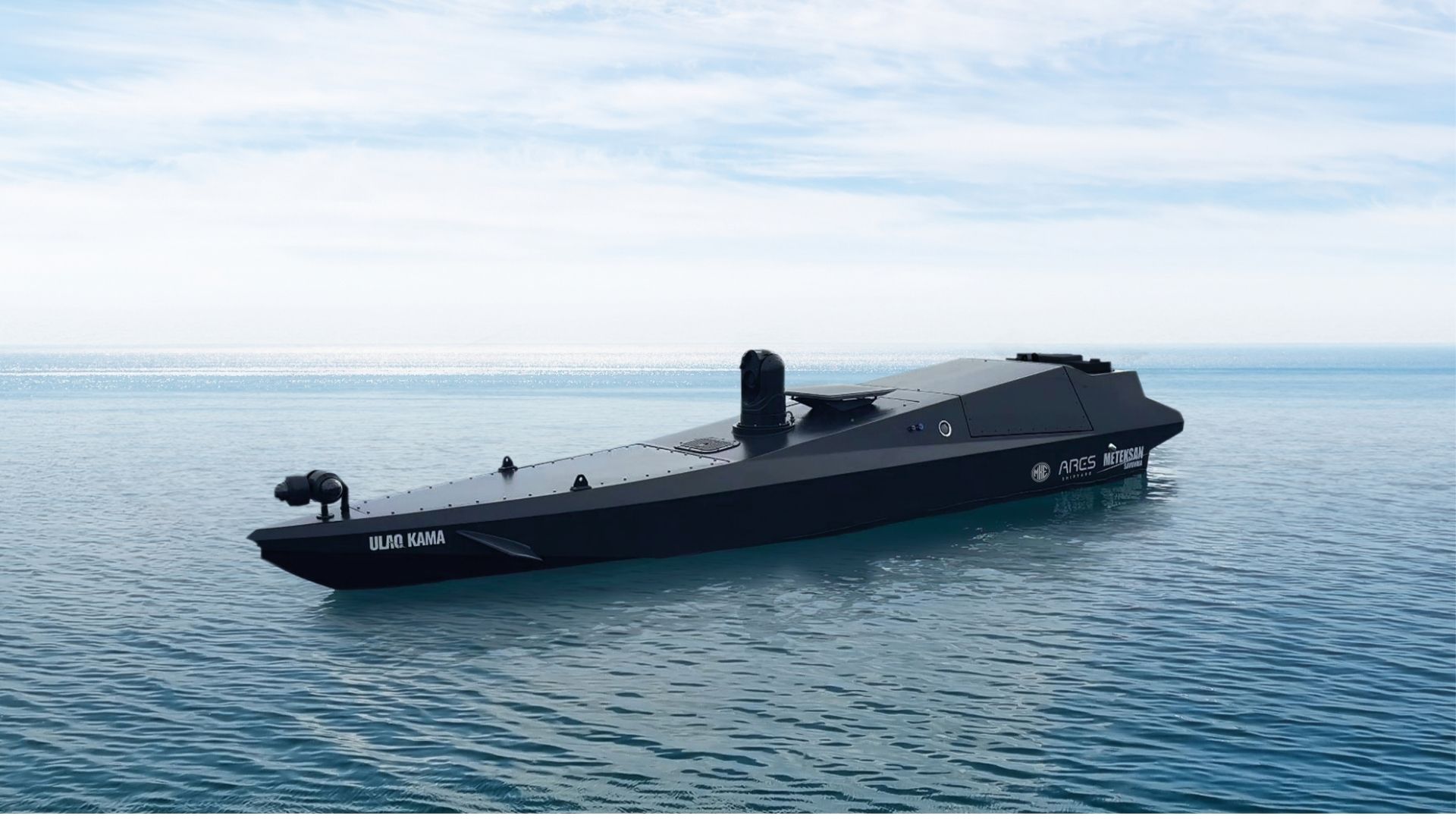
At IDEF 2025 in Istanbul, Türkiye introduced its latest unmanned surface vessel (USV), the ULAQ KAMA, marking a critical milestone in its autonomous naval systems development. Produced jointly by ARES Shipyard and Meteksan Defence, the KAMA is designed as an expendable, high-speed strike drone optimized for saturated maritime attacks and ISR operations in GPS-denied, high-threat environments.
With a length of 6.37 meters, a draft of just 0.30 meters, and a top speed exceeding 50 knots, ULAQ KAMA is engineered for stealth, agility, and resilience. Its composite construction allows reduced radar cross-section and high survivability, while its 200+ nautical mile range and 200 kg payload enable both kinetic and reconnaissance missions. The platform carries advanced electronics including AI-assisted navigation, GNSS/DGNSS receivers, satcom, stabilized EO cameras, and optional thermal sensors, providing robust multi-mode autonomy. It is capable of functioning in sea state 4, enhancing its operability in contested littorals.
KAMA is the latest evolution in Türkiye’s ULAQ USV family, originally launched in 2021. Drawing from real-world lessons—particularly from the Russo-Ukrainian conflict and Houthi drone boat attacks—the KAMA is tailored for cost-efficient, rapid-response, high-risk naval engagements. Unlike traditional naval assets, KAMA leverages visual target matching, autonomous detonation protocols, and remote override, allowing lethal effects without risking human operators.
In comparative terms, KAMA occupies a unique niche. Unlike Ukraine’s MAGURA V5, which prioritizes kamikaze-style kinetic attacks, KAMA incorporates an integrated ISR-strike package with greater navigational autonomy. Similarly, the U.S. Navy’s MUSV prioritizes persistence over disposability, lacking the saturation strike utility that KAMA delivers. Türkiye’s solution thus represents a new class of attritable, ISR-enabled strike drones designed to overwhelm defenses, disrupt maritime logistics, and exploit the vulnerabilities of legacy naval doctrine.
Strategically, ULAQ KAMA underscores Türkiye’s ambition to reshape maritime deterrence through distributed lethality. Its swarm-friendly design, modularity, and autonomous control architecture allow for deployment in dense A2/AD environments, including chokepoints like the Aegean, Eastern Mediterranean, and Bosporus. For NATO, this introduces a potent and scalable asymmetric tool that complements conventional maritime assets, enhancing gray zone deterrence and multi-domain operations.
From a procurement standpoint, ARES and Meteksan claim the capacity to produce over 100 units per year, making KAMA both scalable and budget-friendly. While no procurement contracts have been officially announced at IDEF 2025, its production-readiness, modular architecture, and multi-role capability position it as a viable candidate for export to regional allies and partners.
Ultimately, ULAQ KAMA signals Türkiye’s rise as a front-runner in naval autonomy and drone warfare innovation. In an era defined by asymmetric threats and rapid tactical evolution, the ability to deploy smart, expendable, and mission-flexible systems at scale is becoming indispensable. KAMA meets this moment—quietly, quickly, and with lethal precision.
